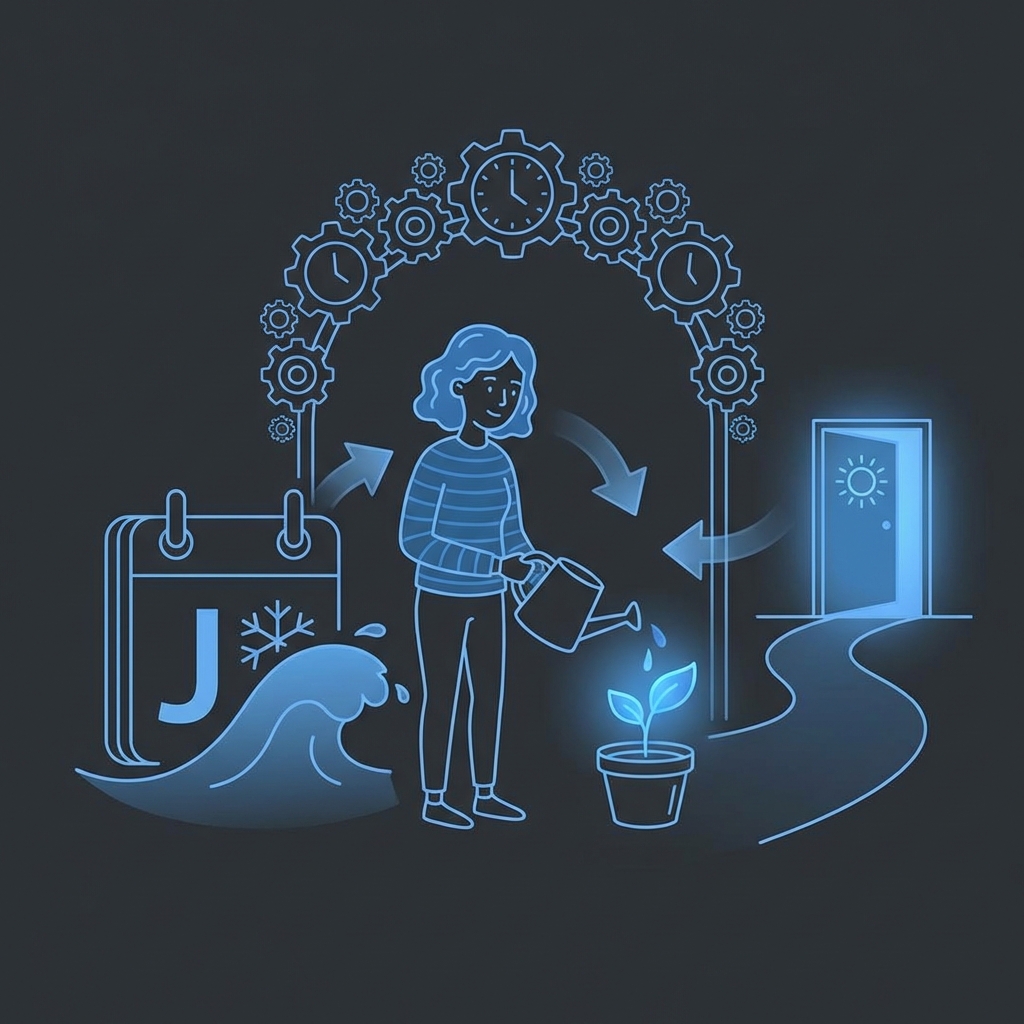
January arrives with the weight of a thousand promises we’re supposed to make to ourselves. New year, new you. Fresh start. Clean slate. The cultural machinery of transformation cranks into gear, flooding us with messages about discipline, goals, and becoming someone better than who we were last month.
But what if January’s real gift isn’t the pressure to transform, but the permission to finally put something down?
Most of us enter the new year already carrying too much. The mental load from December doesn’t magically disappear on January 1st. The kids still need lunches packed. The bills still need paying. The project deadlines still loom. Yet somehow we’re supposed to layer ambitious resolutions on top of an already overflowing plate.
The proof isn’t in what you picked up this January—it’s in what you finally set down.
There’s a different way to approach this month, one that starts with relief instead of demands. Instead of asking “What should I add to become better?” we can ask “What can I remove to breathe easier?”
The Backfire Effect of January Pressure
Traditional January thinking operates from a deficit model: you’re not enough, so you must do more to become enough. Exercise more, organize more, optimize more, hustle more. This approach treats your current life as fundamentally broken, requiring wholesale renovation.
But here’s what actually happens when we pile new expectations onto an already strained system: we create more failure points, not fewer. Every new habit is another thing to remember, track, and feel guilty about when it inevitably slips. The person who’s already mentally exhausted from managing everyone else’s schedules now has to remember to go to the gym at 6 AM and meal prep on Sundays.
The cruel irony is that transformation-first thinking often prevents the very changes it promises. When you’re operating at capacity, adding more creates fragility, not strength. It’s like trying to renovate a house while the foundation is cracking—the cosmetic improvements won’t hold.
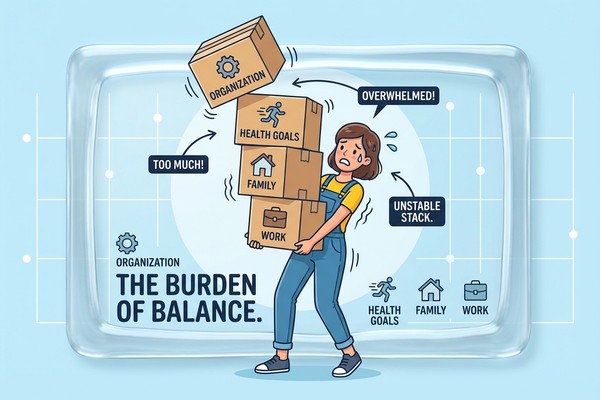
Relief-first thinking flips this script. Instead of asking what you should become, it asks what’s currently taking up the most space in your head. Instead of optimization, it offers subtraction. Instead of willpower, it provides structural change.
When you remove a genuine burden—not just a surface-level inconvenience, but something that creates recurring mental friction—you don’t just free up time. You free up cognitive capacity. You create space for presence, for spontaneity, for the kind of natural growth that doesn’t require a vision board.
Finding Your Biggest Recurring Burden
Not all burdens are created equal. Some irritations are fleeting; others are like background music you can’t turn off, playing constantly in the back of your mind. The key is identifying which burden creates the most ongoing mental drag.
The biggest recurring burdens usually share certain characteristics: they require frequent decision-making, they involve coordinating with other people, they have unclear or shifting deadlines, and they feel like they’re never truly “done.” Think meal planning, managing family schedules, staying on top of home maintenance, or juggling client communications.
Here’s a simple way to identify your primary burden: notice what you think about during transition moments. When you’re walking from one room to another, waiting for your coffee to brew, or lying in bed before sleep—what automatically pops into your mental queue? That persistent background hum is usually pointing toward your biggest load.
The burden might not be the thing that takes the most time. It might be something that only takes ten minutes but requires you to remember it, coordinate it, and worry about it multiple times throughout the week. Mental load isn’t measured in hours—it’s measured in the number of times something pulls your attention away from where you actually want it to be.
The One-Week Experiment
Once you’ve identified your biggest recurring burden, the next step isn’t to optimize it—it’s to experiment with removing it entirely, even temporarily. This isn’t about finding a better way to manage the burden; it’s about discovering what your life feels like without it.
Choose one week in January for this experiment. Pick something concrete and bounded. If meal planning is your burden, order prepared meals for the week. If managing your family’s schedule is the drain, hand that responsibility to your partner or use a service. If staying on top of household tasks is the mental load, hire help for that week or let some things go undone.
Relief isn’t about perfection—it’s about interruption.
The goal isn’t to find a permanent solution during this week (though you might). The goal is to experience what it feels like when that particular mental load isn’t yours to carry. Pay attention to what happens in the space that opens up. Notice how your attention moves when it’s not being constantly pulled toward that familiar worry.
Some people discover they have energy for things they’d forgotten they enjoyed. Others find they’re more present with their kids or partners. Many are surprised by how much mental chatter quiets down when just one major burden is lifted.
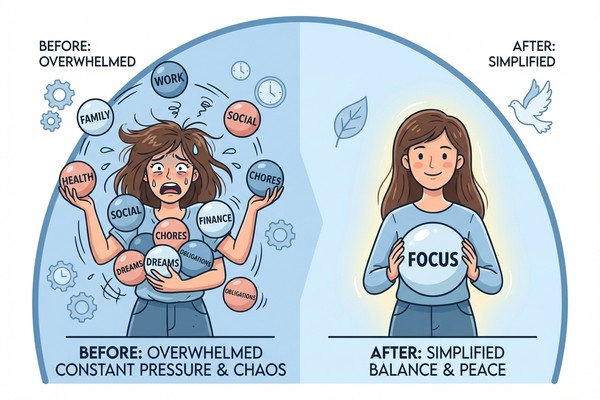
This isn’t about proving you can live without responsibilities forever. It’s about proving to yourself that relief is possible, that the feeling of being overwhelmed isn’t a permanent state of being, and that small structural changes can create disproportionate emotional shifts.
What Would Make February Feel Easier?
As your one-week experiment progresses, start asking yourself a different kind of planning question: “What would make February feel easier than January?”
This question sidesteps the typical goal-setting framework entirely. Instead of focusing on what you want to achieve, it focuses on what you want to feel. Instead of adding complexity, it seeks simplicity. Instead of demanding transformation, it designs for sustainability.
The answers might surprise you. Maybe February would feel easier if you stopped trying to cook elaborate dinners every night. Maybe it would feel easier if you set boundaries around work emails after 6 PM. Maybe it would feel easier if you hired someone to clean your house twice a month, or if you finally automated that one recurring task you keep meaning to set up.
The beauty of this approach is that it naturally leads toward changes that stick. When you design for relief rather than achievement, you’re working with your actual life instead of against it. You’re not trying to become a different person; you’re trying to become a less burdened version of yourself.
When Presence Returns
Something interesting happens when mental load decreases: presence returns almost automatically. You don’t have to practice mindfulness or meditation (though you can). You don’t have to set intentions or repeat affirmations. When your cognitive resources aren’t constantly allocated to tracking, remembering, and worrying, they become available for experiencing.
Parents notice they’re actually listening when their kids tell stories instead of mentally running through tomorrow’s to-do list. Partners find themselves having real conversations instead of logistical check-ins. Creative ideas start surfacing during mundane moments because there’s finally space for them.
This isn’t about achieving some zen state of perfect calm. It’s about the natural result of not being cognitively overloaded. When you’re not using all your mental bandwidth to keep various balls in the air, you have bandwidth available for noticing what’s actually happening around you.
The goal isn’t to become someone new—it’s to become someone less burdened.
The relief-first approach recognizes that most of us don’t need more discipline or motivation. We need less to manage. We don’t need better systems for handling everything; we need fewer things that require handling in the first place.
Building on Relief
As January progresses and you experience what relief feels like, you might find yourself naturally gravitating toward other changes. But these changes will feel different from typical resolutions. Instead of being driven by should or guilt, they’ll be drawn by the space you’ve created.
Maybe you’ll find yourself wanting to take walks, not because you resolved to exercise more, but because you finally have mental space to notice you miss being outside. Maybe you’ll start cooking again, not because you’re trying to eat healthier, but because meal planning is no longer a source of stress.
This is how sustainable change actually works—not through force or willpower, but through creating conditions where better choices become easier and more natural. When you’re not spending all your energy managing burdens, you have energy available for the things that actually matter to you.
January doesn’t have to be about becoming someone else. It can be about becoming yourself, just with less to carry. The transformation happens not through addition, but through subtraction. Not through doing more, but through holding less.
The best part? February is waiting right around the corner, ready to feel easier than January ever did.
This article was created with collaboration between humans and AI—we hope you ❤️ it.