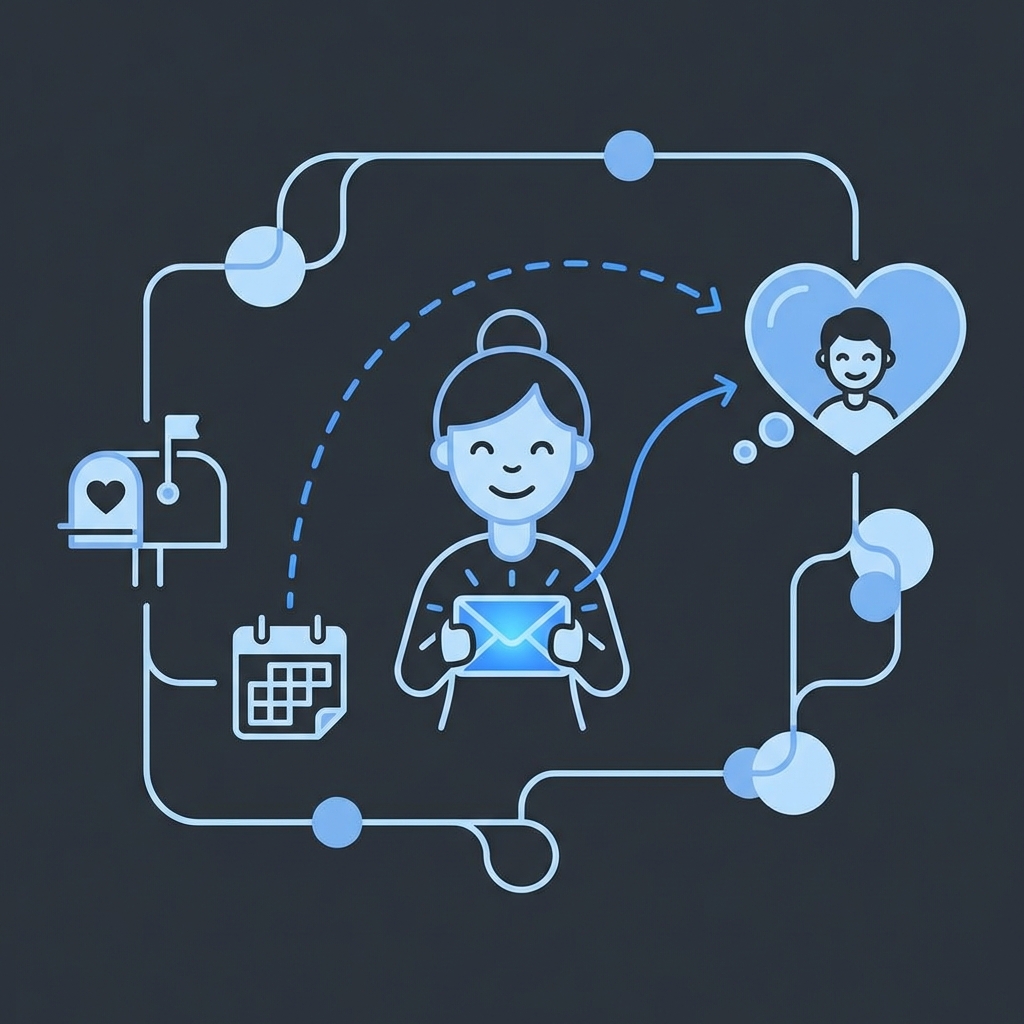
There’s this moment that happens every few months when you realize you’ve been leaving future-you holding the bag again. You know the feeling—it’s Sunday night, and you’re staring at a week that feels impossible before it even starts. The appointments you forgot to buffer. The decisions you put off that are now urgent. The mental notes that somehow never made it anywhere permanent.
We do this to ourselves constantly, don’t we? We act like future-us will somehow have more time, more energy, more clarity than we do right now. As if crossing into next week will magically transform us into someone who thrives on chaos and remembers everything perfectly.
But here’s what I’ve learned: every system you build, every small act of preparation, every moment you spend thinking ahead—it’s not about control. It’s about love.
The Inheritance Nobody Wants
Future-you keeps inheriting today’s overload because present-you is operating under a beautiful, terrible lie. The lie that you’ll figure it out later. That you’ll remember. That the thing that feels overwhelming today will somehow feel manageable tomorrow.
This inheritance isn’t just about forgotten tasks or missed deadlines. It’s about the emotional weight that compounds when nothing has a place, when every decision requires starting from scratch, when you’re constantly playing catch-up with your own life.
Think about the last time you opened your calendar and felt that familiar sinking feeling. Not because anything was particularly terrible, but because everything required so much mental energy to decode. Which meeting was the important one? What prep did you need to do? What was the context you were missing?
That’s the inheritance—not just the work itself, but the cognitive overhead of figuring out what the work even is.
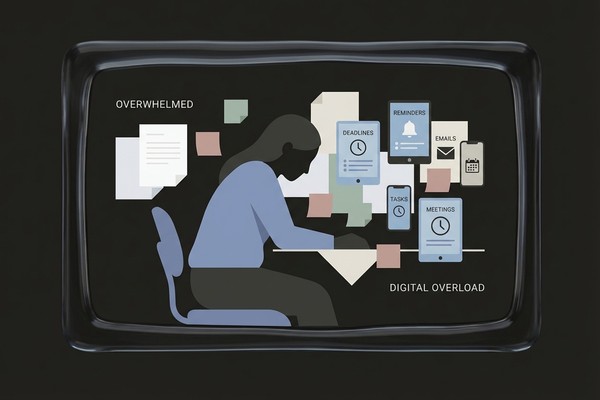
The cruelest part is how we judge ourselves for struggling with this load. We act like remembering everything and making perfect decisions under pressure is just basic adulting. We treat our own forgetfulness as a moral failing instead of recognizing it as the completely predictable result of asking one brain to hold too much.
Small Acts of Revolutionary Care
What if we stopped treating systems as productivity hacks and started seeing them as acts of care? Not the kind of care that optimizes and maximizes, but the kind that says “I see you struggling, and I want to make this easier.”
A buffer between meetings isn’t about efficiency—it’s about giving yourself permission to be human. To process one conversation before diving into the next. To grab water or take three deep breaths or just exist for a moment without performing.
A shared grocery list isn’t about household optimization—it’s about removing the invisible work of telepathically knowing what everyone needs and remembering it all while you’re standing in the cereal aisle trying to recall if you’re out of milk.
Default decisions aren’t about being rigid—they’re about preserving your decision-making energy for the choices that actually matter. When you decide that Tuesday is always the day you prep for the week, you’re not limiting future-you. You’re freeing them from having to figure out when to do it while everything else is on fire.
Systems aren’t about controlling the future. They’re about holding space for your humanity in it.
These small acts accumulate in ways that are hard to measure but impossible to miss once you experience them. It’s the difference between walking into your week feeling like you’re already behind and walking into it feeling like someone—past-you—actually had your back.
The Dignity of Being Supported
There’s something profoundly dignifying about opening your phone and finding that past-you left you exactly the information you need. The confirmation number is right there. The context for the meeting is clearly noted. The grocery list includes everything, even the weird brand preference you always forget to specify.
This isn’t about being overly organized or obsessively planned. It’s about treating yourself with the same consideration you’d show a friend. You wouldn’t hand someone a cryptic to-do list and expect them to decode your shorthand. You wouldn’t schedule back-to-back commitments for someone else without checking if they needed transition time.
But we do this to future-us constantly, then wonder why we always feel scattered and behind.
The dignity piece matters because so much of our relationship with productivity culture is rooted in self-punishment. We’re supposed to push harder, optimize better, need less support. The idea that we might deserve systems that actually help us—rather than systems that judge us for needing help—feels almost radical.
What to Stop Expecting of Yourself
Let’s get specific about the impossible standards we need to release. Stop expecting yourself to remember everything without writing it down. Stop expecting yourself to make good decisions when you’re overwhelmed and under-prepared. Stop expecting yourself to seamlessly transition between completely different types of work without any mental adjustment time.
Stop expecting yourself to be grateful for systems that create more work than they solve. If your productivity setup requires daily maintenance and constant vigilance, it’s not serving you—it’s employing you.
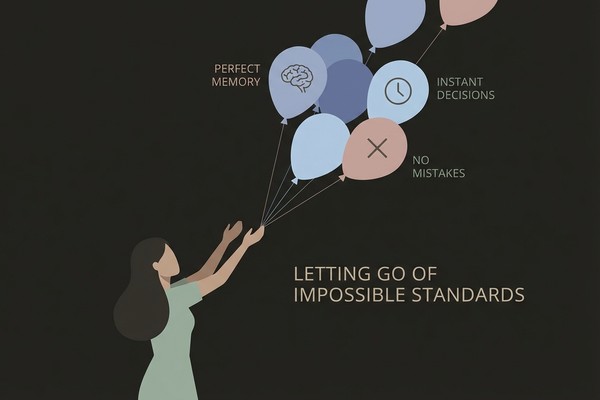
Stop expecting yourself to thrive in chaos just because you can survive it. Survival mode is not a sustainable operating system, no matter how much productivity culture tries to convince us that constant urgency is normal.
And please, stop expecting yourself to figure out better ways to cope with overload instead of addressing the overload itself. The problem isn’t that you’re not managing your mental load efficiently enough. The problem is that the load is too heavy for any one person to carry gracefully.
A Promise and a Release
Here’s an invitation: write one promise to future-you, and identify one thing you’re ready to release them from.
Your promise might be simple: “I will leave you the login information.” “I will put buffer time around the difficult conversations.” “I will make the grocery list before you’re hungry and tired at the store.”
The release might be just as straightforward: “You don’t have to remember everyone’s preferences perfectly.” “You don’t have to have an opinion about every decision immediately.” “You don’t have to make up for my poor planning with superhuman effort.”
The most radical thing you can do is treat future-you like someone you actually like.
This isn’t about perfection or never dropping balls again. It’s about shifting from a relationship of constant disappointment to one of basic consideration. It’s about recognizing that the person who will inherit your choices deserves the same thoughtfulness you’d extend to anyone else you care about.
Building Your Gentle Infrastructure
Start with three things: one handoff, one default, one buffer.
The handoff is something you can stop carrying in your head by putting it somewhere reliable. Maybe it’s moving all your confirmation numbers to one place. Maybe it’s creating a shared calendar so you stop being the sole keeper of everyone’s schedule. Maybe it’s finally writing down the information you keep having to look up.
The default is a decision you can make once instead of repeatedly. What day do you handle certain recurring tasks? What’s your standard response to requests that need consideration? What’s your go-to plan for meals when you’re too tired to be creative?
The buffer is space you can create between things that need space. Time between meetings. A day between your deadline and the actual due date. An extra item on the grocery list. Room for things to take longer or go differently than planned.
None of these require dramatic life overhauls or complex systems. They’re small acts of consideration that compound into something larger: a life that feels like it’s designed for a human being instead of a productivity robot.
The beautiful thing about approaching systems this way is that they become sustainable not because they’re efficient, but because they’re kind. You maintain them not out of obligation but out of genuine care for the person who will benefit from them—which is you, just slightly in the future.
This is what support looks like when it’s designed for humans instead of metrics. It’s not about doing more or being better. It’s about creating space for yourself to be imperfect, to need time, to forget things occasionally without everything falling apart.
And if you’re ready to build more of this kind of support into your life, that’s exactly what Backlit is designed to help with—not by making you more productive, but by helping you hold less while ensuring nothing important gets lost.
This article was created with collaboration between humans and AI—we hope you ❤️ it.