
Most weekly reviews feel like performance evaluations for your life. You sit down with your color-coded calendar and optimized task manager, ready to squeeze more productivity out of the next seven days. But what if you’re already running on empty? What if your week needs less optimization and more compassion?
The traditional weekly review assumes you’re a machine that just needs better programming. It asks what you accomplished, what you didn’t, and how you can do better next time. It rarely asks how you felt during those accomplishments, or whether you had any energy left for the people and moments that actually matter.
Starting With What’s Real
A whole-life weekly review begins with a different question: What’s your actual capacity right now?
Before you look at your calendar or your task list, look at yourself. How did you sleep this week? What’s your stress level? Are you riding high on a recent win, or are you dragging yourself through each day? This isn’t self-indulgence—it’s data. Your energy and emotional state determine what’s actually possible, not what your ambitious Sunday-self thought was possible.
I learned this the hard way after years of planning weeks like I was a productivity robot. I’d stack meetings, deadlines, and social commitments into neat little blocks, then wonder why I felt overwhelmed by Wednesday. The problem wasn’t my planning system—it was my refusal to plan like a human being with limits, emotions, and bad days.
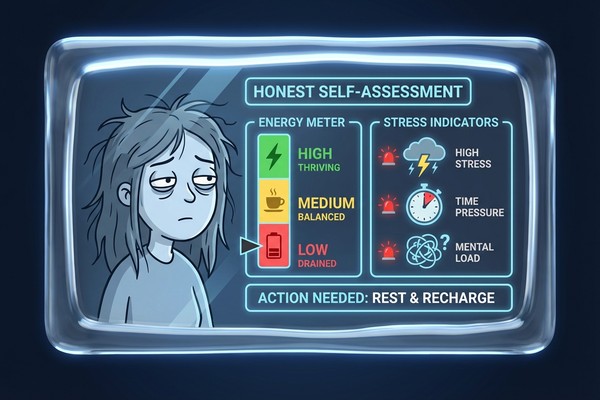
When you start with capacity, everything else becomes more honest. Maybe this is a week where you can tackle that big project. Maybe it’s a week where keeping everyone fed and showing up to work counts as a win. Both are valid, but only one matches your reality.
Scanning Your Whole Life
Once you know where you’re starting from, it’s time to look at what’s coming. But instead of just checking your work calendar, scan all the domains of your life: work, home, health, relationships, money, and self-care.
This isn’t about achieving perfect balance—it’s about seeing the whole picture. Maybe work is intense this week, but your home life is calm. Maybe you have three social events but no major deadlines. Maybe your kid is going through a rough patch and needs extra attention, which means other things will need to slide.
The goal is awareness, not judgment. When you see everything at once, you can make conscious trade-offs instead of being blindsided by competing demands.
Planning like a human means planning for the fact that you’re not just a work-producing machine.
Traditional productivity advice tells you to focus on your “most important tasks.” But what if your most important task this week is being present for a friend going through a divorce? What if it’s finally dealing with that pile of insurance paperwork that’s been stressing you out for months? What if it’s just maintaining your baseline without adding anything new?
Finding Your Peaks and Valleys
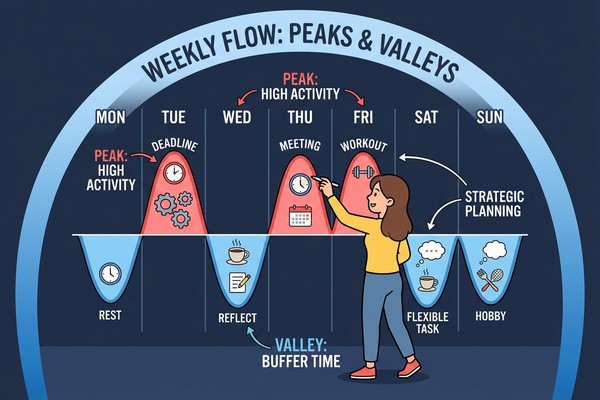
As you scan the week ahead, you’ll start to see natural peaks and valleys. Maybe Tuesday is packed with back-to-back meetings. Maybe Thursday evening is completely free. Maybe the weekend has three birthday parties but Monday is blissfully empty.
Instead of trying to flatten these peaks and fill these valleys, work with them. Protect your valleys as buffer zones. Don’t schedule important conversations right after your most stressful day. Don’t plan to tackle creative work when you know you’ll be drained.
This is where most weekly reviews go wrong—they try to optimize every hour instead of designing for human rhythms. But you’re not a machine that operates at consistent output. You’re a person with good days and hard days, morning energy and afternoon slumps, social batteries that need recharging.
Choosing Your Focus
Here’s where things get simple, maybe uncomfortably so. Instead of trying to advance every area of your life, choose one focus and one maintenance priority for the week.
Your focus is the thing that gets your best energy and attention. Maybe it’s finishing a work project, maybe it’s planning a family trip, maybe it’s having a difficult conversation you’ve been avoiding. Just one thing.
Your maintenance priority is the thing you need to keep from sliding backward. Maybe it’s meal planning so you don’t end up ordering takeout every night. Maybe it’s staying on top of laundry so Monday morning isn’t chaos. Maybe it’s checking in with your aging parent.
This feels too simple because we’re used to productivity systems that make us feel busy and important. But complexity is often just procrastination in disguise. When you have one clear focus and one maintenance priority, you know exactly what deserves your energy.
The Art of the Handoff
One of the most powerful questions you can ask during your weekly review is: What can I hand off or simplify this week?
This might mean asking your partner to handle pickup duty on Thursday. It might mean ordering groceries instead of shopping. It might mean telling your team you need them to own the follow-up on that project instead of you tracking every detail.
The goal isn’t to do everything perfectly—it’s to hold less so you can be more present for what matters.
Most of us are carrying responsibilities that don’t actually need to be ours. We’re remembering things other people could remember, tracking things other people could track, worrying about things other people could handle. A good weekly review identifies at least one thing you can stop carrying.
Planning for Hard Days
Here’s something most weekly reviews never address: What’s your plan for when things go sideways?
Because they will. Someone will get sick, a deadline will move up, your childcare will fall through, or you’ll just wake up feeling overwhelmed. Instead of pretending this won’t happen, plan for it.
Write yourself a “good enough” plan for a hard day. What are the absolute essentials? What can wait? Who can you call for help? What’s your minimum viable version of getting through the day?
This isn’t pessimistic planning—it’s realistic planning. When you have a plan for hard days, you don’t waste precious energy figuring out what to do in the moment. You just follow the plan your clearer-headed self already made.
Learning From Friction
If you want to get fancy with your weekly review, add one more step: log your friction points from the past week.
What took longer than expected? What caused stress? What felt unnecessarily complicated? Where did you find yourself saying “there has to be a better way”?
These friction points are gold. They’re showing you exactly where your systems need work, where your boundaries need strengthening, or where you need to ask for help. But don’t try to fix everything at once—just notice the patterns and tackle one friction point at a time.
A Different Kind of Success
A whole-life weekly review measures success differently. It’s not about how much you accomplished—it’s about how aligned your week felt with your actual capacity and values. Did you protect your energy for what mattered most? Did you maintain your baseline without burning out? Did you show up as the person you want to be?
Sometimes the most successful week is the one where you did less but felt more present. Where you said no to good opportunities because you knew they weren’t right for this season. Where you chose connection over productivity, rest over achievement.
This isn’t about lowering your standards—it’s about raising them. Instead of optimizing for output, you’re optimizing for sustainability, presence, and alignment. Instead of planning like a machine, you’re planning like a whole human being with a whole life.
The weekly review that changes everything isn’t the one that helps you do more. It’s the one that helps you hold less, so you can be more of who you actually are.
This article was created with collaboration between humans and AI—we hope you ❤️ it.