You’ve been carrying an invisible job description your entire adult life. It doesn’t appear on any resume, doesn’t come with a salary, and certainly doesn’t get the recognition it deserves. But make no mistake—you’ve been working as the Chief Operating Officer of your own existence, and the workload is crushing.
Think about what you actually do beyond your “real” job. You’re the family’s scheduling coordinator, making sure everyone gets where they need to be. You’re the household’s inventory manager, tracking what’s running low and what needs replacing. You’re the relationship maintenance specialist, remembering birthdays and checking in on people who matter. You’re the project manager for every home improvement, every vacation, every major purchase. You’re the financial analyst, the meal planner, the appointment scheduler, the gift buyer, the insurance navigator, and the emergency response coordinator.
And somewhere along the way, we all just accepted this as normal.
The Invisible Infrastructure You’ve Become
Modern life has quietly transformed each of us into human infrastructure. We’ve become the connective tissue that holds everything together, the memory banks that store countless details, the processing units that coordinate between different systems and people. We are the APIs between our kids’ schools and our calendars, between our aging parents’ needs and available services, between our partner’s schedule and our own obligations.
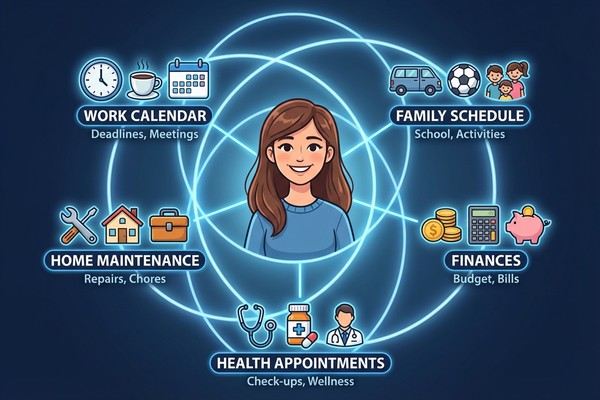
The mental load we’ve discussed throughout this series—that constant background processing of what needs to happen next—isn’t just about remembering tasks. It’s about being the central nervous system for multiple complex, interconnected systems. You coordinate between your teenager’s basketball schedule and your work travel. You remember that the dog needs his shots the same week your mother-in-law visits. You track which bills are due when your partner gets paid.
This coordination work is skilled labor. It requires pattern recognition, forward planning, risk assessment, and constant adaptation. Yet it’s treated as something that should happen automatically, effortlessly, in the margins of your “real” responsibilities.
You weren’t failing at life—you were doing impossible work alone.
The regeneration burden we explored—that exhausting cycle of setting up systems only to watch them decay—happens because you’re not just managing tasks, you’re maintaining the entire infrastructure. When your carefully organized family command center becomes a pile of outdated papers, that’s not personal failure. That’s what happens when one person tries to be the IT department, facilities management, and executive assistant for an entire household.
The verification trap—constantly double-checking that things actually happened—exists because you’ve become the quality assurance department for your own life. Did the payment go through? Did everyone get the message about the schedule change? Did the repair person actually fix the problem? You verify because you’ve learned that if you don’t, things fall through the cracks, and guess who gets blamed?
What Real Support Actually Looks Like
Most productivity systems offer advice. They tell you how to organize better, prioritize smarter, or optimize your workflow. But advice isn’t support—it’s just more work dressed up as a solution. Real support doesn’t teach you to juggle better; it catches some of the balls so you don’t have to.
True support understands context. It knows that “call the dentist” isn’t just about making a phone call—it’s about finding a dentist who takes your insurance, has availability that works with your schedule, and is located somewhere you can actually get to. It’s about remembering that your kid is terrified of dental work and needs extra time, or that your partner’s flexible work schedule makes them the better choice for the appointment.
Real support doesn’t just track what you need to do; it holds the full picture of why, when, and how. It remembers that you prefer morning appointments because afternoon ones mess with school pickup. It knows that you need a two-week buffer before your mother’s visit to get the guest room ready. It understands that “buy groceries” means different things depending on whether it’s a regular week or you’re hosting a dinner party.
The App Sprawl Solution That Isn’t
Right now, you probably have a dozen apps trying to solve pieces of this puzzle. A calendar app that doesn’t talk to your task manager. A grocery list that doesn’t know about your meal plan. A budgeting app that can’t see your upcoming expenses. A family organizer that your partner never checks.
Each app demands its own setup, its own maintenance, its own way of thinking about your life. You become the integration layer between all these disconnected tools, manually moving information from one system to another. The apps multiply your coordination work instead of reducing it.
The problem isn’t that you need better apps—it’s that you need fewer systems to maintain.
Then there’s the self-surveillance trap. Modern productivity culture has convinced us that the solution to overwhelm is more tracking, more metrics, more data about ourselves. Time tracking apps that turn your life into a spreadsheet. Habit trackers that gamify your basic human needs. Mood journals that ask you to quantify your feelings on a scale of one to ten.
This surveillance approach treats you like a machine that needs optimization rather than a human being who needs support. It adds the burden of constant self-monitoring to your already overwhelming load. You end up spending more time tracking your life than living it.
What We’re Building Instead
Backlit starts from a different premise entirely: you shouldn’t have to be your own personal assistant, project manager, and coordination system. You shouldn’t have to remember everything, track everything, and follow up on everything. You deserve support that works the way support should work—quietly, competently, and without adding to your mental load.
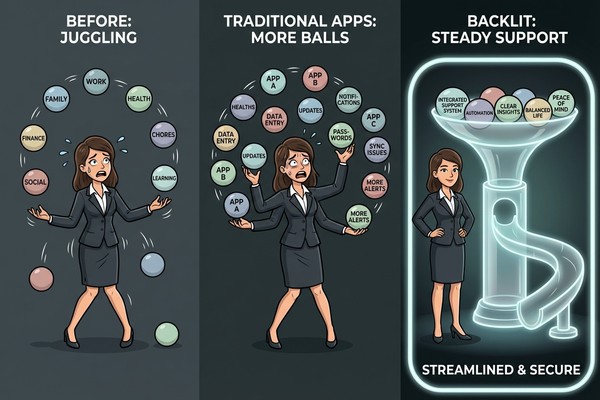
We’re building an AI that doesn’t just remind you to do things—it helps you think through what needs to happen and when. It doesn’t just track your tasks—it understands the relationships between them, the constraints that shape them, and the context that makes them meaningful. It doesn’t just store your information—it actively works with that information to reduce the coordination burden you carry.
This means Backlit learns that when you say “plan Mom’s birthday,” you don’t just need a reminder to buy a gift. You need someone who remembers she’s been wanting to try that new restaurant, knows that your sister always handles the cake, understands that Sunday works better than Saturday because of your kid’s soccer schedule, and can coordinate with everyone without you having to be the central communication hub.
It means having support that knows your patterns and preferences well enough to handle the routine coordination work automatically. Not just “remind me to schedule a haircut” but “I notice it’s been eight weeks since your last haircut, and your usual stylist has availability next Tuesday at 2 PM, which works with your schedule. Should I book it?”
Beyond Productivity Theater
What we’re not building is another productivity optimization tool. We’re not interested in helping you squeeze more tasks into your day or gamifying your to-do list. We’re not building a system that measures your output or rates your efficiency.
Instead, we’re focused on reduction. Reducing the number of things you have to actively remember. Reducing the coordination work you have to do manually. Reducing the verification cycles you have to run. Reducing the setup and maintenance overhead of managing your own life.
The goal isn’t to make you more productive—it’s to make you less burdened.
This means Backlit works in the background, ambient and integrated rather than demanding your attention. It doesn’t buzz with notifications or require you to check in constantly. It works quietly to handle the coordination and follow-up that currently lives in your head, surfacing only what actually needs your decision or attention.
The Learning Process
Right now, Backlit is in early development, and we need your help to build something that actually reduces your mental load instead of adding to it. The best way to design real support is to understand the actual shape of the burden you’re carrying.
We’re asking people to start logging their mental load—not to optimize it or judge it, but to help us understand it. What are the things you find yourself remembering that you wish you didn’t have to? What coordination work happens automatically in your head that you’d love to hand off? What verification loops do you run that feel unnecessary but essential?
This isn’t about productivity tracking or self-improvement. It’s about mapping the invisible work you do so we can build systems that actually take some of it off your plate.
The early version of our app is simple—just a place to capture those mental load moments when they happen. “Remember to follow up with the contractor.” “Check if the insurance covered that appointment.” “Figure out what to do about Mom’s medication confusion.” The small stuff and the big stuff, the urgent and the eventual, the concrete and the abstract.
Every entry helps us understand not just what people need to remember, but how they think about it, when it comes up, and what context matters. This is the foundation for building support that actually supports instead of just organizing.
Your mental load is data about what real support should look like. By sharing it, you’re helping us build something that could lighten the burden for everyone who’s been quietly holding too much for too long.
The waitlist is open, and the early app is ready for people who want to start mapping their mental load. Not because tracking will fix anything, but because understanding the problem is the first step toward building a real solution.
You’ve been the system long enough. It’s time to have a system that works for you instead.
This article was created with collaboration between humans and AI—we hope you ❤️ it.