You know that feeling when someone asks you a simple question and your brain just… stops? Like when your partner asks what you want for dinner while you’re mentally juggling three work deadlines, a doctor’s appointment you need to schedule, and the growing pile of laundry that’s somehow become sentient. Your mouth opens, nothing comes out, and you feel like you’ve temporarily lost the ability to make even the most basic decisions.
That’s not a personal failing. That’s cognitive load theory in action.
Most people have never heard of cognitive load theory, even though they live with its effects every single day. Originally developed to understand how students learn, it explains something much more universal: what happens when your brain’s working memory hits capacity. And for anyone carrying the mental load of modern life—especially working parents who’ve become the family’s default memory system—understanding this isn’t just academic. It’s survival.
The Science of Mental Overload
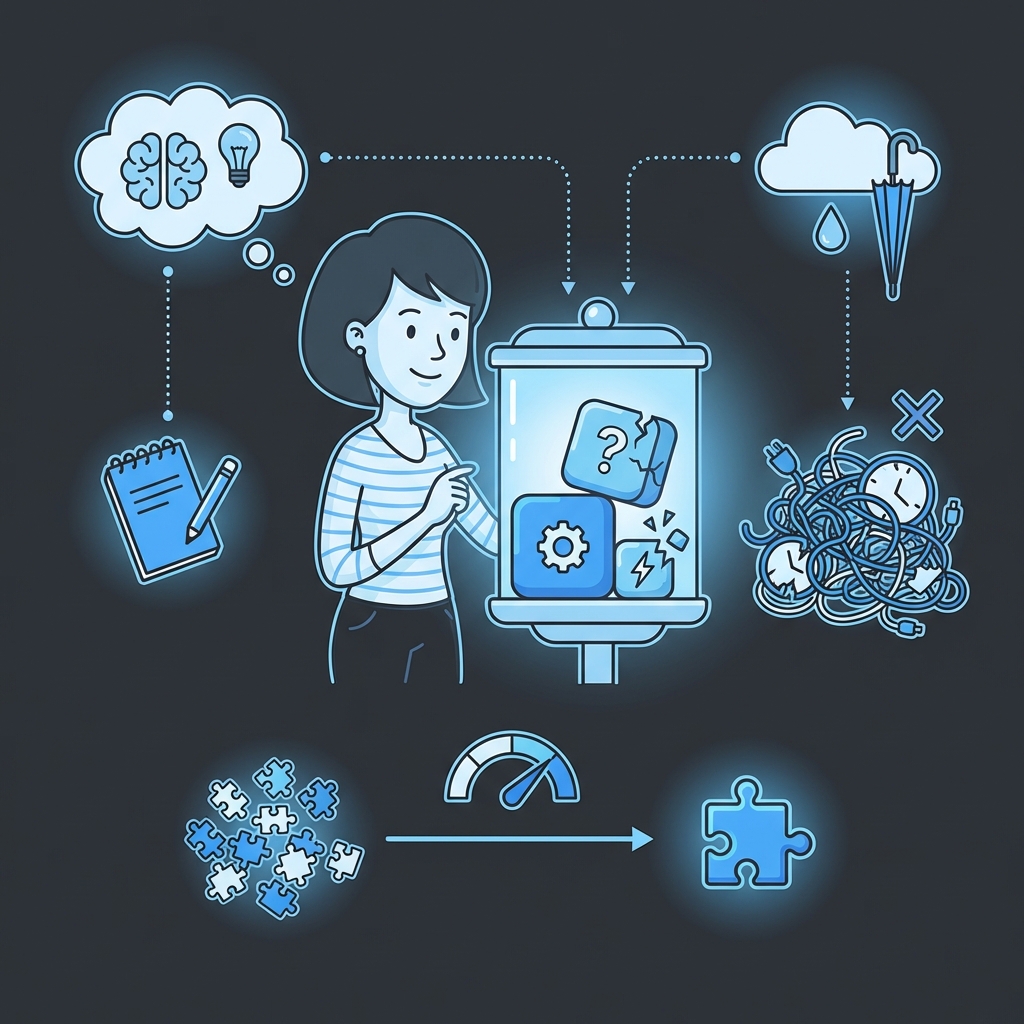
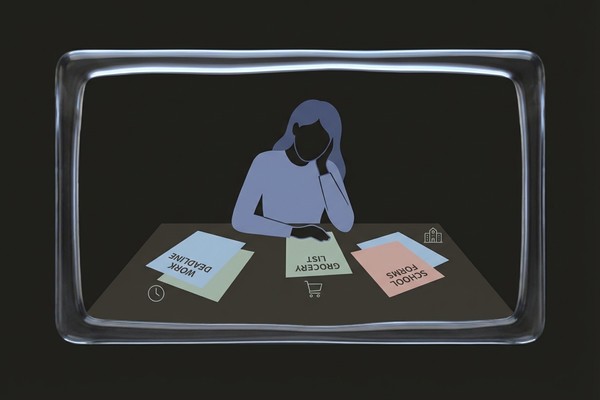
Cognitive load theory breaks down the work your brain does into three distinct types, each competing for the same limited mental resources. Think of your working memory as a small desk where you can only spread out so many papers at once.
Intrinsic load is the inherent difficulty of whatever you’re trying to process. Learning to drive has high intrinsic load because coordinating steering, speed, and spatial awareness is genuinely complex. Deciding what to make for dinner has low intrinsic load—until you factor in dietary restrictions, what’s in the fridge, and who will actually eat it.
Extraneous load comes from everything that’s not essential to the task but demands attention anyway. The notifications pinging while you’re trying to concentrate. The background worry about whether you remembered to pay that bill. The mental sidebar running through tomorrow’s schedule while you’re supposed to be present for today’s conversation.
Germane load is the productive work of making sense of information and building understanding. It’s the good kind of mental effort—when you’re actually learning, connecting dots, or solving problems in a way that sticks.
Here’s the crucial part: these three types of load share the same cognitive resources. When extraneous load is high—when your mental desktop is cluttered with irrelevant papers—there’s less space for the intrinsic work you’re trying to do, and almost no room for the deeper germane processing that leads to insight and growth.
When Your System Is Full
In educational settings, cognitive overload shows up as students who suddenly can’t grasp concepts that should be within their ability. In real life, it shows up everywhere. You find yourself reading the same email three times without absorbing it. You walk into a room and forget why you came. You snap at your kids over something minor because your mental resources are depleted.
The insidious thing about cognitive overload is that it doesn’t feel like a capacity problem—it feels like a competence problem. When you can’t remember whether you already added salt to the soup, it’s easy to conclude you’re losing your edge. When you struggle to focus during an important meeting, you might think you’re not trying hard enough. When you feel overwhelmed by decisions that used to feel automatic, you wonder what’s wrong with you.
Nothing’s wrong with you. Your system is full.
This distinction matters because the solutions are completely different. If you think the problem is competence, you try to push harder, do better, be more disciplined. If you understand the problem is capacity, you look for ways to reduce the load.
The Hidden Cost of High-Load Living
Smart people make seemingly dumb decisions under cognitive load not because they’ve suddenly lost intelligence, but because high-load environments systematically degrade decision quality. When working memory is saturated, your brain shifts into a kind of cognitive triage mode, prioritizing immediate demands over thoughtful analysis.
You end up making choices based on what feels urgent rather than what’s actually important. You default to familiar patterns even when they’re not optimal. You avoid decisions altogether, which is itself a decision—often the worst one.
When your cognitive load is maxed out, every choice feels equally overwhelming, so you either freeze or grab the first option that ends the discomfort.
This is why the parent who flawlessly manages complex projects at work can stand paralyzed in the cereal aisle. It’s not that choosing between Cheerios and granola is inherently difficult—it’s that their working memory is already full of everything else they’re tracking, leaving no room for even simple decisions to get proper processing.
The productivity culture’s response to this is typically more systems, more optimization, more discipline. But that misses the point entirely. Adding another system to manage your systems just increases extraneous load. Trying to optimize your way out of cognitive overload is like trying to solve a storage problem by organizing more efficiently instead of getting rid of stuff.
The Remembering Tax
One of the biggest sources of extraneous load in modern life is what I call the “remembering tax”—the constant cognitive work of tracking, anticipating, and following up on everything that needs to happen. This work is largely invisible, which makes it easy to underestimate and impossible to fairly distribute.
The person who remembers that the car needs an oil change isn’t just storing one piece of information. They’re monitoring mileage, tracking time since the last service, anticipating scheduling needs, and maintaining awareness of this task alongside hundreds of others. Each item on your mental to-do list isn’t just a task—it’s an ongoing cognitive subscription.
Most productivity systems acknowledge that you need to capture tasks somewhere external, but they still leave the remembering work with you. You have to remember to check your system, remember to update it, remember to trust it. The cognitive load of maintenance often exceeds the load of just keeping everything in your head, which is why so many systems get abandoned.
Strategies That Actually Reduce Load
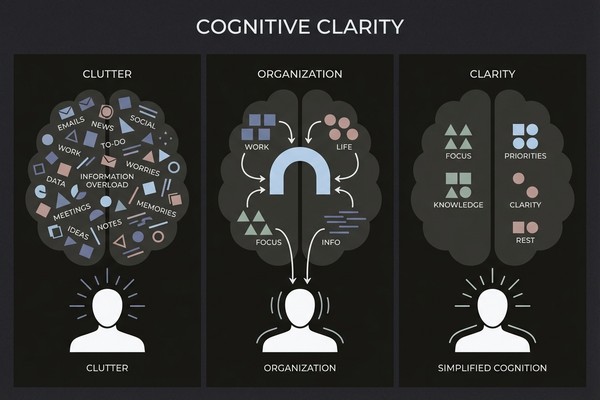
Real cognitive load reduction isn’t about better organization—it’s about genuinely removing cognitive work from your plate. The most effective strategies fall into three categories: chunking, offloading, and eliminating extraneous inputs.
Chunking works by packaging related information together so it takes up less working memory space. Instead of tracking “buy milk, buy bread, buy eggs” as three separate items, you chunk them into “grocery run.” Instead of remembering each step of your morning routine, you create one automatic sequence that runs without conscious oversight.
Offloading means moving cognitive work to external systems that can handle it reliably without your supervision. The key word is “without supervision”—if you have to remember to check your reminder system, you haven’t actually offloaded the work.
Eliminating extraneous inputs is about reducing the noise that competes for cognitive resources. This might mean turning off non-essential notifications, creating physical barriers between work and personal spaces, or simply saying no to commitments that don’t align with your priorities.
Beyond Personal Solutions
Individual strategies help, but they don’t address the systemic issue: modern life generates more cognitive load than any individual can reasonably manage. The solution isn’t just better personal systems—it’s tools and environments designed to genuinely take cognitive work off your plate.
This is where most AI assistants fall short. They can help you organize information or automate specific tasks, but they still leave you with the cognitive work of remembering, monitoring, and coordinating. They optimize the execution while leaving the mental load intact.
The real breakthrough isn’t making you more efficient at managing everything—it’s creating systems that hold and manage things so you don’t have to.
True cognitive load reduction requires tools that don’t just help you remember—they remember for you. They don’t just organize your tasks—they track, follow up, and take responsibility for outcomes. They reduce your mental load not by making you better at carrying it, but by carrying it themselves.
The goal isn’t to become superhuman at juggling infinite cognitive demands. The goal is to create conditions where you don’t have to. Your brain’s working memory is finite and precious. The question isn’t how to cram more into it—it’s how to protect it for the thinking that actually matters to you.
When you understand cognitive load theory, you stop seeing overwhelm as a personal failing and start seeing it as a design problem. And design problems have design solutions.
This article was created with collaboration between humans and AI—we hope you ❤️ it.