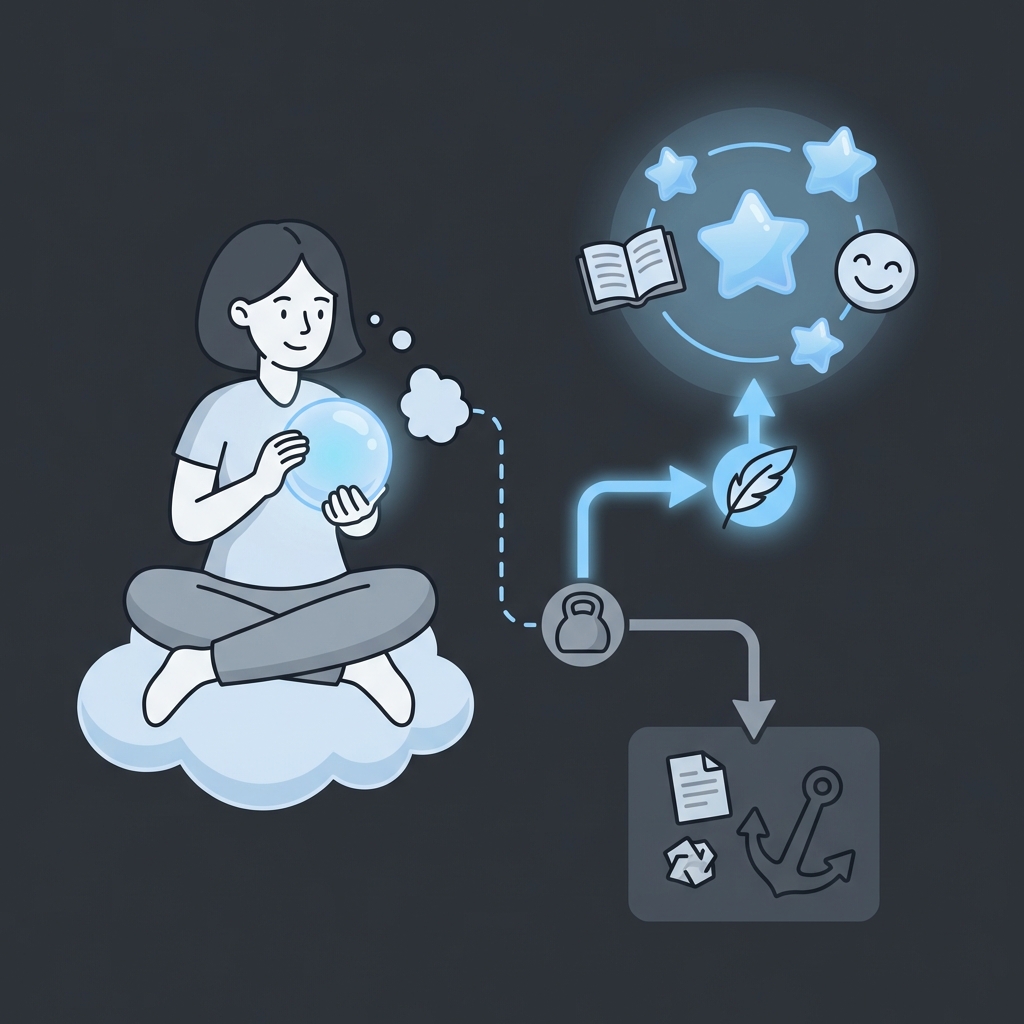
The calendar page turns, and everywhere you look, someone’s asking about your “wins” for the month. Your achievements. Your progress. Your growth metrics and goal completion rates. But here’s what they’re not asking: What got lighter? What stopped feeling so heavy on your shoulders?
This is the question that actually matters. Because real life isn’t measured in crossed-off tasks or hit targets. It’s measured in the quiet exhale when you realize something that used to drain you simply… doesn’t anymore. It’s the moment you notice you’re not bracing for impact every time your phone buzzes. It’s the strange, almost unfamiliar feeling of having bandwidth left at the end of the day.
Achievement culture wants us to count what we accumulated, produced, or conquered. But the people carrying the most mental load—the ones remembering everyone’s schedules, anticipating needs, and holding the invisible threads that keep life together—know that the real victory is often what didn’t happen. The crisis that didn’t unfold because someone else remembered. The stress that didn’t spike because a system finally worked. The Sunday night panic that didn’t come because Monday was actually prepared for.
The proof is in what didn’t happen.
What You Stopped Carrying Alone
Take a moment to scan back through your month, but not for your highlight reel. Look for the opposite: the places where the weight shifted off your shoulders. Maybe your partner started handling bedtime routines without being asked. Maybe you finally hired someone to clean the house, or a colleague took ownership of that recurring project that always seemed to land on your desk.
These shifts feel almost too subtle to celebrate, don’t they? There’s no fanfare when mental load decreases. No notification that pops up saying “Congratulations! You worried about one less thing today!” The absence of stress doesn’t announce itself the way its presence does.
But this is exactly why we need to actively notice these moments. The working parent who realizes they haven’t thought about school pickup logistics in weeks because their partner now owns that routine entirely. The solopreneur who discovers they’re no longer checking their phone obsessively because they’ve set up systems that actually catch things before they become urgent. The person who used to lie awake mentally rehearsing the next day’s schedule, now falling asleep because tomorrow is already handled.
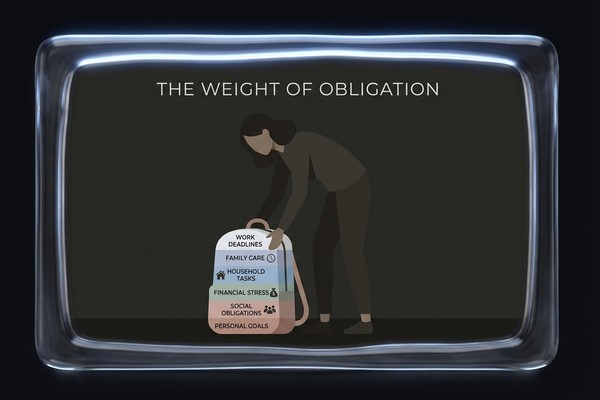
These aren’t small wins. They’re seismic shifts in how you move through the world. When you stop being the single point of failure for everything in your orbit, you don’t just get time back—you get your nervous system back. You get the mental space to think about things other than logistics and damage control.
The Patterns That Keep Repeating
Now look at what kept showing up, month after month. Not the obvious stuff—we all know we procrastinate or that certain people are difficult. Look deeper, at the patterns of responsibility and load distribution that seem to regenerate no matter how many times you address them.
Maybe you keep ending up as the point person for group decisions, even when you actively try to step back. Maybe every family gathering somehow defaults to your house and your planning, despite everyone’s best intentions to “share the load.” Maybe work projects keep expanding to fill whatever capacity you show you have, regardless of your official role.
These patterns reveal something important: they’re not really about you being “bad at boundaries” or “too much of a perfectionist.” They’re about systems—in your family, your workplace, your social circles—that have learned to rely on your willingness to absorb uncertainty and manage complexity.
The person who always ends up coordinating isn’t necessarily controlling or unable to delegate. Often, they’re the one willing to hold the anxiety of things potentially falling through cracks. They’re the one who can tolerate the discomfort of loose ends and unclear ownership until someone steps up or systems get built.
Recognizing these patterns isn’t about blame—it’s about seeing the invisible architecture of how responsibility flows in your life.
Understanding this helps you see that changing these patterns isn’t just about personal willpower. It’s about redesigning systems so that the default isn’t always you. It’s about creating structures where responsibility can land somewhere other than your mental inbox.
What Support Actually Moved the Needle
Think about the moments this month when you felt genuinely supported—not just helped with tasks, but actually relieved of mental load. There’s a crucial difference between someone doing something for you and someone owning something entirely.
When someone does something for you, you still carry the cognitive overhead. You remember to ask, you check that it happened, you notice when it doesn’t get done. The task moves off your to-do list, but the responsibility stays in your head.
But when someone truly owns something, it disappears from your mental radar completely. You don’t wonder if it’s handled—you know it is, because it’s not your job to know anymore. The difference is profound, and it’s what separates real support from well-intentioned task-shifting.
Maybe this month someone in your life made this leap. Your teenager started managing their own school deadlines without reminders. A colleague took full ownership of client communication for a project. Your partner began anticipating household needs instead of waiting for direction. A friend started organizing the monthly get-togethers that you’d been coordinating for years.
These shifts often happen quietly, almost invisibly. The person providing this kind of support isn’t looking for credit or recognition—they’re just stepping into ownership. And for you, the relief isn’t immediate gratitude as much as it is a gradual realization that something has stopped taking up space in your mind.

What to Protect Next Month
Now comes the important part: choosing what to protect. Not what to achieve, not what to optimize, but what to shield from the inevitable creep of responsibility and complexity that wants to fill every available space in your life.
Look at what got lighter this month and ask yourself: what would it take to keep it light? If your mornings became less chaotic because you started preparing the night before, what would protect that evening routine from getting squeezed out by other demands? If you felt less anxious about work because you finally set up proper project tracking, what would keep you from abandoning that system when things get busy?
The things that reduce our mental load are often the first to get sacrificed when life gets intense. The self-care practices, the organizational systems, the boundaries we’ve worked hard to establish—they feel optional in the moment, even though they’re what make everything else sustainable.
Protecting what got lighter might mean saying no to something that seems important but would re-complicate your life. It might mean having a conversation with someone about maintaining a new dynamic that’s working. It might mean building buffers around the systems and routines that are actually serving you.
This isn’t about being rigid or inflexible. It’s about recognizing that some things are worth protecting precisely because they make flexibility possible everywhere else. When you’re not constantly managing crisis and complexity, you have the bandwidth to be responsive and adaptive when it actually matters.
Making Next Month Kinder
As you look ahead, resist the urge to plan for optimization and efficiency. Instead, ask yourself: what would make next month kinder to you? What would make it gentler on your nervous system? What would help you move through your days with less bracing and more ease?
Maybe it’s building in more transition time between commitments so you’re not always rushing. Maybe it’s having one day a week where nothing is scheduled, so you can respond to whatever actually needs attention. Maybe it’s setting up systems that give you information before you have to ask for it, or creating routines that handle predictable needs automatically.
Kindness to yourself isn’t about lowering standards—it’s about designing life to work with your actual human limitations instead of against them.
The goal isn’t to eliminate all challenge or difficulty from your life. It’s to eliminate the unnecessary friction, the predictable stress, the mental overhead that accumulates around the edges of everything you do. When you reduce that background noise of complexity and cognitive load, you have more capacity for the things that actually matter—the relationships, the creative work, the moments of presence and connection that make life meaningful.
This kind of reflection—measuring success by what got lighter rather than what got done—might feel foreign at first. We’re so trained to count outputs and achievements. But for those of us carrying significant mental load, the real transformation happens in the spaces between tasks, in the quiet moments when we realize we’re not holding our breath anymore.
What got lighter for you this month? What stopped feeling so heavy? Those aren’t small changes—they’re the foundation of a more sustainable way of living. And they’re worth protecting as you move into whatever comes next.
This article was created with collaboration between humans and AI—we hope you ❤️ it.