
You know that feeling when someone casually says “let’s schedule something” and your stomach does a little flip? That’s because you understand what they don’t—that scheduling isn’t a task, it’s a job. A complex, invisible job that involves reading minds, managing egos, predicting conflicts, and somehow making everyone happy while you slowly lose your sanity.
Most people think scheduling means opening a calendar app and picking a time. But if you’re the person who actually handles coordination in your family or workplace, you know it’s more like being an air traffic controller, therapist, and fortune teller all at once. You’re not just finding an open slot—you’re navigating a web of spoken and unspoken constraints, managing the emotional labor of disappointing people, and carrying the mental burden of remembering why Tuesday at 3 PM won’t work even though it looks perfectly free on paper.
The Hidden Architecture of Every Schedule
When someone asks you to “just schedule” something, what they’re really asking you to do is become the repository for everyone else’s complexity. Take a simple family dinner with your in-laws. What looks like “find a date that works” actually involves layers of invisible work that would make a project manager weep.
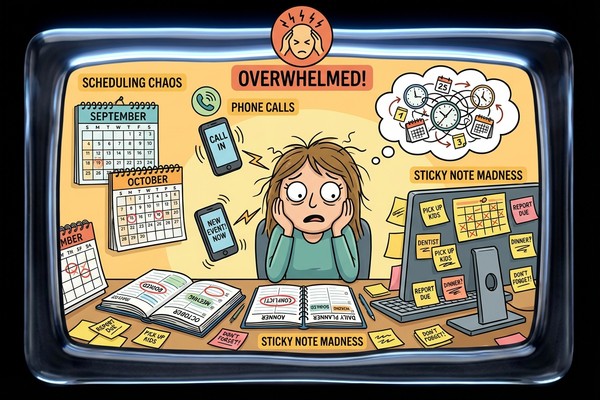
First, there’s the constraint mapping. You need to remember that your mother-in-law doesn’t drive at night anymore, your partner has that recurring work thing on Thursdays, your teenager has soccer practice but you’re not sure which days this month, and your toddler melts down if dinner is too late. None of this lives in any calendar—it lives in your head, taking up precious mental real estate.
Then comes the preference archaeology. Everyone has opinions about timing, but they don’t volunteer this information upfront. You have to excavate it through careful questioning and past experience. Your sister prefers Sunday afternoons but won’t say so directly. Your dad “doesn’t care” but gets grumpy if it conflicts with his shows. Your partner says they’re “flexible” but you know they hate early morning commitments on weekends.
The actual scheduling is just the beginning. Once you’ve found a time that theoretically works, you enter the confirmation phase—sending texts, making calls, double-checking that yes, everyone still remembers, and no, nothing has changed since yesterday. You become a human notification system because apparently grown adults can’t be trusted to remember their own commitments.
The person who coordinates carries everyone else’s forgetting.
And then, inevitably, someone needs to reschedule. The whole delicate house of cards collapses, and you start over. But now you’re working with even more constraints because you’ve learned new information about everyone’s secret preferences and hard boundaries. The rescheduling is often more complex than the original scheduling because now you’re managing disappointment and guilt on top of logistics.
The Emotional Labor No One Talks About
What makes scheduling particularly exhausting isn’t just the logistics—it’s the emotional responsibility that comes with being the coordinator. When you’re the person who handles scheduling, you become responsible not just for finding times that work, but for managing everyone’s feelings about those times.
You’re the one who has to deliver bad news when the perfect time doesn’t exist. You’re the one who has to negotiate between competing priorities and somehow make everyone feel heard and valued. You absorb the frustration when plans fall through and the guilt when someone feels left out or inconvenienced.
This emotional labor is completely invisible to everyone else involved. They see the end result—a calendar invite or a confirmed plan—but they don’t see the careful diplomacy, the strategic timing of requests, the mental energy spent anticipating problems and managing personalities. They don’t see you lying awake at night wondering if you should have pushed harder for the time that worked better for your mom, or whether your partner is secretly annoyed about the weekend commitment you agreed to.
The worst part is that when coordination goes well, it’s invisible. No one thanks you for the smooth scheduling because smooth scheduling feels effortless to everyone except the person making it happen. But when something goes wrong—when there’s a conflict or a miscommunication—suddenly everyone notices, and somehow it’s your fault for not anticipating every possible complication.
What Real Handoff Looks Like
Here’s where most scheduling tools get it wrong: they think handoff means giving you a better way to manage all this complexity yourself. They offer shared calendars and scheduling links and automated reminders, but they still leave you holding the bag for all the invisible work. You’re still the one who has to remember everyone’s constraints, manage their preferences, and absorb their emotional reactions.
Real handoff in scheduling means something different. It means having a system that doesn’t just help you coordinate—it actually owns the coordination. Instead of giving you better tools to juggle everyone’s complexity, it takes the juggling off your plate entirely.
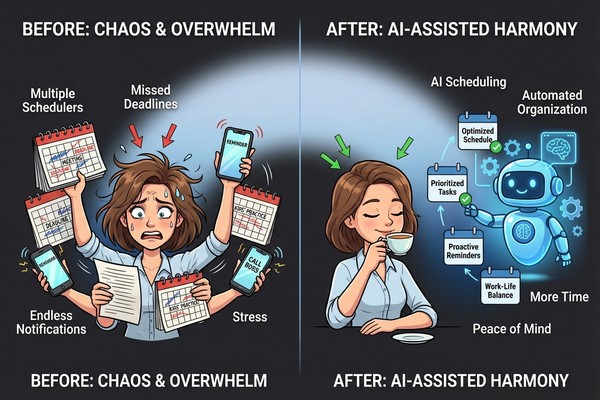
Think about what this would actually look like. Instead of you being the human database of everyone’s scheduling constraints, the system learns and remembers them. Instead of you having to chase people down for confirmations, the system handles the follow-up and only surfaces issues that actually need your attention. Instead of you managing the emotional labor of rescheduling, the system presents options and handles the basic negotiation.
True handoff means you can say “schedule dinner with the family sometime next month” and trust that it will happen without you becoming the air traffic controller. The system knows that mom doesn’t drive at night, that Thursdays are complicated, that your teenager needs advance notice for anything that conflicts with social plans. It handles the back-and-forth, manages the confirmations, and only comes back to you with real decisions or genuine conflicts.
The Coordination Loops You’re Probably Running
Take a moment to think about your own coordination patterns. What are the scheduling loops you run over and over again? Maybe it’s the monthly family dinner dance, or the quarterly work planning sessions, or the endless parade of kids’ activities and appointments. Maybe it’s the simple-but-somehow-complex task of scheduling date nights with your partner, or coordinating with contractors for home repairs.
Each of these loops involves the same invisible work: constraint mapping, preference archaeology, confirmation management, and emotional labor. Each one requires you to hold context that doesn’t live anywhere else and to manage relationships that extend far beyond the actual calendar event.
The power of identifying these loops is recognizing that they’re systems, not individual tasks. They’re recurring patterns of coordination work that could, in theory, be owned by something other than your brain. But only if we stop pretending that scheduling is just about finding open time slots.
Designing for Shared Context
The key to real scheduling handoff isn’t better calendar interfaces—it’s shared context that doesn’t require your constant input and maintenance. Right now, you are the shared context. You’re the one who remembers that your partner hates early meetings, that your mom needs two weeks’ notice for anything, that your kid’s soccer schedule changes monthly but the coach never updates parents until the last minute.
Real coordination tools don’t just manage your calendar—they hold your context.
A system that truly handles scheduling would learn these patterns and constraints without you having to program them in manually. It would understand that when your mother-in-law suggests “sometime soon” she actually means “within the next two weeks but not on a weekend because that’s when she sees her other grandchildren.” It would know that your teenager’s “I’m free” actually means “I’m free unless something better comes up” and plan accordingly.
This kind of context-aware coordination would transform scheduling from a job you do into something that happens around you. Instead of being the central processor for everyone else’s scheduling complexity, you become a participant in your own calendar rather than its administrator.
The goal isn’t to optimize your scheduling workflow—it’s to get you out of the scheduling business entirely, while still ensuring that the coordination actually happens. That’s the difference between a tool that helps you do the work and a system that does the work for you.
This article was created with collaboration between humans and AI—we hope you ❤️ it.