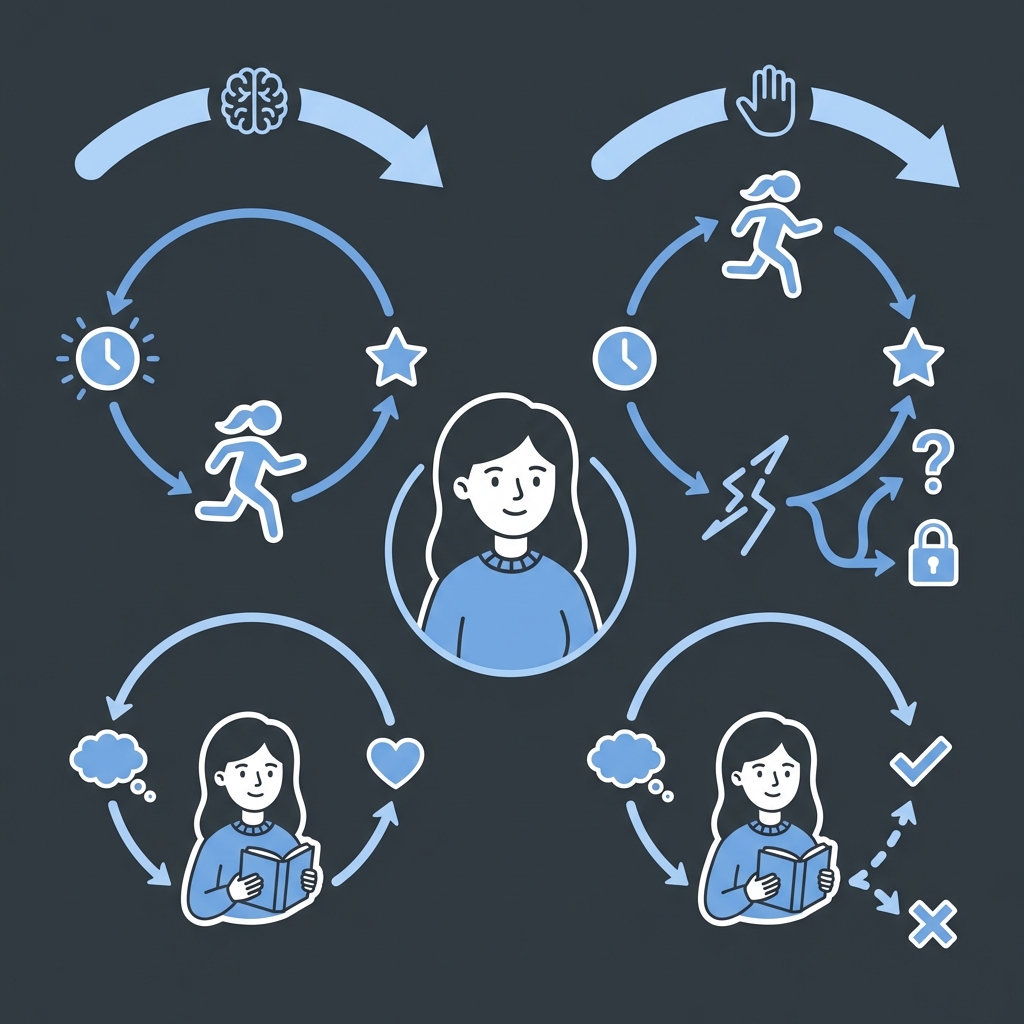
The self-help section of any bookstore will tell you that habits form in 21 days. Just pick your behavior, white-knuckle through three weeks, and voilà—you’re transformed. It’s a seductive promise, especially when you’re staring at yet another abandoned morning routine or feeling guilty about that meditation app gathering digital dust.
But here’s what actually happens: You start strong, maybe even make it two weeks, then life throws you a curveball. A sick kid, a work deadline, a weekend trip. Suddenly your carefully constructed habit crumbles, and you’re back to square one, wondering what’s wrong with your willpower.
Nothing’s wrong with you. The problem is that most of what we’ve been told about habit formation is either oversimplified or flat-out wrong.
The Real Mechanics of How Habits Work
Real habit formation isn’t about grinding through arbitrary timeframes. It’s about understanding a simple but powerful loop: cue, routine, reward. This isn’t just pop psychology—it’s backed by decades of neuroscience research, particularly the work of MIT’s Ann Graybiel and her team studying the basal ganglia.
Here’s how it actually works: A cue triggers your brain to go into automatic mode. You perform the routine (the behavior itself). Then comes the reward, which helps your brain remember this loop for next time. The more you repeat this cycle, the more automatic it becomes, until eventually the cue alone starts triggering the craving for the reward.
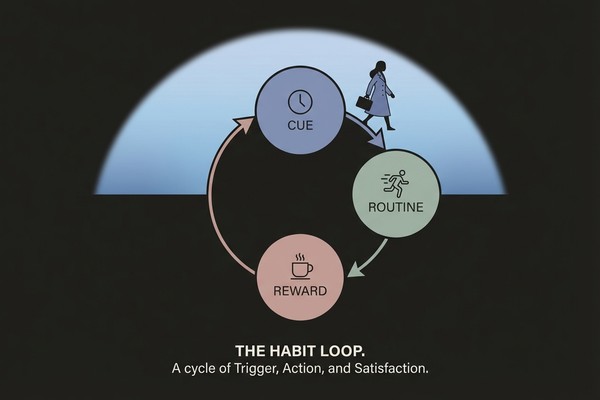
Take your morning coffee habit. The cue might be stumbling into the kitchen. The routine is making coffee. The reward is that first satisfying sip (plus the caffeine hit). After enough repetitions, just walking into the kitchen triggers the craving for coffee, and your hands start moving toward the coffee maker without conscious thought.
This is why willpower feels so exhausting when you’re trying to build new habits—you’re fighting against a brain that hasn’t automated the process yet. Every decision requires conscious effort until the loop gets established.
But here’s where it gets interesting: the strength of a habit isn’t just about repetition. It’s about how reliably the cue appears, how satisfying the reward feels, and crucially, how stable your context remains.
Why the 21-Day Rule Is Mythology
The 21-day myth comes from Dr. Maxwell Maltz, a plastic surgeon who noticed that patients took about 21 days to adjust to their new appearance after surgery. Somehow this observation about psychological adjustment got twisted into a universal rule about habit formation.
The reality? When researchers actually studied habit formation, they found it takes anywhere from 18 to 254 days for a behavior to become automatic, with an average of 66 days. And that’s for simple behaviors like drinking a glass of water after breakfast.
More complex habits—like exercising regularly or maintaining a creative practice—can take much longer. Some never fully automate at all, especially if they require ongoing decision-making or adaptation.
The magic isn’t in hitting a specific number of days. It’s in understanding why some behaviors stick while others don’t.
This variability isn’t a bug in the system—it’s a feature. Your brain is constantly evaluating whether habits are worth maintaining based on how much they cost (in effort) versus how much they pay off (in reward). A habit that requires significant mental energy every single time isn’t going to stick, no matter how many days you force yourself through it.
The Fragility Problem: Why Context Matters
Here’s something the habit gurus don’t tell you: habits are incredibly context-dependent. They’re not just stored in your brain as abstract behaviors—they’re tied to specific environments, times, emotional states, and social situations.
This is why your workout routine falls apart when you travel, or why you stop meal prepping when your schedule changes. The cues that triggered your habit loop have disappeared or shifted, and suddenly you’re back to making conscious decisions about everything.
Think about it: if you always meditate in your bedroom at 6 AM, what happens when you’re staying at a friend’s house, or when daylight saving time shifts your sleep schedule? The environmental cues that made the habit feel automatic are gone.
This context dependency explains why major life changes—new job, moving, having a baby, pandemic lockdowns—tend to disrupt even well-established habits. It’s not that you’ve lost discipline. It’s that the entire cue structure supporting your habits has been scrambled.
The most robust habits are those that can survive context changes. They either have multiple cues (so if one disappears, others remain) or they’re built around cues that stay consistent across different environments.
What Actually Works: Stacking and Friction
Instead of relying on motivation or arbitrary timelines, the most reliable approach to habit formation focuses on two key levers: habit stacking and friction reduction.
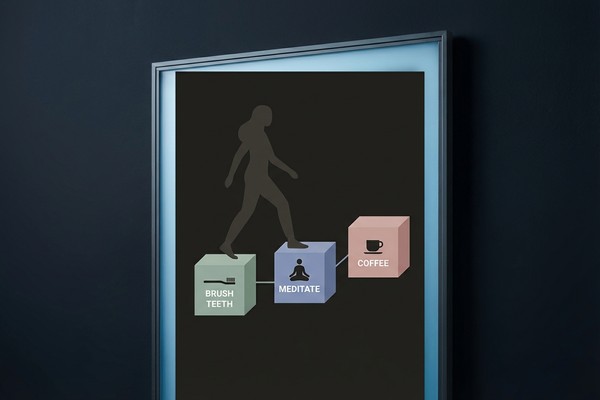
Habit stacking, popularized by James Clear but rooted in behavioral psychology, means attaching a new habit to an existing one. Instead of trying to remember to meditate at some random time, you meditate right after you brush your teeth. The existing habit becomes the cue for the new one.
This works because you’re borrowing the cue structure from a habit that’s already automatic. You don’t have to remember to brush your teeth—it just happens. So you don’t have to remember to meditate either, as long as it’s linked to teeth brushing.
Friction reduction is about making the habit as easy as possible to execute. This might mean laying out your workout clothes the night before, keeping your journal next to your bed, or pre-cutting vegetables on Sunday so healthy snacking requires no prep during the week.
The key insight here is that small amounts of friction can completely derail a forming habit. Having to dig through a closet to find workout clothes, or having to think about what to write in your journal, or having to clean a pan before you can cook—these tiny obstacles loom large when your brain is still deciding whether this new behavior is worth the effort.
Why Habits Break (And What to Do About It)
Even well-established habits can break, and understanding why helps you design better restart protocols. The most common culprits are context disruption, competing cues, and high cognitive load periods.
Context disruption we’ve covered—your environment changes and takes your cues with it. Competing cues happen when new demands on your attention interfere with your habit triggers. High cognitive load periods are those overwhelming times when your brain is already maxed out on decision-making, leaving no bandwidth for maintaining non-essential routines.
The traditional response to a broken habit is to feel guilty and try to restart from scratch. But this ignores everything we know about how habits actually work. A better approach is to have a restart protocol ready.
First, identify what changed. Did your cues disappear? Are you trying to maintain the habit in a new context? Has your reward structure shifted? Understanding the breakdown helps you rebuild more effectively.
Second, start smaller than you think you need to. If you were running three miles before your habit broke, restart with a ten-minute walk. If you were journaling for twenty minutes, restart with three sentences. The goal is to re-establish the cue-routine-reward loop with as little friction as possible.
The restart isn’t about punishment or proving your commitment. It’s about rebuilding the neural pathway that makes the behavior automatic.
Third, focus on consistency over intensity. It’s better to do a tiny version of your habit every day for two weeks than to do the full version sporadically. You’re training your brain to recognize and respond to the cue again.
Beyond Personal Willpower
This brings us to something most habit advice misses entirely: the mental load of maintaining cue structures. Every habit you want to build requires you to remember the cue, notice when it appears, and execute the routine consistently enough for the loop to strengthen.
That’s a lot of cognitive overhead, especially when you’re trying to build multiple habits or when your life is already complex. You’re essentially asking your brain to run multiple background programs while handling all your other daily decisions and responsibilities.
The most sustainable approach isn’t to become a habit-building machine. It’s to design systems that hold the cue structure for you. This might mean setting up your environment so good choices are automatic, creating external reminders that don’t rely on your memory, or using tools that track context and prompt behaviors when conditions are right.
The goal isn’t to optimize yourself into a habit robot. It’s to reduce the mental load of maintaining the behaviors that matter to you, so your limited cognitive resources can go toward the things that actually require your conscious attention.
Real habit formation isn’t about willpower or magic timelines. It’s about understanding how your brain actually works, respecting the role of context, and designing systems that make good behaviors easier than bad ones. The science is less dramatic than the self-help books suggest, but it’s also more forgiving—and more effective—than trying to force yourself into arbitrary molds.
This article was created with collaboration between humans and AI—we hope you ❤️ it.