
You know that feeling when you need help but can’t bring yourself to ask? You craft the text message three different ways, delete it, then decide to just figure it out yourself. Or you finally work up the courage to ask, but it comes out as a rambling apology: “I’m so sorry to bother you, I know you’re busy, I hate to ask but…”
Here’s what I’ve learned: the apology isn’t helping anyone. It’s actually making the ask harder to respond to, and it’s training you to see your needs as burdens rather than normal human requests.
Most of us learned early that asking for help means being a bother. We absorbed the message that self-sufficiency is virtue and needing support is weakness. But this creates a strange dynamic where we either don’t ask at all (and burn out trying to do everything alone) or we ask in ways that make the other person work harder to help us.
The solution isn’t to stop needing help. It’s to ask in ways that respect both your needs and the other person’s capacity to respond clearly.
Why Apologizing Makes Everything Harder
When you lead with an apology, you’re essentially asking the other person to manage your emotions about asking before they can even process what you actually need. “I’m so sorry to bother you” puts them in the position of having to reassure you that it’s okay to ask, which is emotional work they didn’t sign up for.
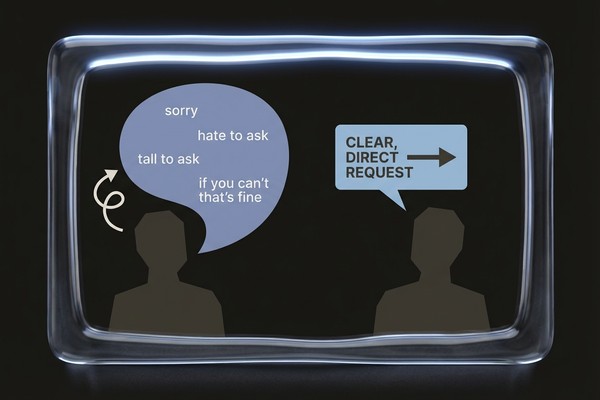
Think about it from the receiving end. When someone approaches you with excessive apologies, what happens? You have to spend mental energy figuring out if they actually need something urgent or if they’re just anxious about asking. You might even feel obligated to say yes because they seem so distressed about the request itself.
The apology also signals that you think your need is unreasonable, which makes the other person wonder if it actually is. If you’re treating your request like an imposition, they’re more likely to experience it as one.
Clear asks are gifts—they tell people exactly how to help you.
Compare these two approaches: “I’m so sorry to ask, I know you’re swamped, but could you maybe look at this thing if you have time?” versus “Could you review this proposal by Thursday? It should take about 15 minutes.” The second version gives the person everything they need to make a decision quickly and confidently.
What Makes an Ask Easy to Say Yes To
The easiest requests to respond to are specific, time-bound, and outcome-focused. They answer three key questions before the person even has to ask them: What exactly do you need? When do you need it? What does success look like?
Specificity eliminates guesswork. Instead of “Can you help me with this project?” try “Can you review the budget section and flag any line items that seem too high?” The person immediately knows what type of help you need and can assess whether they have the right expertise and availability.
Timeline creates boundaries that work for everyone. “Sometime this week” leaves the other person managing your deadline in their head. “By Wednesday at 2pm” or “No rush, but within the next two weeks” gives them the information they need to plan their response.
Outcome clarity prevents scope creep and sets expectations. When you say “Can you look at this?” the person doesn’t know if you want proofreading, strategic feedback, or a complete rewrite. “Can you check this for typos before I send it?” or “Can you tell me if the main argument makes sense?” gives them a clear target.
The magic happens when you combine all three elements. The person can quickly assess: Do I have the skills for this? Do I have the time? Do I understand what good looks like? If the answer to all three is yes, they can say yes confidently. If any answer is no, they can decline without having to guess what they’re declining.
Scripts That Actually Work
Let’s get practical. Here are templates that respect both your needs and the other person’s ability to respond clearly:
For work requests: “I need [specific thing] by [specific time] so that [brief context]. This should take about [time estimate]. Are you available to help with this?” Example: “I need feedback on the client presentation by Tuesday morning so I can incorporate changes before the meeting. This should take about 20 minutes to review. Are you available to help with this?”
For household help: “Could you handle [specific task] by [when]? I’m managing [brief context] and this would help me focus on [other priority].” Example: “Could you pick up groceries after work today? I’m dealing with the insurance claim and this would help me focus on getting that resolved.”
For personal favors: “I have [situation] and could use help with [specific action]. Would you be up for [clear request] on [timeframe]?” Example: “I have a job interview next week and could use practice with answers. Would you be up for a 30-minute mock interview sometime this weekend?”
For professional services: “I need [outcome] and I think you might be the right person to help. The scope would be [specifics] and my timeline is [when]. Does this sound like something you take on?” Example: “I need help organizing my home office and I think you might be the right person to help. The scope would be sorting papers and setting up filing systems in one room, and my timeline is flexible over the next month. Does this sound like something you take on?”
The Context Sweet Spot
Here’s where many people go wrong: they either provide no context (leaving the person confused about why this matters) or they provide so much context that the actual request gets buried.
The right amount of context answers one question: Why does this matter? Not your entire backstory, not every factor that led to this moment, just enough information for the person to understand the stakes and urgency.

Too little: “Can you review this?” Too much: “So I’ve been working on this project for three months and my boss mentioned last week that it needs to be perfect because the client has been difficult and I’m worried about the deadline and I’ve been losing sleep…” Just right: “Can you review this client proposal? It’s going to the CEO next week and I want to make sure the financial projections are solid.”
The context should make the person more willing to help, not more overwhelmed by your situation. Frame it as “here’s why this matters” rather than “here’s why I’m stressed.”
When the Answer Is No
This is where the non-apologetic approach really pays off. When you ask clearly and without excessive apologies, “no” becomes a clean transaction instead of a relationship crisis.
A clear no to a clear ask sounds like: “I can’t take this on right now” or “This isn’t my area of expertise” or “My bandwidth is full until next month.” These responses give you useful information and often open the door to alternatives.
A “no” to a clear request is information, not rejection.
When you’ve asked apologetically, “no” feels personal because you’ve already framed the ask as potentially unreasonable. When you’ve asked clearly, “no” is just a mismatch of capacity or timing.
Your response to “no” should be equally clean: “Thanks for being direct” or “I appreciate you letting me know” or “No problem, I’ll figure out another approach.” This reinforces that asking and declining are both normal parts of getting things done.
Sometimes “no” comes with alternatives: “I can’t do the full review, but I could look at just the executive summary” or “I’m swamped this week, but I could help next week” or “This isn’t my strength, but Sarah might be perfect for this.” When you ask clearly, people can offer partial help or referrals more easily.
The Ask You’ve Been Avoiding
Right now, think of one request you’ve been putting off because you can’t figure out how to ask without feeling like a burden. Maybe it’s asking your partner to handle bedtime routines two nights a week. Maybe it’s asking a colleague to cover a meeting so you can attend your kid’s school event. Maybe it’s asking a friend to be a reference for a job application.
Write it down using the formula: specific action + clear timeline + brief context. Notice how different it feels when you frame it as a clear request rather than an apologetic plea.
The goal isn’t to guarantee a “yes”—it’s to make both the asking and the responding easier for everyone involved.
Beyond Individual Asks
Here’s the bigger picture: while learning to ask for help without apologizing is crucial, the real goal is building systems that reduce the number of individual asks you need to make in the first place.
When you’re constantly having to ask for help with recurring tasks, that’s often a sign that the underlying system needs attention, not that you need to get better at asking. If you’re always asking someone to remind you about deadlines, maybe you need better tracking systems. If you’re always asking for help with household logistics, maybe you need clearer ongoing agreements about who handles what.
The clearest, most respectful ask is often the one you don’t have to make because the system is already handling it. But until those systems are in place, asking clearly and without apology is a skill that will serve you well—and make you someone others actually want to help.
This article was created with collaboration between humans and AI—we hope you ❤️ it.