
Your sister texts asking how you’re doing. You see it, think “I’ll respond properly later,” and then three weeks pass. Your friend mentions feeling overwhelmed at work, and you mentally note to check in, but that mental note gets buried under seventeen other mental notes. Your partner tries to tell you about their day while you’re answering emails, and you offer distracted “mm-hmms” until they stop trying.
These aren’t character flaws. They’re the predictable casualties of a culture that measures worth by output and treats relationships like optional extras—nice to have when there’s time left over, but certainly not essential infrastructure.
The truth is, hustle culture doesn’t just steal your time. It rewires your brain to see human connection through the lens of productivity, turning the people you love into another item on an optimization checklist. And when relationships get optimized, they get hollowed out.
The Invisible Architecture of Connection
Relationships don’t run on grand gestures or scheduled quality time alone. They run on what I call the relationship maintenance stack—the ongoing, mostly invisible work of staying connected to another human being.
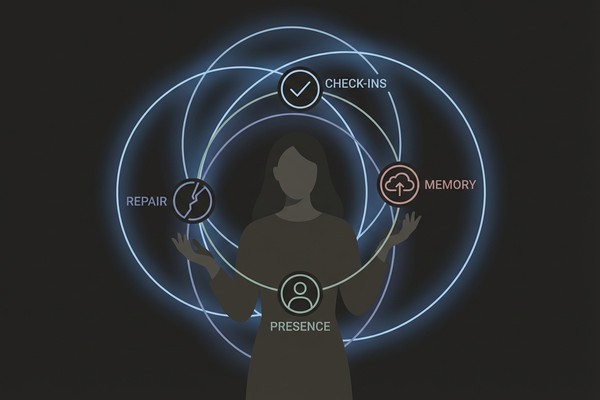
There’s the check-in layer: remembering to ask how the job interview went, following up on the thing they were worried about last week, noticing when someone’s been quiet longer than usual. There’s the memory layer: holding space in your mind for their ongoing concerns, their wins, their patterns, their preferences. There’s the presence layer: the ability to be genuinely available when you’re together, not just physically there while your mind runs through tomorrow’s agenda.
And there’s the repair layer—perhaps the most crucial and most fragile. This is the work of addressing small disconnections before they become big ones, of apologizing for distraction, of circling back to conversations that got interrupted by life.
Each layer requires something productivity culture has trained us to see as wasteful: unstructured mental space, unoptimized time, attention that isn’t driving toward a measurable outcome.
The maintenance work of relationships is invisible until it stops happening.
When you’re operating in hustle mode, these layers start to thin. Check-ins become sporadic. Memory gets outsourced to calendar reminders that you ignore. Presence fractures into multitasking. Repair work gets deferred indefinitely because there’s always something more urgent demanding attention.
The Productivity Trap in Relationships
Hustle culture doesn’t just ignore relationships—it actively reframes them through a transactional lens. People become networking opportunities or emotional resources to be managed efficiently. Conversations get evaluated for their ROI. Social time gets justified only if it serves some larger goal.
This shows up in subtle ways that feel reasonable in the moment. You find yourself steering conversations toward topics that might benefit your work. You prioritize social events based on who else will be there and what you might gain. You start treating family time like a scheduled obligation to be optimized rather than a source of renewal.
Even well-intentioned relationship advice gets infected by productivity thinking. “Schedule date nights.” “Set boundaries around work time.” “Be more intentional about quality time.” All of this advice treats relationships like another system to be optimized, another area where better planning and execution will yield better results.
But relationships aren’t productivity problems. They’re complex, ongoing negotiations between imperfect humans who need different things at different times. They require presence, not planning. Responsiveness, not optimization. The willingness to be inefficient when efficiency would damage connection.
The Quiet Erosion
The breakdown doesn’t happen overnight. It happens in small, seemingly reasonable compromises that accumulate over time.
Phone calls get shorter because you’re always rushing to the next thing. Visits get skipped because the travel time feels inefficient. Follow-up conversations get forgotten because you were too busy to write them down, and now it feels too late to circle back.
You start responding to emotional sharing with solutions instead of empathy, because solutions feel more actionable. You interrupt stories to check your phone because that notification might be important. You say “we should hang out soon” without ever actually scheduling it, because scheduling feels like work and you’re already overwhelmed with work.
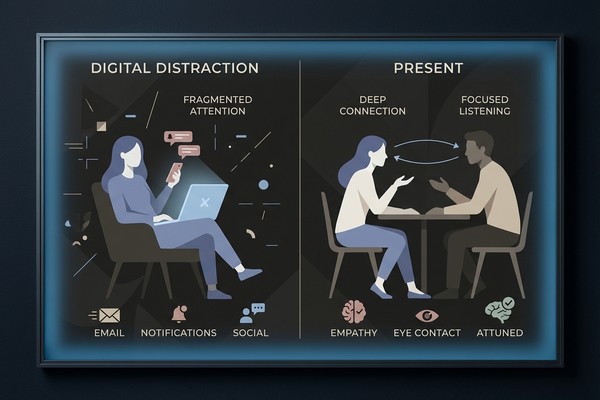
The people in your life adapt to your availability rather than expressing their needs. Your partner stops trying to share the small details of their day. Your friends stop inviting you to spontaneous gatherings because you’re always too busy. Your family stops calling as often because you sound rushed when you answer.
This adaptation happens so gradually that you barely notice it. You might even feel relieved that people are being more “understanding” of your busy schedule. But what’s really happening is that your relationships are quietly reorganizing themselves around your unavailability.
Efficiency is the wrong metric for human connection.
When Relationship Debt Comes Due
Like financial debt, relationship debt compounds quietly until it demands payment all at once. The friend who stops reaching out. The family member who stops sharing important news because you’ve been too distracted to respond meaningfully. The partner who starts making major decisions without consulting you because you’ve been too busy to engage with the small ones.
Sometimes the payment comes as a crisis—a relationship that suddenly feels foreign, a support network that isn’t there when you need it, the realization that you’ve become a stranger in your own life. Sometimes it comes as a slow recognition that your relationships have become shallow, that conversations stay on the surface because there’s no foundation of ongoing attention to build depth upon.
The cruelest irony is that relationships are actually your primary buffer against the burnout that hustle culture creates. Strong relationships provide emotional regulation, perspective, meaning, and practical support. They’re not luxuries that successful people can afford—they’re the infrastructure that makes sustainable success possible.
When you sacrifice relationships for productivity, you’re not just missing out on connection. You’re dismantling the very system that could help you handle stress, recover from setbacks, and maintain perspective on what actually matters.
Reframing Connection as Infrastructure
What if we stopped treating relationships like optional extras and started treating them like essential infrastructure? What if maintaining connections was as non-negotiable as maintaining your health or your skills?
This isn’t about adding “relationship time” to your already-packed schedule. It’s about recognizing that the quality of your relationships determines the quality of everything else. Your ability to think clearly, handle stress, recover from disappointments, celebrate wins, and maintain perspective all depend on having people in your life who know you and care about your wellbeing.
Infrastructure thinking means protecting relationship time even when—especially when—you feel too busy for it. It means recognizing that a ten-minute phone call with a friend isn’t a distraction from your important work; it’s maintenance work that keeps your support system functional.
It means understanding that presence isn’t a productivity hack. You can’t optimize your way into deeper connections. You can’t schedule your way into intimacy. You can’t efficiency your way into love.
Protecting What Matters
The goal isn’t to abandon all structure or ignore your responsibilities. It’s to create protective boundaries around the relationship maintenance work that keeps your connections alive.
This might mean setting specific times when you’re unavailable for work but available for the people you love. It might mean creating rituals around checking in with important people, not because it’s efficient but because it’s necessary. It might mean learning to recognize when someone needs your full attention and having the discipline to give it, even when part of your brain is trying to solve other problems.
Most importantly, it means rejecting the false choice between success and connection. The most sustainably successful people aren’t those who’ve optimized relationships out of their lives—they’re those who’ve built their lives on a foundation of strong relationships that can weather the inevitable storms of ambitious living.
The proof of a life well-lived isn’t in what you accomplished—it’s in who was there to celebrate it with you.
Your relationships aren’t holding you back from success. They’re not inefficient uses of your time. They’re not luxuries you can afford only after you’ve achieved your goals. They’re the ground you stand on, the context that gives your achievements meaning, and the safety net that makes risk-taking possible.
In a world that profits from your isolation and exhaustion, choosing to prioritize connection isn’t just personally wise—it’s quietly revolutionary.
This article was created with collaboration between humans and AI—we hope you ❤️ it.