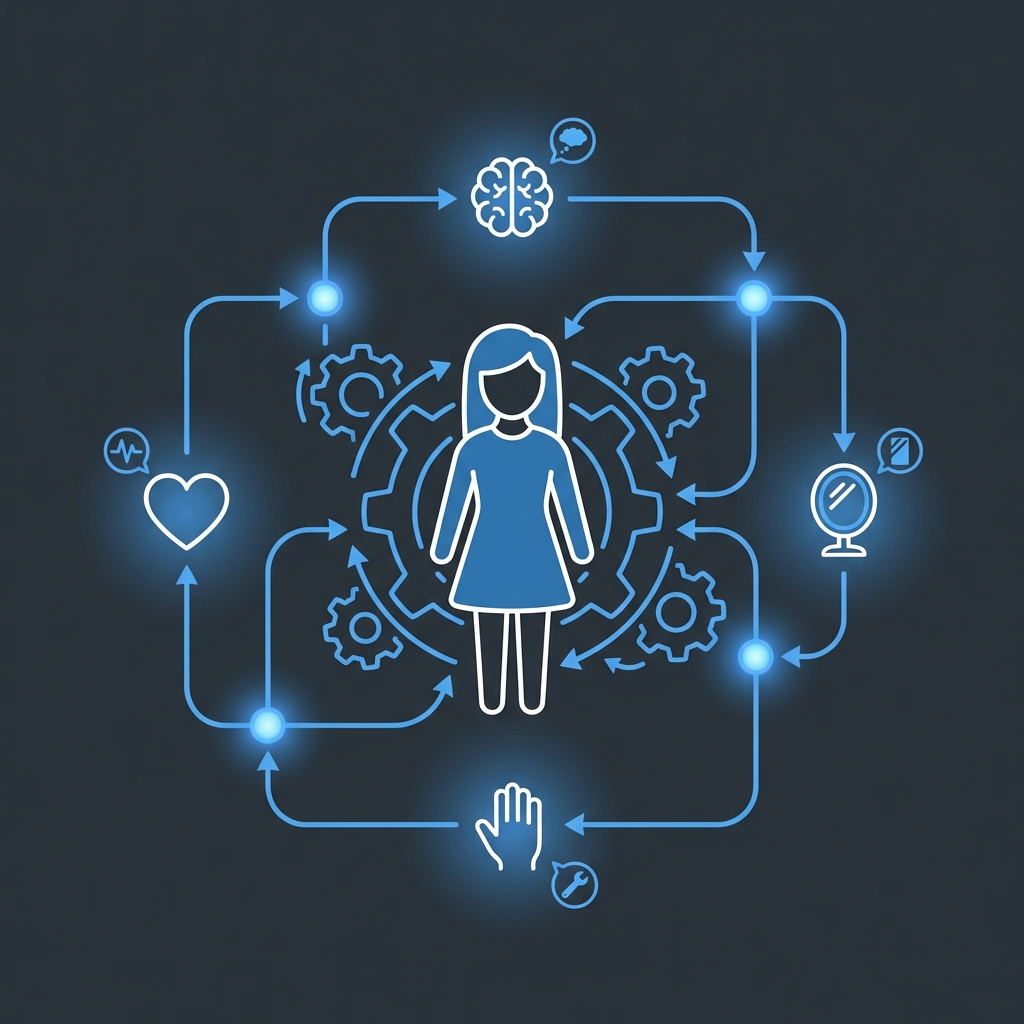
You wake up and immediately slip into character. Not consciously—it just happens. You’re the reliable coworker, the attentive parent, the friend who always remembers birthdays. By the time you’ve had your coffee, you’ve already performed a dozen micro-behaviors that reinforce who you’re supposed to be.
Most of us think identity is something we have, like eye color or a Social Security number. But identity is actually something we do—a complex system of maintenance, performance, and invisible agreements with everyone around us. And like any system, it requires constant energy to keep running.
The exhaustion you feel isn’t just from your tasks. It’s from the relentless work of being yourself.
The Labor of Staying Consistent
Identity maintenance is perhaps the most overlooked form of invisible work. Every day, you make hundreds of micro-decisions to stay consistent with who you’ve told people you are. You respond to texts in your characteristic way. You show up to meetings with your usual energy. You maintain the same standards, the same quirks, the same reliable patterns that make you you.
This consistency isn’t automatic—it’s work. When your teenager asks for help with homework and you’re exhausted, you still summon your “patient parent” persona. When a colleague needs a favor and you’re overwhelmed, you still activate your “helpful team member” identity. These aren’t fake performances; they’re real parts of who you are. But they require energy to maintain.
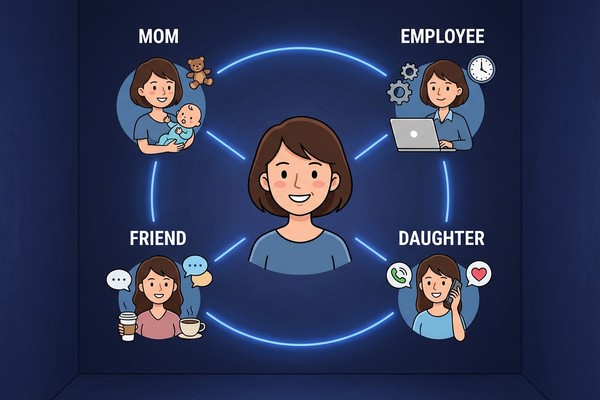
The challenge intensifies because we rarely maintain just one identity. You’re simultaneously the competent professional, the nurturing parent, the supportive partner, the reliable friend. Each role comes with its own set of expectations, behavioral patterns, and invisible contracts.
The exhaustion isn’t just from doing things—it’s from being the person who does them.
Think about the last time you felt completely drained after a social gathering where nothing particularly stressful happened. That fatigue often comes from identity maintenance—the cognitive load of tracking and performing multiple versions of yourself across different relationships and contexts.
The Invisible Contracts We Sign
Every relationship involves unspoken agreements about who you’ll be for that person. Your boss expects you to be solution-oriented and deadline-conscious. Your children expect you to be available and nurturing. Your parents expect you to be the same person you’ve always been, even as you grow and change.
These aren’t formal contracts, but they’re binding nonetheless. Break them, and you’ll face confusion, disappointment, or conflict. Your reliable friend who suddenly becomes flaky creates ripples. Your calm coworker who starts expressing frustration makes people uncomfortable. Your always-available parent who begins setting boundaries triggers family dynamics.
The weight of these invisible contracts becomes clear when you try to change. Want to be less accommodating? Prepare for pushback from people who benefited from your people-pleasing. Trying to be more assertive? Get ready for comments about how you’ve “changed” or become “difficult.”
This isn’t necessarily manipulation—though sometimes it is. Often, it’s just human nature. People become comfortable with predictable patterns, and they unconsciously resist disruptions to those patterns, even positive ones.
The tragedy is that these contracts often trap us in versions of ourselves that no longer serve us. The helpful person who can’t say no. The strong person who can’t ask for support. The positive person who can’t express legitimate concerns. We maintain these identities not because they make us happy, but because changing them feels too disruptive to our entire social ecosystem.
When Change Becomes a Threat
This is why even positive changes can feel threatening. It’s not just about learning new skills or breaking old habits—it’s about renegotiating your entire network of relationships and expectations.
When you decide to prioritize your own needs more, you’re not just changing a behavior. You’re potentially disappointing people who relied on your self-sacrifice. When you choose to be more direct in your communication, you’re not just adjusting your speaking style. You’re challenging relationships built on your previous indirectness.
The resistance often comes from within as much as from others. Your identity feels stable because it’s reinforced by consistent patterns. Disrupting those patterns can trigger a kind of existential anxiety. Who are you if you’re not the person who always says yes? What’s your value if you’re not the one who holds everything together?
Change threatens identity because identity is a promise—to others and to yourself.
This internal resistance explains why sustainable change often happens slowly, through small experiments rather than dramatic reinventions. Your identity system can absorb minor adjustments, but it rebels against wholesale transformations.
The Gentle Art of Identity Redesign
The solution isn’t to abandon your identity or ignore others’ expectations. It’s to approach identity change like a careful renovation rather than a demolition.
Start with experiments, not declarations. Instead of announcing “I’m not going to be the family organizer anymore,” try delegating one recurring task and see what happens. Rather than proclaiming “I’m going to be more assertive,” practice expressing one small preference per day.
These experiments let you test new identity elements without triggering the full defensive response from your social system. You can observe reactions, adjust your approach, and gradually expand what feels sustainable.
The key is to frame these changes as additions rather than subtractions. “I’m also someone who takes care of myself” feels less threatening than “I’m not going to take care of everyone else.” “I’m learning to be more direct” creates less resistance than “I’m tired of being accommodating.”
This approach acknowledges that identity change is inherently social. You can’t just decide to be different in isolation—you need to bring your relationships along with you, giving them time to adjust to new patterns and expectations.
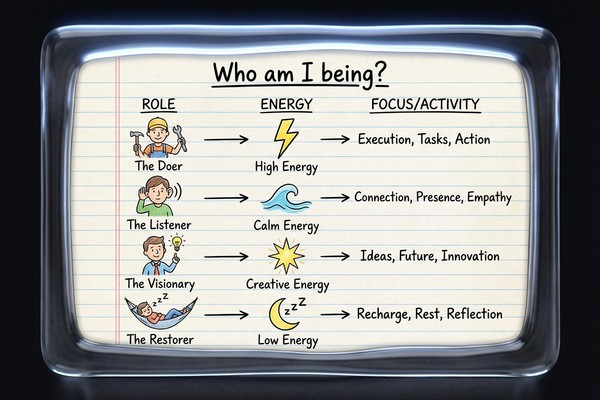
The ‘Who Am I Being?’ Inventory
One of the most revealing exercises is to map out your identity performances across different relationships. For one week, pay attention to who you become in different contexts.
Notice how you show up differently with your boss versus your best friend. Observe the energy it takes to maintain your “professional self” versus your “family self.” Track which identity performances feel authentic and energizing versus draining and performative.
The goal isn’t to judge these different versions of yourself—they’re all real parts of who you are. Instead, you’re gathering data about which aspects of your identity system are working and which might need adjustment.
Some questions to consider: Which roles feel most essential to who you are? Which feel like costumes you put on out of habit or obligation? Where do you feel most like yourself? Where do you feel most performed?
This inventory often reveals surprising patterns. You might discover that your “professional self” actually feels more authentic than your “family self” because work relationships have clearer boundaries. Or you might realize that certain friendships require so much identity maintenance that they’ve become exhausting rather than nourishing.
The Relief of Dropping One Performance
There’s profound relief in letting go of even one identity performance that no longer serves you. Maybe it’s the role of family peacekeeper, where you absorb everyone else’s conflicts. Perhaps it’s the identity of the person who never needs help, even when you’re drowning.
The initial discomfort of change—the confused looks, the questions about why you’re “acting different”—is temporary. But the energy you reclaim by dropping unsustainable identity maintenance is permanent.
This doesn’t mean becoming selfish or abandoning your responsibilities. It means being more intentional about which aspects of your identity deserve your energy and which you’ve been maintaining out of habit or fear.
Systems That Protect Identity Transitions
The most sustainable identity changes happen within supportive systems rather than through individual willpower alone. This is where thoughtful tools and frameworks become essential—not to optimize your performance, but to protect your energy during vulnerable transitions.
When you’re experimenting with new ways of being, you need systems that can hold some of the cognitive load. Tools that remember your commitments so you don’t have to. Frameworks that help you communicate changes without triggering defensive reactions. Support structures that reinforce new patterns until they become natural.
The goal isn’t to become a different person—it’s to become more yourself.
The most effective identity transitions happen when you have external support for the internal work. Whether that’s a trusted friend who can reflect back your growth, a tool that tracks your experiments, or a framework that helps you navigate relationship changes—having support makes the difference between sustainable change and exhausting self-improvement projects.
Your identity isn’t fixed, but it’s also not infinitely flexible. It’s a living system that requires care, attention, and sometimes gentle renovation. The work of being yourself doesn’t have to be overwhelming when you have the right support for the transition.
The question isn’t whether you’ll change—you’re already changing, whether you’re conscious of it or not. The question is whether you’ll have the support and systems to make those changes sustainable, authentic, and aligned with who you’re becoming rather than who you’ve always been expected to be.
This article was created with collaboration between humans and AI—we hope you ❤️ it.