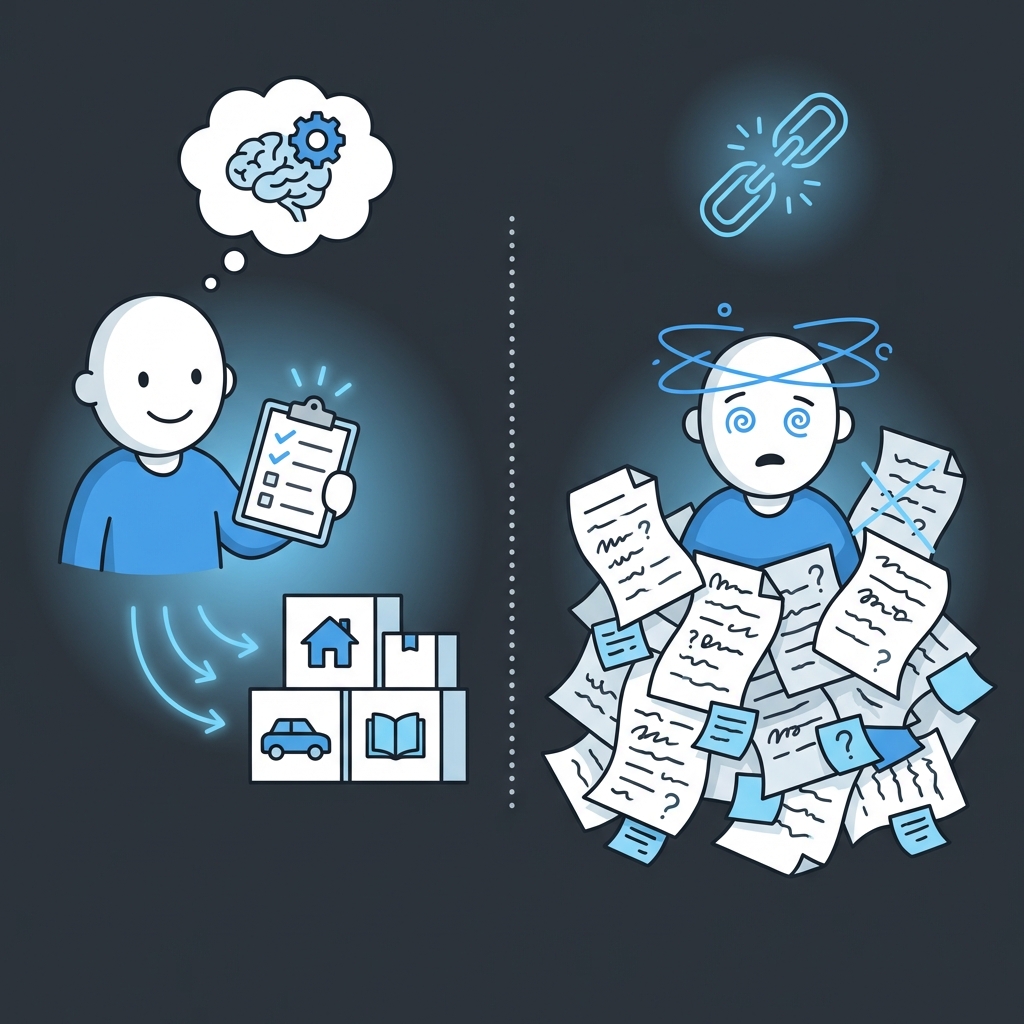
There’s something almost sacred about the moment you write down that first task. The relief is immediate—like setting down a heavy bag you didn’t realize you were carrying. Your brain exhales. The thing that was bouncing around your mental space, demanding attention at random moments, is finally captured somewhere safe.
Lists work beautifully for this initial act of capture. They’re the mental equivalent of clearing your desk: suddenly you can see what you’re dealing with. That swirling anxiety of “what am I forgetting?” gets replaced by the concrete satisfaction of items on a page. For a brief, shining moment, you feel organized.
But then something shifts. The list grows. What started as a helpful container becomes a source of stress itself. You find yourself staring at seventeen items, feeling more overwhelmed than when you started. The very tool that was supposed to help you manage your mental load has become another thing to manage.
The Sweet Spot of Empty Lists
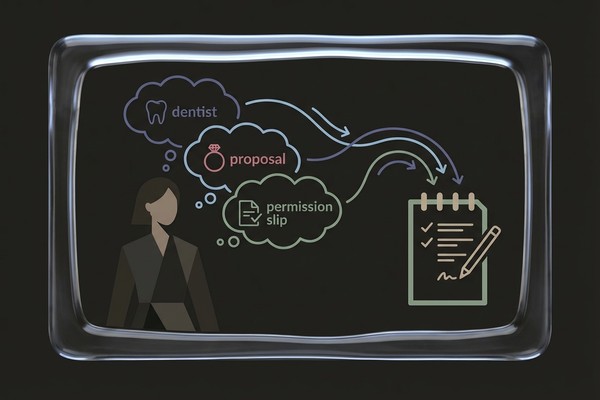
Lists excel at one thing: getting stuff out of your head. They’re brilliant capture devices. When your mind is spinning with “don’t forget to call the dentist” and “need to follow up on that proposal” and “kids need permission slips signed,” writing it all down creates immediate relief.
This isn’t just psychological—it’s cognitive. Your brain can stop using precious working memory to hold onto these tasks. Research shows that our minds are constantly rehearsing unfinished tasks, a phenomenon called the Zeigarnik effect. Writing things down interrupts this mental loop.
The problem is that capture is just the beginning. Lists are fantastic at collecting tasks but terrible at helping you figure out what to do with them. They’re like having a really good filing cabinet but no filing system. Everything goes in, but nothing gets organized in a way that actually helps you act.
Lists are brilliant at capture but awful at coordination.
Most productivity advice stops at “write it down,” as if the mere act of listing solves the problem. But anyone who’s ever stared at a page full of tasks knows that’s where the real work begins. What do you do first? What can wait? What needs other people? What’s actually important versus what just feels urgent?
Where Lists Fall Apart
The trouble starts when your list hits that critical mass—usually somewhere around seven to ten items. Suddenly, looking at your list doesn’t bring relief; it brings dread. You start avoiding it entirely, which defeats the whole purpose.
This happens because lists don’t solve the core problem of mental load: they don’t think for you. They just reflect your thinking back at you, often in a more overwhelming format. A list that says “plan vacation, fix leaky faucet, finish quarterly report, schedule doctor appointment, call mom, organize closet, research preschools” isn’t helpful—it’s paralyzing.
The human brain isn’t designed to process long, undifferentiated lists. We need hierarchy, context, and sequence. We need to know not just what needs doing, but when, how, and in what order. Traditional lists provide none of this structure.
Even worse, most lists mix time horizons randomly. “Buy milk” sits next to “plan retirement savings” as if they’re equivalent tasks. Your brain knows they’re not, which creates a constant low-level stress as you try to mentally sort through the chaos every time you look at the list.
The Triage Trap
When lists get overwhelming, most people try to solve the problem by getting better at triage. They color-code items, add priority numbers, or reorganize constantly. But this creates a new problem: now you’re not just managing tasks, you’re managing the management system.
This is where many productivity systems go wrong. They assume the solution to feeling overwhelmed is better organization. But organization requires ongoing mental energy. Every time you look at your list, you have to re-evaluate priorities, consider contexts, and make decisions about what to do next.
The cognitive load doesn’t disappear—it just shifts from remembering tasks to managing the system that remembers tasks. You trade one form of mental work for another, often more complex form.
Better List Architecture
The most helpful lists I’ve seen don’t try to capture everything in one place. Instead, they create natural boundaries that match how our brains actually work. Think of it as list architecture rather than list management.
Time horizons matter enormously. Your brain processes “today,” “this week,” and “someday” very differently. Mixing them creates confusion. A better approach separates these naturally into distinct spaces where each item lives in its appropriate time frame.
Context matters too. “Call dentist” and “review budget” might both be important, but they require completely different mental modes. One needs two minutes and a phone. The other needs focused time and spreadsheets. Grouping by context rather than priority often makes lists more actionable.
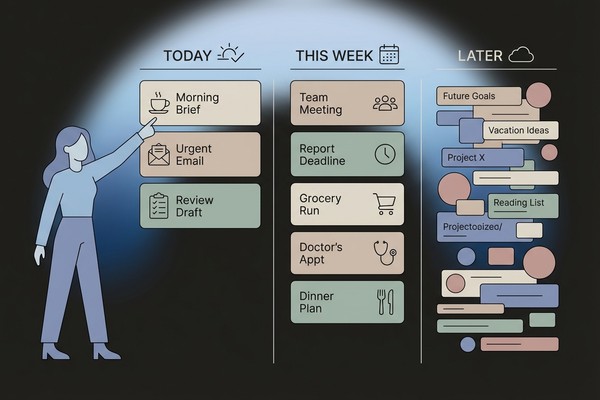
The most effective lists I’ve encountered limit the “active” zone to just a few items—usually three to five things that actually need attention in the immediate future. Everything else gets organized into appropriate holding areas: this week, this month, someday, waiting for others.
This isn’t about being more organized; it’s about being more realistic. Your brain can only hold so much in active consideration. Fighting this limitation creates stress. Working with it creates clarity.
The best lists don’t show you everything—they show you what matters now.
The Missing Layer: Follow-Through
But even well-organized lists have a fundamental limitation: they’re static. They sit there waiting for you to remember to look at them, to decide what to do next, to follow up on things that didn’t get done. The list itself doesn’t take any responsibility for outcomes.
This is where most productivity systems fail. They optimize for capture and organization but ignore the ongoing work of coordination. They assume you’ll remember to check your list, update priorities as things change, and follow up on items that slip through the cracks.
In reality, this coordination work is often harder than the original tasks. It requires constant vigilance, regular review, and ongoing decision-making. It’s mental load in a different form—sometimes more demanding than what you started with.
The systems that actually reduce mental load don’t just organize your tasks; they take responsibility for them. They remind you when things need attention, suggest what to do next based on context and priority, and follow up when deadlines approach. They act more like a capable assistant than a passive filing system.
When Systems Think for You
The difference between a list and a system is ownership. A list shows you what you’ve captured. A system takes responsibility for making sure things actually happen.
This shift changes everything. Instead of constantly wondering “what should I do next?” or “what am I forgetting?” you can trust that the system will surface the right thing at the right time. The mental energy you were spending on coordination gets freed up for actually doing the work.
This isn’t about finding the perfect app or methodology. It’s about recognizing that the real work isn’t capturing tasks—it’s managing the ongoing flow of decisions, reminders, and follow-ups that make sure important things don’t fall through the cracks.
The most effective systems I’ve encountered don’t try to make people better at managing lists. They make lists unnecessary by taking over the work that lists can’t do: thinking about context, tracking deadlines, and nudging you toward action when it matters.
The goal isn’t a better list—it’s not needing to think about the list at all.
Lists help, until they don’t. They’re a useful starting point, but they’re not the destination. The real relief comes when something else takes responsibility for the ongoing work of coordination, leaving you free to focus on what actually matters: the work itself, not the work of managing the work.
This article was created with collaboration between humans and AI—we hope you ❤️ it.