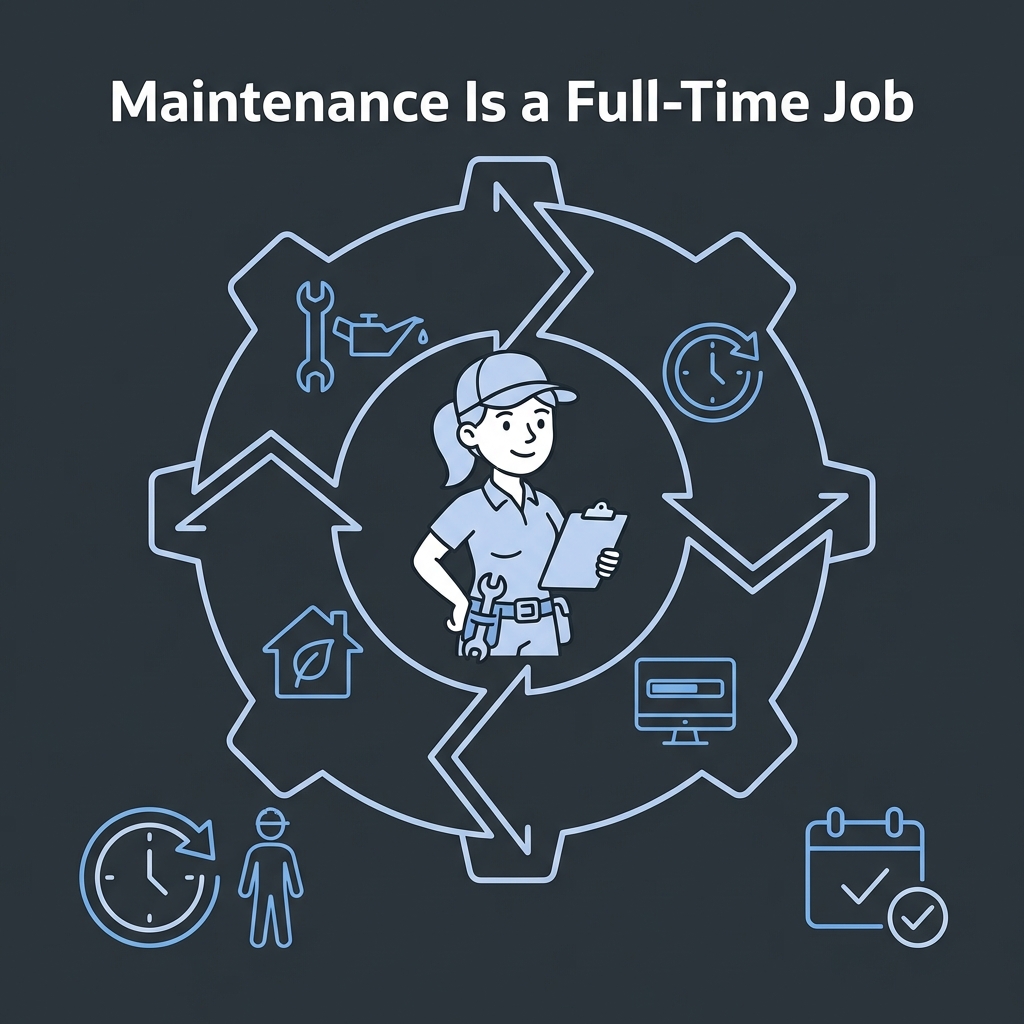
You know that feeling when you finally deep-clean your kitchen, and for exactly 24 hours, everything gleams? The counters shine, the sink sparkles, every dish has a home. Then life happens. Crumbs appear. Coffee rings form. The gleam fades back to “lived-in.” And you realize you’ll be doing this exact same work again next week, and the week after that, forever.
Welcome to maintenance—the Sisyphean boulder of modern life.
We live in a culture obsessed with progress, breakthroughs, and transformation. We celebrate the promotion, the weight loss, the home renovation reveal. But most of life isn’t milestones. Most of life is keeping things from falling apart. And somehow, we’ve convinced ourselves that this constant work of maintenance doesn’t really count.
The Invisible Weight of Keeping Up
Maintenance work hides in plain sight across every domain of our lives. In our homes, it’s the endless cycle of cleaning, organizing, restocking, and repairing. The toilet paper doesn’t replace itself. The baseboards don’t dust themselves. The lightbulbs don’t change themselves when they burn out.
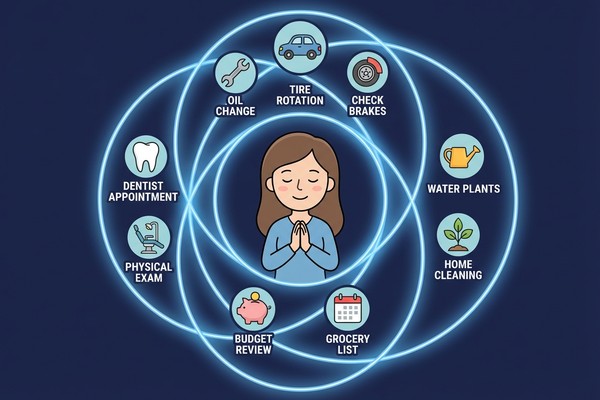
In our health, it’s the daily decisions that prevent bigger problems later. Taking vitamins, scheduling checkups, exercising enough to maintain muscle mass, getting adequate sleep. It’s not glamorous work—there’s no finish line where you get to stop brushing your teeth.
Our relationships require constant tending too. Checking in with friends, remembering birthdays, having the small conversations that prevent big conflicts, showing up consistently over time. The work of staying connected never ends.
Even our finances demand ongoing attention. Paying bills, reconciling accounts, reviewing subscriptions, updating insurance. Miss a few cycles, and suddenly you’re dealing with late fees, overdrafts, or coverage gaps.
The cruel irony is that when maintenance works, it’s invisible. Nobody celebrates the fact that your car didn’t break down because you changed the oil on schedule. No one notices that your friendships stayed strong because you consistently reached out. The proof is in what didn’t happen.
The proof is in what didn’t happen.
This invisibility makes maintenance feel thankless. Progress gets applause; maintenance gets taken for granted. We optimize for the visible wins while the invisible work accumulates in the background.
Why Maintenance Always Loses
Maintenance work operates under different rules than project work. Projects have deadlines, budgets, and clear endpoints. Maintenance has no deadline until it’s too late. The consequences of skipping maintenance are often delayed and diffuse. Skip flossing today? Your teeth won’t fall out tomorrow. Ignore that friendship for a few months? It might survive, or it might quietly fade.
This delayed consequence structure makes maintenance uniquely vulnerable to procrastination. When everything feels urgent, the things without immediate deadlines get pushed aside. We tell ourselves we’ll catch up later, when things calm down. But things rarely calm down.
Meanwhile, maintenance debt compounds. Miss a few weeks of cleaning, and the mess becomes overwhelming. Skip several months of financial reviews, and you lose track of where your money goes. Neglect relationships during busy seasons, and rebuilding connection requires exponentially more effort.
The productivity culture makes this worse by treating maintenance as inefficiency. Why spend time on recurring tasks when you could be achieving something new? Why maintain when you could be optimizing? This mindset treats maintenance as a distraction from “real work” rather than the foundation that makes real work possible.
The Mathematics of Maintenance Debt
Think of maintenance debt like financial debt—it accumulates interest over time. The longer you defer maintenance, the more expensive it becomes to address. A small repair becomes a major replacement. A minor health issue becomes a chronic condition. A small relationship tension becomes a major conflict.
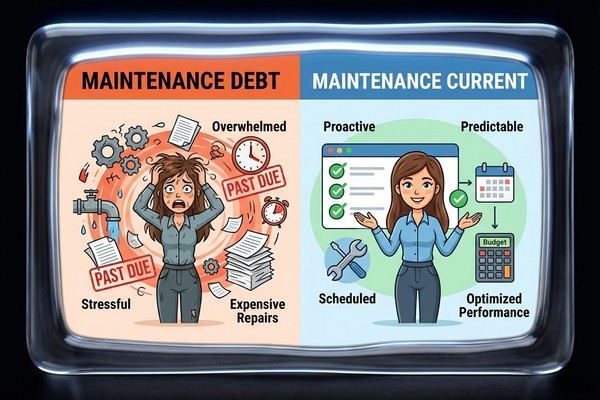
But unlike financial debt, maintenance debt often feels moral. We blame ourselves for “letting things go” or “falling behind.” We treat our inability to keep up with endless maintenance cycles as personal failure rather than capacity math.
Here’s the truth: you cannot maintain everything at the same level all the time. Something always gives. The question isn’t whether you’ll have maintenance debt—it’s which maintenance debt you’ll choose to carry, and how you’ll manage it strategically.
Some maintenance debt is temporary and manageable. Your house gets messier during busy work periods, then you catch up on weekends. Some maintenance debt is dangerous to carry long-term. Skipping medical checkups or ignoring relationship conflicts compounds quickly.
The goal isn’t perfect maintenance—it’s conscious maintenance debt management.
Building Systems That Remember
The most effective maintenance strategies work with human nature, not against it. Instead of relying on willpower and memory, they create systems that make maintenance easier, more automatic, or less frequent.
Defaults reduce decision fatigue. Automatic bill pay eliminates the monthly task of remembering due dates. Subscription services for household essentials mean you never run out of basics. Standing weekly dates with friends remove the work of coordinating schedules repeatedly.
Rhythms create predictable patterns that become habits over time. Sunday meal prep, Friday house reset, monthly financial review. When maintenance becomes routine, it requires less mental energy to initiate.
Strategic reminders catch things before they become urgent. Calendar alerts for oil changes, annual checkups, or relationship check-ins. The key is reminding yourself before the deadline, not after the consequence.
Thoughtful handoffs delegate maintenance to people or systems better positioned to handle it. Hiring a house cleaner isn’t lazy—it’s recognizing that your time might be better spent elsewhere. Using a financial advisor isn’t admitting defeat—it’s acknowledging that expertise matters.
The goal isn’t perfect maintenance—it’s conscious maintenance debt management.
The most powerful approach combines multiple strategies. Automatic systems handle routine tasks, rhythms create sustainable patterns, reminders catch exceptions, and handoffs address your least favorite or most complex maintenance work.
What Maintenance Debt Are You Carrying?
Take a moment to inventory your current maintenance debt. Where are you behind? What’s been nagging at you? What small problems are growing into bigger ones?
Maybe it’s the pile of unopened mail that’s become a mountain. The friend you keep meaning to call. The doctor’s appointment you’ve been postponing. The financial review that’s six months overdue.
Notice how you feel about each item. Is there shame? Guilt? Overwhelm? These emotions are signals that you’re treating maintenance debt as moral failure rather than capacity reality.
Now consider: which debt is costing you the most energy to carry? What would happen if you addressed one piece this week? Not everything—just one thing.
The goal isn’t to eliminate all maintenance debt immediately. It’s to stop carrying it silently and start managing it consciously. Some debt you’ll address quickly. Some you’ll systematize to prevent recurrence. Some you’ll decide to carry temporarily while you focus elsewhere.
The Dream of a System That Remembers
Imagine having a system that understood your maintenance cycles—one that remembered when your car registration expires, when your friendships need tending, when your health checkups are due. Not just a calendar reminder, but something that understood the full context of your maintenance landscape and helped you manage it strategically.
This isn’t about optimizing your productivity or doing more things faster. It’s about reducing the mental load of remembering everything that needs maintaining. It’s about having support for the invisible work that keeps your life functioning.
Because maintenance isn’t a personal failing—it’s a full-time job that we’ve somehow convinced ourselves should happen automatically in the background. It’s time to make this work visible, give it the respect it deserves, and build systems that actually help us manage it.
The dishes will always need washing. The bills will always need paying. The relationships will always need tending. But maybe, with the right support, the weight of remembering it all doesn’t have to rest entirely on your shoulders.
This article was created with collaboration between humans and AI—we hope you ❤️ it.