You missed three days of your morning routine. The meditation app sits unopened, the journal remains blank, and that carefully planned workout schedule feels like a relic from another person’s life. If you’re anything like most people, you’re probably telling yourself you’ve failed again—that you lack discipline, that you’re not cut out for change, that you should just give up trying.
But here’s what nobody talks about in the endless stream of habit-formation advice: starting over is actual work. It’s not a character flaw or a sign of weakness. It’s a predictable, energy-intensive process that deserves recognition and planning, not shame.
The Hidden Labor of Restarting
When we “fall off” something—whether it’s a routine, a project, or a commitment—we don’t just lose momentum. We lose context. We lose the mental scaffolding that made the thing feel natural and automatic. Restarting isn’t just about doing the activity again; it’s about rebuilding the entire cognitive framework that supported it.
Think about returning to a workout routine after a two-week break. You’re not just dealing with physical deconditioning. You’re dealing with decision fatigue about which exercises to do, uncertainty about your current capabilities, and the mental work of re-establishing when, where, and how you’ll fit this back into your life. You have to remember where you put your workout clothes, figure out if your old schedule still makes sense, and navigate the internal resistance that’s built up during your absence.
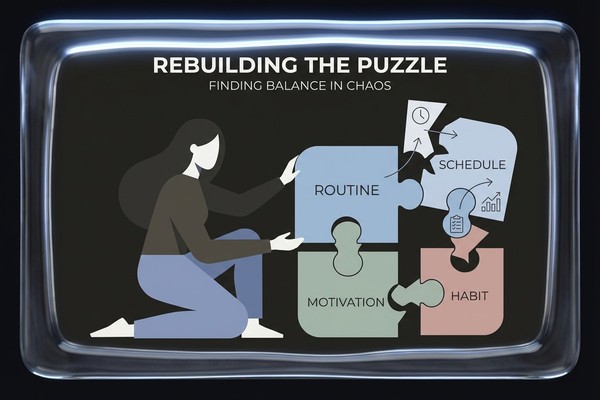
This context rebuilding is invisible work, but it’s real work. It requires cognitive resources, emotional energy, and time. The productivity industrial complex pretends this work doesn’t exist, selling us the fantasy that we should be able to snap back into any routine effortlessly. This is not only unrealistic—it’s cruel.
Every lapse involves grief, too. You have to mourn the version of yourself who was “doing better,” release the identity you’d started to build, and face the gap between your intentions and your reality. This emotional labor gets dismissed as “making excuses,” but it’s actually a necessary part of the restart process.
Why All-or-Nothing Makes Everything Worse
The most toxic advice in productivity culture is the idea that you should “get back on track” by returning to exactly what you were doing before—same intensity, same scope, same expectations. This all-or-nothing approach treats lapses like moral failures that need to be corrected through increased effort and discipline.
But lapses aren’t moral failures. They’re information. They tell us something about our capacity, our circumstances, or our approach that we need to understand and integrate, not override.
When you try to restart at full intensity after a break, you’re setting yourself up for another crash. You’re ignoring the conditions that led to the lapse in the first place and demanding that your current self perform at the level of your peak self. This creates a cycle of unsustainable effort followed by inevitable burnout, followed by shame, followed by another unsustainable restart attempt.
The goal isn’t to never slip—it’s to get better at restarting.
Instead of treating lapses as problems to be solved through willpower, we need to treat them as a predictable part of any change process. Life happens. Energy fluctuates. Priorities shift. Systems that can’t accommodate this basic reality aren’t robust—they’re brittle.
A Compassionate Restart Protocol
So what does a humane restart actually look like? It starts with accepting that you’re not picking up where you left off—you’re starting from where you are now, with your current capacity and circumstances.
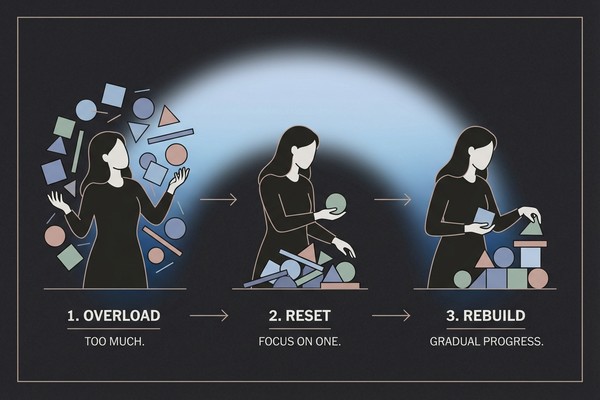
First, shrink the scope. If you were meditating for twenty minutes, start with five. If you were working out five days a week, commit to two. If you were writing a thousand words a day, aim for a paragraph. This isn’t about lowering your standards permanently—it’s about creating a sustainable entry point that doesn’t require heroic effort.
The resistance to this approach is predictable: “But five minutes won’t make a difference!” This misses the point entirely. Five minutes isn’t about the outcome—it’s about rebuilding the neural pathway, re-establishing the cue-response pattern, and proving to yourself that you can show up. The “difference” it makes is in your relationship with the practice, not in the immediate results.
Next, restore your defaults. Look at what made the routine work before and see what you can quickly reinstate. Put your workout clothes where you’ll see them. Set up your meditation space again. Clear the mental and physical clutter that’s accumulated during your break. Don’t overthink this—just remove the obvious friction points.
Then focus on rebuilding cues, not outcomes. The goal is to re-establish the trigger that starts the behavior, even if you do a minimal version of the behavior itself. Show up at the gym even if you only do ten minutes. Open your journal even if you only write one sentence. Sit in your meditation spot even if you only take three deep breaths.
Designing for Interruption
The most sustainable systems aren’t the ones that work perfectly when everything goes right—they’re the ones that gracefully handle when everything goes wrong. Instead of designing routines that require perfect conditions, we need to design for the messy reality of human life.
This means building in explicit restart protocols from the beginning. Before you even start a new routine, decide what the minimum viable version looks like. What’s the smallest possible action that would still count as engagement with your goal? How will you handle a one-day miss versus a one-week miss versus a one-month miss?
It also means accepting that some seasons of life are for maintenance, not growth. During busy periods, illness, family crises, or major transitions, the goal isn’t to maintain peak performance—it’s to maintain connection. Sometimes “success” looks like remembering that the routine exists and planning to return to it when you have capacity.
The systems that serve us best are the ones that keep our place while we live our lives. They don’t punish us for being human, and they don’t require us to be superhuman to engage with them.
What Would Good Enough Look Like?
Here’s a question that cuts through the perfectionist paralysis that keeps us stuck in restart limbo: What would “good enough” look like this week?
Not perfect. Not optimal. Not impressive to anyone else. Just good enough to maintain forward motion without overwhelming your current capacity.
Maybe good enough is one workout instead of five. Maybe it’s ten minutes of reading instead of an hour. Maybe it’s meal planning for three days instead of seven. Maybe it’s checking in with one friend instead of overhauling your entire social life.
Good enough is not giving up—it’s giving yourself permission to be human while still moving forward.
This isn’t about lowering your standards or abandoning your goals. It’s about right-sizing your expectations to match your current reality. It’s about choosing sustainable progress over dramatic gestures that lead to burnout.
The beautiful thing about “good enough” is that it often turns into more than enough once you build momentum. But even if it doesn’t—even if good enough stays good enough for a while—that’s still infinitely better than the nothing that comes from waiting for perfect conditions to restart.
Systems That Remember for You
The ultimate restart-friendly system is one that doesn’t require you to remember everything, rebuild everything, or re-decide everything when you return. It’s a system that holds your place while you deal with whatever life threw at you.
This might look like having your workout playlist ready to go, your meditation app bookmarked to the right program, or your journal sitting open to a fresh page with a pen beside it. It might mean having a simple checklist that walks you through your restart protocol, or a friend who checks in without judgment when you’ve been quiet for a while.
The goal is to minimize the cognitive load of restarting so that you can direct your energy toward the actual practice instead of the meta-work of figuring out how to practice.
Starting over is work—real, legitimate, energy-intensive work. But it’s also a skill that gets easier with practice. The more compassionately you handle your restarts, the less dramatic they become. The more you normalize lapses as part of the process, the less time you spend in shame spirals and the more time you spend actually engaging with what matters to you.
You haven’t failed. You’ve just paused. And now you get to choose how to begin again.
This article was created with collaboration between humans and AI—we hope you ❤️ it.