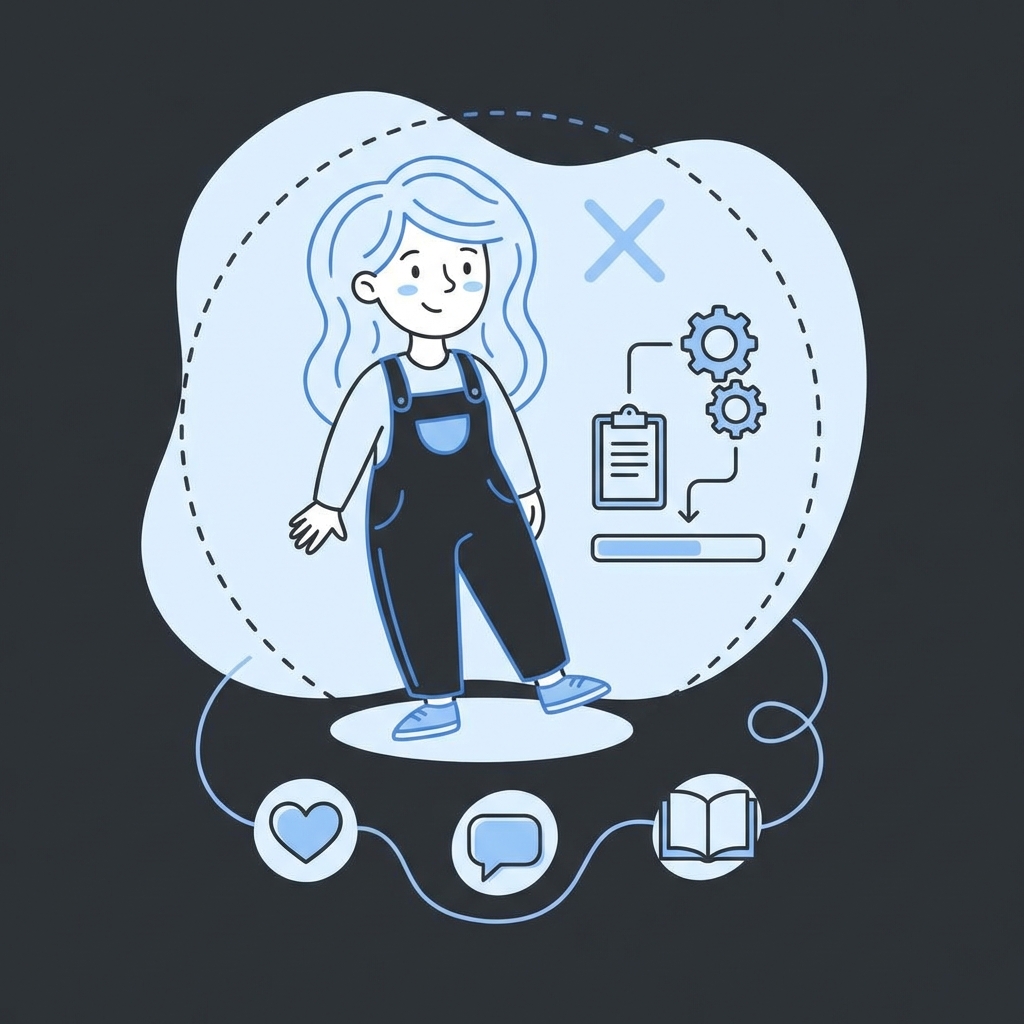
There’s something deeply unsettling about watching someone treat their Tuesday morning like a failed product launch. I see it everywhere—people debugging their daily routines, optimizing their morning workflows, and running post-mortems on why they didn’t hit their weekly metrics. We’ve imported the language of software development into our lives so thoroughly that we’ve forgotten something fundamental: humans aren’t code.
The project management mindset has colonized our personal lives with remarkable efficiency. We sprint through our days, track our habits like KPIs, and treat setbacks like bugs to be patched. But here’s what nobody talks about—this approach works beautifully for shipping software and absolutely terribly for living as a human being.
I’m not anti-organization. Structure matters. Planning helps. But somewhere along the way, we confused having a system with being a system. And that confusion is quietly breaking us.
When Projects Work (And When They Don’t)
Project thinking excels at creating clarity. It takes the overwhelming vastness of “get healthier” and transforms it into “walk 10,000 steps daily for 30 days.” It gives us milestones, deadlines, and the satisfying click of completion. For finite goals with clear parameters, this approach is genuinely helpful.
But life isn’t a series of discrete projects with predictable timelines and stable requirements. Life is an ongoing, adaptive process filled with variables that no project manager would ever accept in their scope document.
Consider what happens when you treat your morning routine like a software deployment. You’ve optimized it perfectly: wake at 6 AM, meditate for 10 minutes, exercise for 30, shower, coffee, emails. It works flawlessly for three weeks. Then your kid gets sick, or you catch something yourself, or your partner needs support through a difficult time, or you simply wake up one day feeling emotionally depleted.
In project terms, this is a failure. You’ve missed your deliverables. The system is broken and needs debugging. But in human terms, this is Tuesday. This is what adaptation looks like when you’re not a machine.
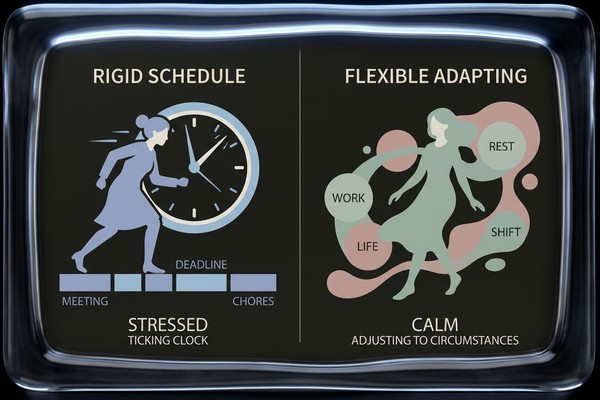
The project mindset treats variance as a problem to be solved rather than a feature to be designed around. It assumes consistent capacity, stable priorities, and predictable energy levels. These assumptions work great for software. They’re disasters for humans.
The Reality of Human Variance
Real humans operate with radical inconsistency that would make any project manager weep. We have good days and terrible days, often for reasons we can’t fully explain. We get sick. We have family emergencies. We experience seasonal depression, hormonal fluctuations, and the simple reality that some weeks we’re firing on all cylinders while others we’re barely keeping our heads above water.
Parents know this intimately. You can have the most beautiful system in the world, but when your toddler decides 3 AM is party time for a week straight, your carefully optimized routines become irrelevant. The system that worked perfectly before kids doesn’t just need tweaking—it needs to be rebuilt from the ground up around the reality of unpredictable demands.
But it’s not just parents. Anyone who’s dealt with chronic illness, depression, aging parents, job transitions, or simply the natural ebb and flow of human energy knows that rigid systems don’t bend—they break. And when they break, they often take our sense of competence and self-worth with them.
The system that punishes you for being human isn’t a system worth keeping.
I’ve watched people abandon perfectly good habits because their rigid implementation couldn’t survive a single disrupted week. They had no framework for “getting back on track” because the track itself was designed for a robot, not a human. When the inevitable variance hit, they interpreted it as personal failure rather than systemic inadequacy.
Why Rigid Systems Fail Real Life
Rigid systems fail humans because they’re built on false assumptions about how we actually function. They assume we’re consistent processors with predictable uptime, when we’re actually adaptive organisms with complex, interconnected needs.
The productivity industrial complex loves to sell us systems that promise to eliminate variance. “Follow this morning routine and you’ll never have a bad day.” “Use this habit tracker and you’ll never miss a workout.” “Implement this time-blocking method and you’ll never feel overwhelmed.” These promises are seductive precisely because they offer certainty in an uncertain world.
But they’re also lies. Not because the creators are dishonest, but because they’re solving for the wrong problem. They’re trying to make humans more machine-like instead of making systems more human-friendly.
When your system breaks down because you got the flu, that’s not a personal failing—it’s a design flaw. When your productivity plummets because you’re worried about a family member, that’s not a bug in your character—it’s a feature of being human. When you can’t maintain your usual energy levels during a major life transition, that’s not weakness—it’s adaptation.
Designing for Humans, Not Machines
What would a truly human-centered system look like? It would be built around three core principles: resilience, slack, and gentle feedback loops.
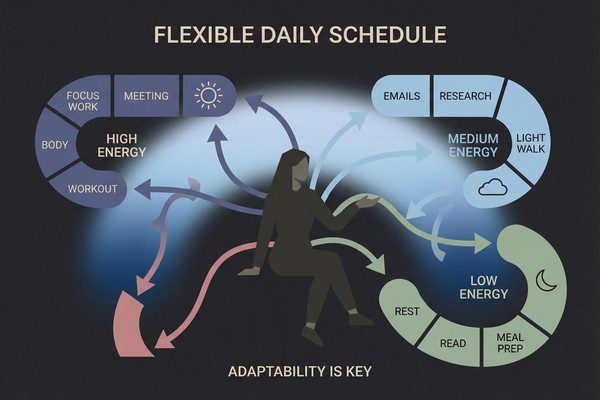
Resilience means the system can absorb shocks without breaking completely. Instead of a morning routine that requires perfect execution, you might have a menu of options scaled to your current capacity. On high-energy days, you do the full routine. On medium days, you pick the three most important elements. On survival days, you do one small thing that keeps you connected to your intentions.
This isn’t lowering standards—it’s designing for reality. A resilient system recognizes that your capacity varies and builds that variance into its architecture rather than treating it as an exception.
Slack is the buffer space that makes resilience possible. It’s the recognition that humans need margins, not just for emergencies but for the simple reality that we’re not machines running at constant capacity. Slack means not scheduling every minute, not optimizing every process, and leaving room for the unexpected—both the delightful and the difficult.
Most productivity systems are allergic to slack because it feels inefficient. But slack is what allows systems to bend without breaking. It’s what makes the difference between a system that serves you and one that enslaves you.
Gentle feedback loops replace the harsh binary of success/failure with nuanced information about what’s working and what needs adjustment. Instead of tracking whether you “succeeded” or “failed” at your habits, you might notice patterns: “I tend to skip workouts when I’m stressed about work” or “I sleep better when I read instead of scrolling before bed.”
This kind of feedback helps you understand your patterns without judging them. It treats your behavior as data to be understood rather than performance to be evaluated.
Design for recovery, not perfection.
Where Is Your System Too Rigid?
Take a moment to examine your current systems—your routines, your goals, your expectations of yourself. Where do you feel like you’re constantly failing to live up to your own standards? Where does a single disruption derail you completely? Where do you find yourself starting over again and again because the system couldn’t accommodate your humanity?
These friction points aren’t character flaws—they’re design opportunities. They’re places where your system is optimized for a theoretical perfect human rather than the actual human you are.
Maybe your exercise routine assumes you’ll always have an hour of free time and consistent energy levels. Maybe your meal planning doesn’t account for the weeks when executive function is low. Maybe your work schedule doesn’t include buffer time for the inevitable interruptions that come with having a life.
The goal isn’t to eliminate all structure—it’s to create structure that serves you rather than enslaving you. It’s to build systems that work with your grain instead of against it.
Reframing: Systems That Adapt to You
What if, instead of trying to make yourself more consistent, you made your systems more adaptive? What if you designed for the human you actually are rather than the human you think you should be?
This might mean having multiple versions of your routines for different life seasons. It might mean building in automatic recovery protocols for when things go sideways. It might mean measuring success differently—not by perfect adherence to a plan, but by your ability to stay connected to what matters even when everything else is chaos.
The most sustainable systems I’ve seen aren’t the most optimized—they’re the most forgiving. They assume good intentions and temporary setbacks rather than moral failures. They’re designed by people who understand that being human means being beautifully, frustratingly, necessarily inconsistent.
Your life isn’t a project with a clear deadline and stable requirements. It’s an ongoing process of adaptation, growth, and response to an ever-changing world. The systems that serve you best will be the ones that honor that reality rather than fighting against it.
Stop treating yourself like a project that needs to be managed and start treating yourself like a human who deserves systems designed for the messy, wonderful, unpredictable reality of being alive.
This article was created with collaboration between humans and AI—we hope you ❤️ it.