You know that feeling when you walk into a room and completely forget why you went there? Or when you stare at your to-do list, knowing everything on it is important, but somehow can’t figure out where to start? Maybe you’ve caught yourself putting off “simple” tasks for days, then beating yourself up for being lazy or disorganized.
Here’s what’s really happening: your brain isn’t broken, and you’re not failing at life. Stress is literally shrinking your working memory, and understanding this changes everything about how you should respond to overwhelm.
Your Brain’s Juggling Act
Working memory is like having a mental workspace where you hold and manipulate information in real-time. It’s where you keep track of what you’re doing, what comes next, and how everything connects. When you’re cooking dinner while helping with homework and mentally planning tomorrow’s meetings, working memory is what lets you juggle all those moving pieces without dropping them.
But here’s the thing about working memory—it’s incredibly limited. Most people can hold about four chunks of information at once, maybe seven on a good day. Think of it as having only a few hands to juggle with. Under normal circumstances, that’s usually enough.
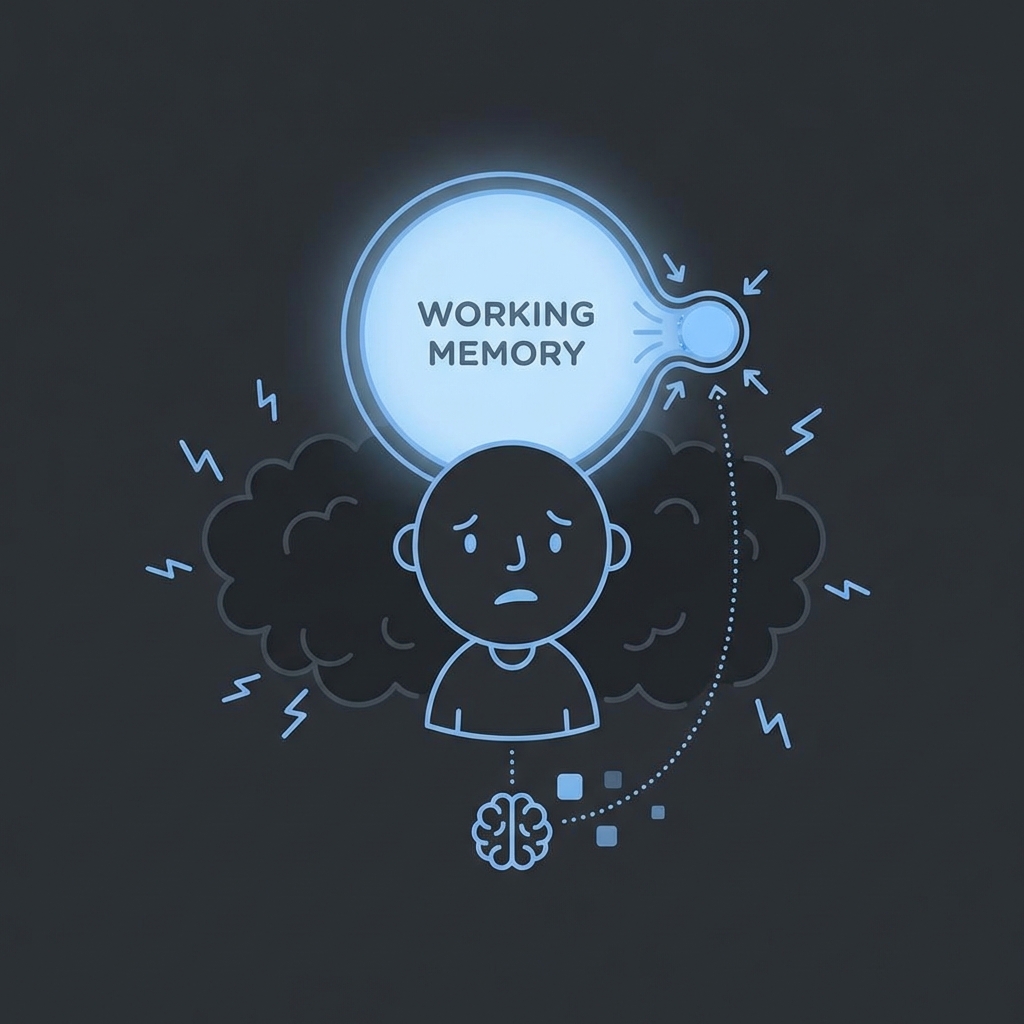
The problem starts when stress enters the picture. Stress doesn’t just make you feel overwhelmed—it actually hijacks some of your cognitive resources. Parts of your working memory get consumed by worry, threat detection, and emotional regulation. Suddenly, you’re trying to juggle the same number of balls with fewer hands.
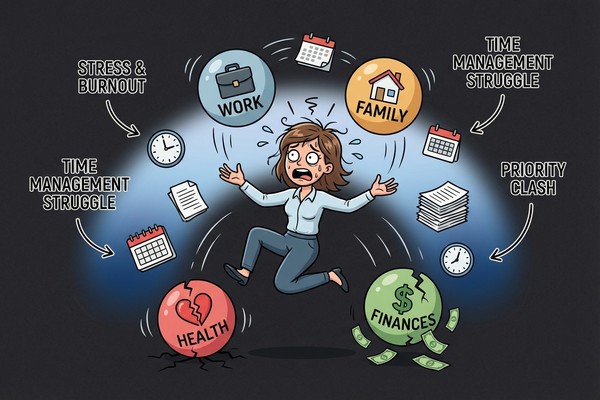
This isn’t a character flaw or a sign that you need better time management skills. It’s basic neuroscience. When your nervous system is activated, your brain prioritizes survival over efficiency. The part of your brain responsible for executive function—planning, organizing, decision-making—gets less bandwidth because your system is busy scanning for threats and managing emotional responses.
When Simple Becomes Impossible
Ever notice how tasks that should take five minutes can feel insurmountable when you’re stressed? There’s a reason for this, and it’s not because you’ve suddenly become incompetent.
Consider something as straightforward as scheduling a doctor’s appointment. Under normal circumstances, your working memory handles this easily: remember you need the appointment, find the number, consider your calendar, make the call, note the time. Four or five mental operations, well within your cognitive capacity.
But when you’re stressed, each step becomes harder. You have to hold the intention to call while also managing anxiety about what the appointment might reveal. You need to access your calendar while your brain is simultaneously processing work deadlines and family logistics. The phone number you looked up three seconds ago vanishes from your mind because there’s no room to store it alongside everything else competing for space.
The tasks didn’t get harder—your available mental resources got smaller.
This is why high-stress periods often look like procrastination from the outside. You’re not avoiding the task because you’re lazy. You’re avoiding it because your brain genuinely doesn’t have the bandwidth to execute it smoothly, and some part of you knows this. The procrastination is actually protective—your system trying to prevent you from failing at something that feels too complex for your current capacity.
The Shame Spiral
Here’s where things get particularly cruel. When stress shrinks your working memory and simple tasks become difficult, the natural response is often self-criticism. You start wondering what’s wrong with you. Why can’t you just make the appointment, send the email, or tackle that project that’s been sitting on your desk?
This self-judgment creates additional stress, which further reduces your cognitive capacity, which makes tasks even harder, which generates more self-criticism. It’s a vicious cycle that can leave you feeling stuck and ashamed.
The productivity culture doesn’t help. It tells us that organization and efficiency are moral virtues, that struggling with “basic” tasks reveals some fundamental character flaw. But this completely ignores how cognition actually works. Your brain’s capacity fluctuates based on stress, sleep, emotional state, and dozens of other factors. Expecting consistent performance regardless of these variables isn’t realistic—it’s cruel.
Understanding the neuroscience changes how you interpret your own behavior. That week when you couldn’t get anything done wasn’t because you’re fundamentally disorganized. It was because your working memory was compromised, and your brain was doing exactly what it’s designed to do under stress—prioritize immediate survival over long-term planning.
Creating Space to Think
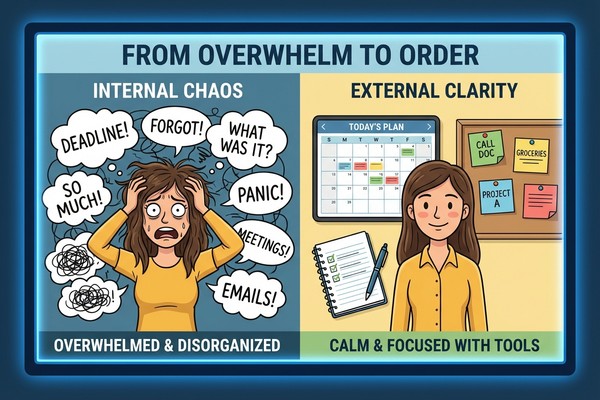
The solution isn’t to push harder or develop better willpower. It’s to reduce the cognitive load on your already-strained working memory. This means making your environment do more of the work so your brain can do less.
Start with decisions. Every choice you make, no matter how small, uses up working memory. When you’re already operating at capacity, even deciding what to wear or what to eat for lunch can feel overwhelming. This is why successful people often wear the same thing every day or eat the same breakfast—they’re not being boring, they’re being strategic about preserving cognitive resources for what matters most.
Look for places where you can eliminate or automate decisions. Set out clothes the night before. Batch similar tasks together so you’re not constantly switching contexts. Create templates for recurring communications so you’re not starting from scratch every time.
Externalize what you can. Your brain shouldn’t be your primary storage system for important information. Write things down, set reminders, create systems that remember for you. This isn’t admitting defeat—it’s being smart about how memory actually works. Even people with excellent memories perform better when they don’t have to rely on them for everything.
The Relief of Simplification
Sometimes the most radical thing you can do is temporarily lower your standards. This isn’t giving up—it’s recognizing that your current capacity might not match your usual expectations, and that’s okay.
What would it look like to simplify for the next 48 hours? Maybe dinner comes from the freezer instead of being homemade. Maybe you respond to emails with one sentence instead of perfectly crafted paragraphs. Maybe you ask for help with something you usually handle alone.
Simplification isn’t failure—it’s intelligent resource management.
The goal isn’t to stay in simplified mode forever. It’s to give your nervous system space to regulate so your working memory can return to normal capacity. Think of it like resting a sprained ankle—you’re not planning to limp forever, but you recognize that pushing through the injury will only make it worse.
This approach requires letting go of the idea that consistency equals competence. Your capacity will fluctuate, and your systems need to account for this reality rather than pretend it doesn’t exist. The most sustainable approach is one that works even when you’re not at your best.
When Systems Step In
The most helpful tools and systems are the ones that don’t require you to be operating at full capacity to use them effectively. They should work especially well when your working memory is compromised, not just when you’re feeling sharp and organized.
This is where many productivity systems fail. They assume you’ll always have the bandwidth to maintain them, update them, and make decisions about them. But the times when you most need support are exactly when you have the least capacity to manage complex systems.
The best support steps in automatically when it senses you’re struggling, rather than waiting for you to remember to ask for help. It reduces the number of decisions you need to make rather than giving you more options to consider. It takes ownership of outcomes rather than just organizing your tasks more efficiently.
Your brain is doing exactly what it’s supposed to do under stress. The solution isn’t to override your neurobiology—it’s to work with it by reducing cognitive load and creating space for your working memory to function. When you stop fighting your brain’s natural responses and start supporting them instead, everything becomes a little bit easier.
What’s one thing you could simplify in the next 48 hours to give your working memory some breathing room?
This article was created with collaboration between humans and AI—we hope you ❤️ it.