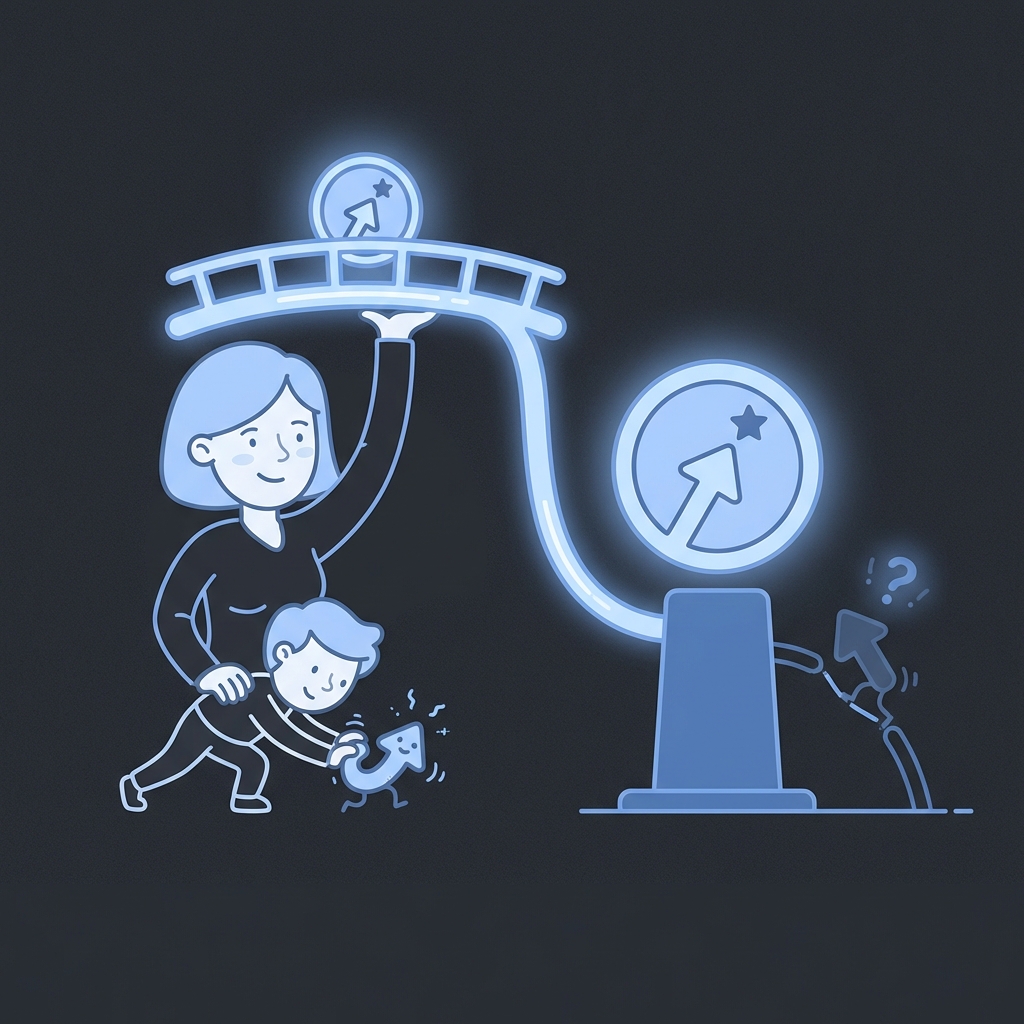
We’ve all been sold the same story: if you want something badly enough, you’ll find a way. Motivation is the magic ingredient that separates the successful from the stuck. But here’s what nobody talks about—motivation is actually terrible at predicting who succeeds and who burns out six weeks later.
I’ve watched incredibly motivated people flame out spectacularly, while others who seemed less driven somehow kept showing up, day after day, making steady progress. The difference wasn’t their internal fire or their morning affirmations. It was what surrounded them when the fire inevitably dimmed.
The truth is uncomfortable because it challenges our deeply held belief in individual willpower. But once you see it, you can’t unsee it: the people who sustain change over time aren’t the ones with the strongest motivation. They’re the ones with the strongest support systems.
Why Motivation Makes a Terrible Foundation
Motivation is volatile by design. It spikes when we’re inspired, crashes when we’re overwhelmed, and disappears entirely when we’re tired or stressed. Building a life change on motivation alone is like building a house on quicksand—it might hold up during perfect weather, but the first storm will reveal how unstable the foundation really is.
Think about the last time you felt supremely motivated to change something. Maybe it was after reading an inspiring book, attending a workshop, or having one of those clarity moments in the shower. That feeling was real and powerful. But motivation operates on emotional peaks, and emotional peaks don’t last. They can’t last—our brains literally aren’t wired to sustain that level of intensity.
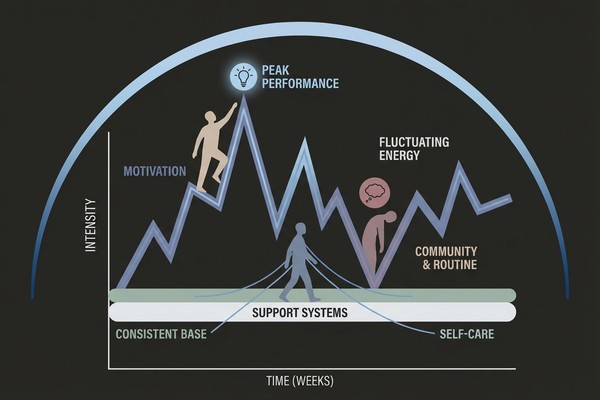
The productivity industry has convinced us that the solution to motivation’s volatility is better motivation—stronger why’s, clearer goals, more compelling visions. But this is like trying to fix a leaky boat by rowing harder. You’re addressing the symptom, not the structural problem.
What actually predicts long-term success isn’t the height of your motivational peaks. It’s what catches you when you inevitably fall into the valleys.
Real Support Goes Beyond Cheerleading
When most people think of support, they picture encouragement and accountability—someone cheering you on or checking if you did the thing you said you’d do. But the support that actually changes outcomes is much more practical and much less visible.
Real support is infrastructure. It’s your partner automatically handling dinner on the nights you have late meetings. It’s a friend who texts you the name of that therapist she mentioned, with the phone number already included. It’s a colleague who knows your project timeline and proactively flags potential conflicts before they become crises.
Support isn’t just emotional—it’s operational. It reduces the number of decisions you have to make and the things you have to remember.
This kind of support works because it addresses the real barriers to sustained action. Most of us don’t fail because we lack willpower. We fail because we run out of cognitive bandwidth to manage all the micro-decisions and micro-remembrances that change requires.
Consider what happens when you’re trying to exercise regularly. The motivational approach focuses on your commitment level and your reasons for wanting to be fit. The support approach focuses on removing friction: workout clothes laid out the night before, a gym buddy who picks you up, a spouse who handles morning kid duty on your workout days.
The difference is profound. One approach asks you to be stronger. The other makes being strong easier.
Infrastructure Support in Action
The most effective support systems work invisibly, reducing mental load rather than adding to it. They anticipate needs instead of responding to requests. They create conditions where the right choice becomes the easiest choice.
Take meal planning, something that derails many families every single week. The motivational approach would focus on your commitment to healthy eating and your reasons for wanting to cook at home. The support approach might look like a neighbor who coordinates grocery pickup for several families, reducing everyone’s trips. Or a partner who automatically adds ingredients to the shopping list when they notice you’re running low. Or a group text where parents share what they’re making for dinner, creating gentle accountability without formal check-ins.
Notice how none of these examples require sustained motivation from the person trying to change. The support does the work of remembering, anticipating, and reducing decisions. The person just has to show up and participate in a system that’s already running.
This is why some people seem to effortlessly maintain habits that others struggle with. It’s rarely about their superior discipline. It’s about the invisible infrastructure that makes those habits feel natural rather than forced.
The Compounding Effect of Reduced Friction
Here’s where support systems become truly powerful: they compound over time. Each piece of friction you remove creates mental space for the next improvement. Each decision you don’t have to make preserves cognitive energy for the decisions that actually matter.
When you’re not spending mental energy remembering to schedule that appointment, you have more bandwidth to be present during the appointment. When you’re not negotiating with yourself about whether to work out, you can focus on enjoying the workout. When you’re not constantly managing the logistics of daily life, you can actually engage with the substance of what you’re trying to accomplish.
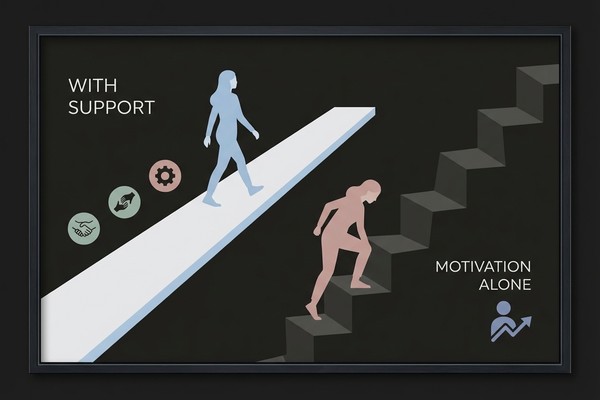
This creates an upward spiral that looks like exceptional self-discipline from the outside but feels surprisingly sustainable from the inside. The person isn’t working harder—they’re working within a system that makes the work feel easier.
I’ve seen this play out repeatedly with parents who finally get consistent help with childcare. Suddenly they’re not just able to exercise or work on projects—they’re able to think clearly about what they actually want to do with that time. The support doesn’t just create space; it creates the mental clarity to use that space well.
What Kind of Support Are You Missing?
Most of us have some support, but it’s often incomplete or inconsistent. We might have emotional encouragement but lack practical help. Or we might have people willing to help but no systems for coordinating that help effectively.
The most revealing question isn’t whether you have support, but what kind of support would make the biggest difference in your daily experience. Is it someone who remembers things so you don’t have to? Someone who handles logistics while you focus on execution? Someone who provides expertise so you don’t have to research everything from scratch?
Sometimes the missing piece is as simple as shared context. Your partner might be willing to help with household management, but if they don’t know what needs to be managed, you end up doing the invisible work of delegating—which isn’t really delegation at all.
Other times, the gap is in timing. People offer to help when you’re doing well, but the support you actually need is when things are falling apart. The friend who checks in during your busy season, not just when you have time to chat. The colleague who notices when you’re overwhelmed and offers specific help, not generic availability.
The best support anticipates needs instead of responding to requests.
Think about the last time you struggled to maintain a change you cared about. Was it really a motivation problem, or was it a support problem disguised as a motivation problem?
How to Ask for Support Without Apologizing
One of the biggest barriers to getting support is our discomfort with asking for it. We’ve internalized the message that needing help is a personal failing, so we either don’t ask at all or we ask in ways that make it easy for people to say no.
But asking for support isn’t an admission of weakness—it’s a recognition of how sustainable change actually works. When you frame requests around shared outcomes rather than personal deficits, people respond differently.
Instead of “I’m terrible at remembering to follow up, can you remind me?” try “I want to make sure this project moves forward smoothly. Would you be willing to check in with me about next steps on Friday?”
Instead of “I’m so disorganized, I need help managing my calendar,” try “I’m trying to protect my deep work time. Could you help me think through how to structure my week?”
The difference isn’t just semantic. It’s positioning support as part of a system designed for success, rather than a band-aid for personal inadequacy. People are much more willing to participate in systems than to compensate for someone else’s perceived shortcomings.
Sometimes the most effective way to ask for support is to offer it first. Create the kind of infrastructure you wish existed, and invite others to participate. Start the group text about dinner plans. Organize the neighborhood grocery run. Build the system that makes everyone’s life a little easier, including your own.
Building Support Into Systems
The most sustainable support doesn’t depend on individual relationships or personal favors. It’s built into the structure of how things work. It’s automatic, predictable, and doesn’t require ongoing negotiation.
This might mean joining or creating groups where mutual support is the explicit purpose. Parent cooperatives where families rotate responsibilities. Professional networks where members share resources and connections. Online communities where people track progress together without the pressure of formal accountability.
It might mean designing your environment so that support is embedded in your daily routines. Meal delivery services that remove the decision fatigue around dinner. Shared calendars that give your family context about your schedule without requiring constant communication. Apps that handle recurring tasks so you don’t have to remember them.
The goal isn’t to eliminate all effort from your life. It’s to ensure that your effort goes toward the things that actually matter to you, rather than the overhead of managing the things that matter to you.
When support becomes infrastructure, change becomes inevitable rather than effortful.
The people who seem to effortlessly maintain positive changes aren’t relying on superior motivation. They’ve built or found systems where the right choices are supported by default. They’ve stopped trying to be stronger and started focusing on making strength unnecessary.
This doesn’t mean you become passive or dependent. It means you become strategic about where you spend your finite cognitive resources. Instead of using all your mental energy to remember and manage, you use it to engage and create.
The shift from motivation-dependent change to support-dependent change is profound. One approach asks you to be different. The other approach makes being different feel natural. One burns through your willpower. The other preserves it for the moments when you actually need it.
When you stop going alone, you don’t just increase your chances of success. You change the entire experience of growth from an exhausting solo performance to a sustainable collaborative effort. And that difference—between struggling alone and building together—is often the difference between temporary change and lasting transformation.
This article was created with collaboration between humans and AI—we hope you ❤️ it.