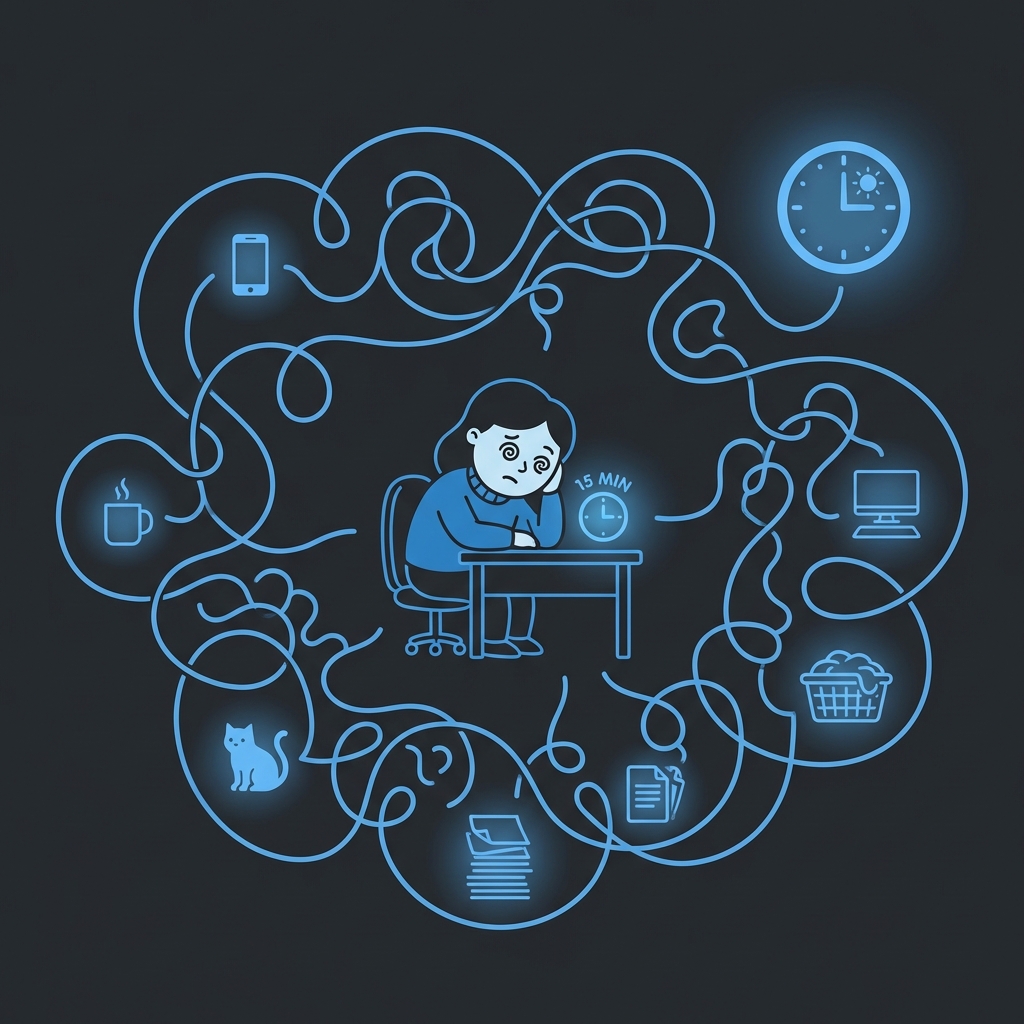
It started so innocently. “I’ll just run to the store and grab milk on my way to pick up the kids.” Fifteen minutes, tops. You’ve done this errand a hundred times before.
But somehow, three hours later, you’re sitting in your car in the school pickup line, exhausted and bewildered, wondering where your entire afternoon went. The milk is in the backseat—mission accomplished, technically—but you feel like you’ve been through a blender.
Sound familiar? You’re not losing your mind. You’ve just experienced the hidden mathematics of modern life, where a 15-minute task expands like gas to fill whatever space it encounters, dragging a dozen other micro-decisions and context switches in its wake.
The Innocent Beginning
Let’s trace what actually happened, step by step, because the devil really is in the details here.
First, you had to find your keys. Not where you thought you left them, naturally. While searching, you noticed the dishwasher finished its cycle, so you unloaded it quickly—can’t leave clean dishes sitting there. Then you remembered you needed to check if you had reusable bags in the car, which meant going to the garage, where you spotted that Amazon package that arrived yesterday.
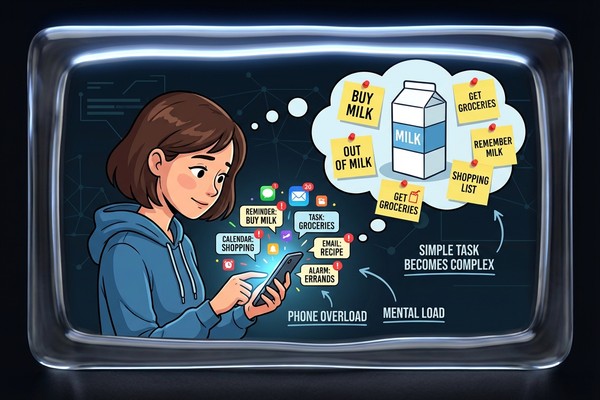
You brought the package inside and opened it—just to make sure it wasn’t something perishable or urgent. It was the phone case you ordered three weeks ago and forgot about. Which reminded you that your daughter mentioned her phone screen was cracked. Should you order her a case too? You pulled out your phone to check, saw seventeen notifications, and got pulled into a text thread about weekend plans that required an immediate response.
Twenty-five minutes in, you haven’t left the house yet.
The Cascade Effect
Finally in the car, you realized you should probably check if the store has what you need before making the trip. Their app showed milk in stock but also reminded you that your prescription was ready for pickup. The pharmacy is right next to the grocery store—efficient! Except now you need to remember to bring your insurance card and ID.
Back inside for your wallet. While grabbing it, you noticed the mail on the counter and quickly sorted through it. Bills, junk, and a reminder notice for your car registration renewal. Due next week. You made a mental note to handle that soon, knowing full well that mental notes have a half-life of approximately twelve minutes.
At the store, the milk aisle was blocked by a restocking cart. While waiting, you figured you might as well grab the other items on your mental list—the ones you didn’t write down because this was supposed to be a “quick trip.” Bread, bananas, that specific yogurt your son likes. Except they were out of his yogurt, so you stood there for three minutes debating alternatives, knowing that bringing home the wrong kind would result in a minor household crisis.
The pharmacy line was longer than expected. While waiting, you answered two more texts and realized you’d forgotten to respond to an email from your boss that came in during lunch. You fired off a quick reply, then worried it sounded too casual, then worried you were overthinking it.
The proof isn’t in what you accomplished—it’s in the invisible work of holding everything together.
The Reorientation Tax
Here’s what productivity culture doesn’t tell you: every time you switch contexts—from driving to shopping to texting to email—your brain pays a reorientation tax. It takes mental energy to figure out where you are, what you were doing, and what comes next.
By the time you got back to the car, you’d made approximately thirty-seven micro-decisions, most of which you weren’t even conscious of. Paper or plastic? This checkout line or that one? Respond to that text now or later? Park here or drive around looking for a closer spot?
Each decision was tiny. Insignificant. But they accumulated like interest, compounding throughout your afternoon until you felt cognitively spent despite accomplishing what should have been a simple errand.
The cruel irony is that you probably told yourself you were being efficient. Multitasking. Killing two birds with one stone. But efficiency and effectiveness aren’t the same thing, and neither has much to do with how you actually feel at the end of the day.
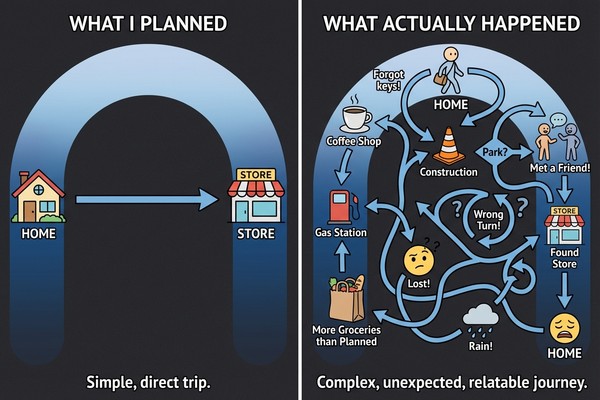
The “I Did Nothing” Feeling
You pulled into the school pickup line feeling defeated. What did you even accomplish today? You had milk to show for three hours of effort—hardly seems proportional. Your to-do list looked exactly the same as it did this morning, maybe longer.
This is the emotional tax of modern life that nobody talks about. You spent your afternoon doing operations work—the invisible labor of coordinating, deciding, remembering, and managing the hundred tiny logistics that keep life running. But because none of it was on your official task list, it doesn’t count as “productive” in our achievement-obsessed culture.
Think about it: you successfully navigated traffic, made multiple purchasing decisions, coordinated prescription pickup, maintained social connections through text responses, and kept your household supplied with essentials. You were a logistics coordinator, decision-maker, and family operations manager all afternoon.
But instead of feeling accomplished, you felt behind.
Reframing the Reality
Here’s what I wish someone had told me years ago: this feeling isn’t a personal failing. It’s a predictable outcome of trying to manage modern life with tools and expectations designed for a simpler time.
The problem isn’t that you’re disorganized or inefficient. The problem is that you’re treating operational work like it doesn’t exist, then wondering why you feel exhausted by tasks that should be simple.
Every “quick errand” is actually a project with multiple phases:
- Planning and preparation
- Navigation and logistics
- Decision-making and problem-solving
- Follow-up and integration
When you frame it that way, three hours for a milk run starts to make more sense. You weren’t just buying milk—you were managing a complex set of interconnected systems and relationships.
The fifteen-minute task that took all day wasn’t inefficiency. It was reality colliding with unrealistic expectations.
A Different Approach
So what’s the alternative? The answer isn’t to become more efficient at juggling—it’s to juggle less.
Consider batching these micro-errands instead of treating each one as an isolated task. Designate specific times for “operations work”—maybe Saturday morning for errands, or one evening a week for online ordering and scheduling.
Better yet, look for opportunities to hand off some of these decisions entirely. Grocery pickup eliminates the in-store decision fatigue. Prescription auto-refill removes the coordination overhead. Automatic bill pay reduces the monthly administrative burden.
The goal isn’t to optimize your errand-running—it’s to reduce the number of errands that require your personal attention in the first place.
The Bigger Picture
What you experienced today is a microcosm of a larger problem: we’re all carrying too much operational overhead in our heads. Every subscription that needs managing, every appointment that needs scheduling, every household item that needs replenishing—it’s all mental load, even when the individual tasks seem trivial.
The solution isn’t better time management or more efficient multitasking. It’s recognizing that remembering, coordinating, and managing are forms of work that deserve the same respect and systematic approach as any other kind of work.
Your fifteen-minute milk run expanded into an afternoon because life is complex, not because you’re doing it wrong. The first step toward feeling less overwhelmed is accepting that reality instead of fighting it.
Tomorrow, when you tell yourself you’ll “just quickly” handle something, remember today. Remember that quick tasks rarely stay quick, and that’s not a bug in your system—it’s a feature of modern life that deserves better planning and more realistic expectations.
The milk is in the fridge. The prescription is picked up. The texts are answered. You didn’t do nothing today—you did everything, one micro-decision at a time.
This article was created with collaboration between humans and AI—we hope you ❤️ it.