You’re sitting at dinner with your family, but your mind is already three moves ahead. While everyone else is talking about their day, you’re mentally running through tomorrow’s schedule, wondering if you remembered to pack your daughter’s soccer cleats, calculating whether you have enough time between meetings to prep for the client call, and quietly panicking about whether you confirmed that dentist appointment for next week.
This is the anticipation tax—the invisible cognitive toll of living perpetually ahead of the present moment. It’s the mental energy spent not on what’s happening now, but on everything that might happen later. And if you’re someone who carries a lot of mental load, chances are you’re paying this tax every single day without even realizing it.
The Weight of What’s Coming
The anticipation tax shows up in countless small moments throughout your day. It’s the split second when you walk into the kitchen and your brain automatically scans for what needs to be restocked. It’s lying in bed at night, supposedly relaxing, while your mind churns through next week’s logistics. It’s the way you can’t fully enjoy a conversation because part of you is already planning your exit strategy and what comes after.
Unlike regular anxiety, which tends to focus on specific fears, the anticipation tax is more diffuse. It’s not necessarily worry—it’s preparation. Your brain has learned that staying three steps ahead keeps things running smoothly. You catch potential problems before they become real problems. You remember the thing everyone else forgot. You’re the reason nothing falls through the cracks.
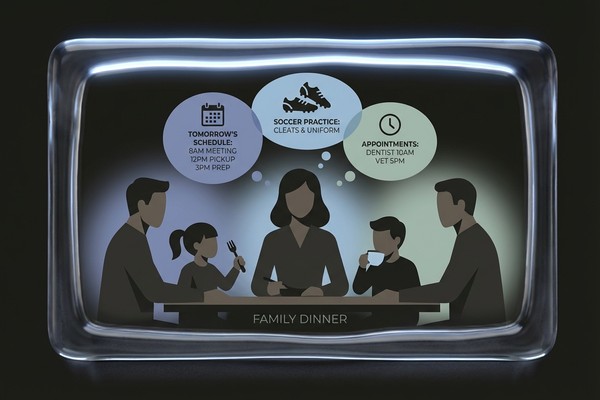
But here’s what makes the anticipation tax so insidious: it masquerades as responsibility. Society tells us that good parents, reliable employees, and capable adults should be thinking ahead. We’re praised for being proactive, organized, prepared. No one talks about the cost of being the person who’s always mentally living in the future.
The Invisible Value of Always Knowing
Before we talk about reducing the anticipation tax, we need to acknowledge what it actually accomplishes. People who live three steps ahead aren’t doing it for fun—they’re doing it because it works.
When you’re mentally rehearsing tomorrow’s presentation while folding laundry tonight, you’re not being neurotic. You’re doing invisible work that prevents tomorrow from becoming chaotic. When you’re lying awake thinking through the weekend’s logistics, you’re the reason Saturday morning runs smoothly instead of dissolving into a series of forgotten commitments and last-minute scrambles.
This kind of mental preparation catches problems before they become crises. It’s the reason you remember to buy batteries before the smoke detector starts beeping at 2 AM. It’s why you think to confirm the babysitter before date night, why you remember to check the weather before planning outdoor activities, why you notice when you’re running low on your prescription before you’re completely out.
The anticipation tax isn’t optional when you’re the designated rememberer for everyone around you.
The challenge is that this cognitive work is completely invisible to others. When things go smoothly, it looks effortless. No one sees the mental energy you spent preventing problems because the problems never happened. The proof is in what didn’t go wrong, which is impossible to quantify or appreciate.
When Preparation Becomes Prison
But there’s a tipping point where useful anticipation becomes something else entirely—a compulsive need to mentally control outcomes that haven’t happened yet. This is where the anticipation tax shifts from being a useful tool to being a prison that keeps you locked out of the present moment.
You know you’ve crossed this line when you find yourself mentally rehearsing conversations that may never happen, or when you’re planning contingencies for contingencies. It’s when you realize you can’t watch a movie without your mind wandering to Monday’s to-do list, or when you catch yourself mentally packing for a trip that’s still weeks away.
The shift happens gradually. What starts as helpful preparation slowly expands until your brain is running constant background simulations of future scenarios. You become so accustomed to living ahead of yourself that being fully present starts to feel irresponsible, even dangerous.
This is particularly common among people who’ve learned that their vigilance prevents other people’s mistakes. If you’re the one who remembers everything, your brain has learned that letting your guard down means things fall apart. So you stay alert, stay ahead, stay prepared—even when the cost is never being able to fully inhabit the moment you’re actually in.
The Diminishing Returns of Over-Anticipation
Here’s the thing about living three steps ahead: there’s a point where additional preparation stops being helpful and starts being counterproductive. Your brain can only hold so many future scenarios before it starts spinning its wheels.
Think about it this way—if you’re mentally preparing for every possible outcome of tomorrow’s meeting, you’re not actually improving your performance. You’re just burning cognitive fuel on scenarios that probably won’t happen. Most of the time, the meeting will unfold in ways you didn’t anticipate anyway, making all that mental rehearsal a waste of energy.
The anticipation tax becomes especially expensive when it starts interfering with your ability to respond to what’s actually happening. When you’re so focused on what might go wrong that you miss what’s going right, or when you’re so busy planning the next conversation that you’re not fully listening to the current one.
[image: Three-panel illustration showing: 1) Cartoon woman calmly planning (labeled “Useful Planning”), 2) Woman with multiple swirling thought bubbles (labeled “Over-Anticipation”), 3) Woman looking overwhelmed with tangled thoughts (labeled “Diminishing Returns”) template: arc-2]
This is where the productivity culture gets it wrong. More preparation isn’t always better preparation. Sometimes the most productive thing you can do is stop trying to mentally control outcomes and trust that you’ll handle whatever actually happens when it happens.
Finding the Sweet Spot
Reducing the anticipation tax doesn’t mean abandoning all preparation or becoming irresponsible. It means finding the sweet spot where you’re prepared enough to handle what’s likely to come without burning mental energy on every possible scenario.
The key is distinguishing between productive anticipation and anxious over-preparation. Productive anticipation focuses on high-probability scenarios and actionable preparation. It’s checking the weather before leaving the house, not mentally rehearsing how you’ll handle every possible weather scenario for the next week.
One way to gauge this is to ask yourself: “Is this mental energy leading to actual preparation, or am I just spinning?” If you’re mentally rehearsing a difficult conversation for the third time but haven’t taken any concrete steps to prepare for it, you’re probably paying unnecessary anticipation tax.
Another helpful distinction is between anticipation that serves you and anticipation that serves your anxiety. When you’re mentally preparing because it genuinely helps you perform better, that’s useful. When you’re mentally preparing because not preparing makes you feel anxious, you’re probably over-investing.
The goal isn’t to stop thinking ahead—it’s to think ahead more efficiently.
Systems That Anticipate So You Don’t Have To
This is where the right kind of support makes all the difference. Instead of carrying all that future-focused mental load yourself, you can build systems that do the anticipating for you.
Traditional productivity tools often miss this nuance. They focus on helping you organize your thoughts about the future rather than reducing how much mental energy you need to spend on future-focused thinking in the first place. They’re digital notebooks for your anticipation rather than replacements for it.
What you really need are systems that can hold the cognitive load of tracking what’s coming, what might go wrong, and what needs to be prepared—so your brain doesn’t have to run those constant background processes. Systems that notice patterns you might miss, remember dependencies you might forget, and surface the right information at the right time without requiring you to mentally juggle it all.
When a system genuinely takes over the work of anticipation, something remarkable happens: you can be present without feeling irresponsible. You can trust that important things won’t slip through the cracks, even when you’re not actively thinking about them. The anticipation tax decreases because the anticipation itself is being handled elsewhere.
Reclaiming the Present
The anticipation tax isn’t something you’ll eliminate completely—some level of future-focused thinking is necessary and valuable. But you can significantly reduce how much mental energy you spend living ahead of yourself.
Start by noticing when you’re paying the tax. Catch yourself in those moments when your body is in one place but your mind is three steps ahead. Don’t judge it—just notice it. Awareness is the first step toward choice.
Then experiment with trusting that you’ll handle things as they come up, rather than trying to mentally solve them in advance. This feels risky at first, especially if you’ve been the designated anticipator for a long time. But most of the time, you’ll find that you’re just as capable of handling things in the moment as you would have been after hours of mental preparation.
The goal isn’t to become someone who never thinks ahead. It’s to become someone who thinks ahead more selectively, more efficiently, and with less of your precious mental energy tied up in scenarios that may never happen.
Because here’s what you gain when you reduce the anticipation tax: you get to actually inhabit your own life. You get to be fully present for the good moments instead of mentally fast-forwarding through them. You get to experience the relief of not carrying the weight of everything that might happen.
And that might be worth more than being prepared for absolutely everything.
This article was created with collaboration between humans and AI—we hope you ❤️ it.