
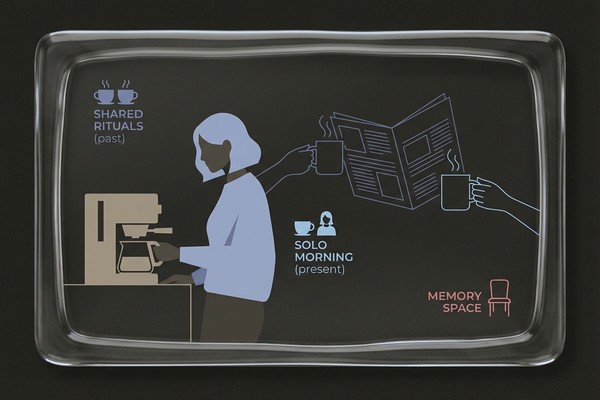
The coffee maker sits silent on the counter, and for the first time in three years, you have to remember how to make coffee for one. Not the romantic tragedy of it—just the mechanics. Half the water, one scoop instead of two, a single mug instead of the matching pair that used to bookend your mornings together.
This is the part no one talks about when relationships end. Not the heartbreak—that gets plenty of airtime. It’s the administrative collapse that follows, the quiet dismantling of a life’s infrastructure that took years to build and now needs rebuilding from scratch.
The productivity gurus would call this an opportunity. A fresh start. A chance to optimize your routines and design your ideal life. But they’ve never stood in a kitchen at 7 AM, staring at a coffee maker and realizing that even this—the simple act of caffeinating yourself—has become a decision that requires conscious thought again.
The Practical Collapse
The to-do list that emerges from a breakup isn’t romantic. It’s a spreadsheet of untangling: whose name is on the electric bill, who keeps the Netflix password, how to split a Costco membership that made sense for two people but feels absurd for one. These aren’t just administrative tasks—they’re the skeleton of a shared life being carefully disassembled, bone by bone.
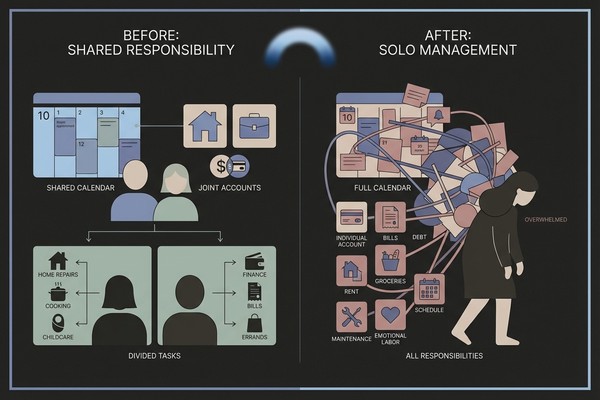
You discover how much invisible infrastructure you’d built together. The unspoken division of labor that happened so gradually you barely noticed it taking shape. One person always handled the car maintenance, the other managed the household subscriptions. Someone remembered to buy toilet paper, someone else kept track of the vet appointments. These weren’t assignments—they were evolutions, the natural settling of responsibility that happens when two people build a life together.
Now every single one of these systems needs conscious reconstruction. The mental load doesn’t just double—it explodes. Suddenly you’re not just responsible for remembering your own dentist appointments and grocery needs, but for rebuilding the entire operating system that kept your shared life running smoothly.
The bank wants both signatures to close the joint account. The landlord needs to know who’s staying and who’s going. The insurance company has forms. Everything that was automatic now requires decisions, phone calls, paperwork. Each task is small, but together they form a mountain of cognitive work that sits on top of whatever emotional processing you’re already doing.
The Hidden Work of Starting Over
What nobody mentions is how exhausting it is to rebuild the basic functionality of daily life. This isn’t about healing or moving on—it’s about the mechanical work of existing as a single person again when all your systems were designed for two.
You have to relearn your own preferences. What temperature do you keep the apartment when it’s just you? What groceries do you buy when you’re not accommodating someone else’s dietary restrictions or favorites? These sound like small freedoms, but they’re also decisions that require mental energy you may not have.
The support structures that felt permanent reveal themselves as borrowed. The friends who were really his friends, the social invitations that came as a package deal, the family relationships that existed through association. Some connections survive the transition, but others simply evaporate, leaving gaps in your social infrastructure that you didn’t even realize existed until they were gone.
The proof isn’t in what you gained—it’s in what you have to rebuild from scratch.
Even the physical space holds the ghost of shared systems. The side of the bed that was never yours, the closet space that feels too big, the refrigerator that’s suddenly too large for one person’s food. You’re not just living alone—you’re living in the architectural remains of a partnership, surrounded by infrastructure designed for a life you’re no longer living.
The Emotional Labor of Functional Recovery
This is where the productivity advice falls completely flat. The self-help industry treats post-breakup life reconstruction as a personal optimization project. They suggest this is your chance to design your ideal morning routine, to meal prep efficiently, to finally get organized. They miss the point entirely.
You’re not trying to optimize—you’re trying to function. There’s a difference between choosing to live alone and having aloneness thrust upon you along with the full cognitive load of maintaining a household, a social life, and a sense of routine that previously existed in partnership.
The emotional work isn’t just processing the loss of the relationship—it’s processing the loss of shared mental load. The grief isn’t only for the person who’s gone, but for the version of yourself who didn’t have to remember everything, manage everything, decide everything alone.
Some days the hardest part isn’t missing them—it’s missing the way your brain could relax because someone else was tracking the household supplies, or remembering to pay the water bill, or handling the social calendar. You’re grieving the loss of cognitive partnership as much as romantic partnership.
This isn’t about dependency—it’s about the very real work of mental load distribution that happens in functional relationships. When that distribution disappears overnight, the full weight of life maintenance falls on one person who may already be emotionally depleted.
What Rebuilding Actually Asks of You
The culture of breakup recovery focuses almost exclusively on emotional healing, as if the practical reconstruction of life happens automatically in the background. But rebuilding the infrastructure of daily existence is work—real, exhausting, time-consuming work that deserves recognition.
You’re essentially starting a new job: Life Administrator for a household of one. This job requires learning new systems, taking on responsibilities you may have never handled before, and making countless small decisions that used to be shared or automatic.
The grocery shopping alone becomes a cognitive exercise. What do you actually like to eat when you’re not compromising with someone else’s preferences? How much food does one person actually need? Do you still buy the expensive olive oil, or was that a shared luxury that doesn’t make sense anymore?
Every subscription, every routine, every small system needs conscious evaluation. Keep the gym membership you used to go to together? Cancel the streaming service you barely used but they loved? Figure out how to split the Spotify family plan that somehow became central to your music listening habits.
This isn’t healing—this is rebuilding. And rebuilding is work that happens in addition to healing, not instead of it.
The timeline for this reconstruction doesn’t match the timeline for emotional recovery. Your heart might be ready to move forward, but your life’s infrastructure is still under construction. Or the opposite—you might have successfully rebuilt all the practical systems while still emotionally processing the loss.
The Unspoken Weight
What makes this particularly difficult is how invisible this work remains, even to yourself. When people ask how you’re doing, they’re asking about your emotional state, not whether you’ve figured out how to manage the household bills or rebuilt your social calendar. The practical reconstruction happens in the background, unwitnessed and unacknowledged.
This invisibility matters because it means you don’t get credit for the enormous cognitive lift you’re managing. Friends and family see the apartment looking normal, your routines appearing functional, and assume you’re “doing well.” They don’t see the mental spreadsheet you’re constantly running, tracking all the systems you’re rebuilding from scratch.
The productivity culture makes this worse by suggesting that this reconstruction should be energizing rather than exhausting. That living alone should feel like freedom rather than an overwhelming expansion of responsibility. When the reality doesn’t match this narrative, it’s easy to feel like you’re failing at recovery rather than succeeding at an enormous administrative undertaking.
But here’s what’s true: rebuilding the infrastructure of daily life after it’s been shared for years is substantial work. It requires mental energy, emotional bandwidth, and time. It’s not a character flaw if it feels overwhelming—it’s a reasonable response to an objectively challenging situation.
The apartment after the breakup isn’t just a physical space—it’s a construction site where you’re rebuilding the operational systems of your life, one small decision at a time. The coffee maker will eventually feel normal again, programmed for one instead of two. But first, you have to give yourself credit for all the invisible work of making that transition possible.
What infrastructure did you lose that no one thinks to ask about?
This article was created with collaboration between humans and AI—we hope you ❤️ it.