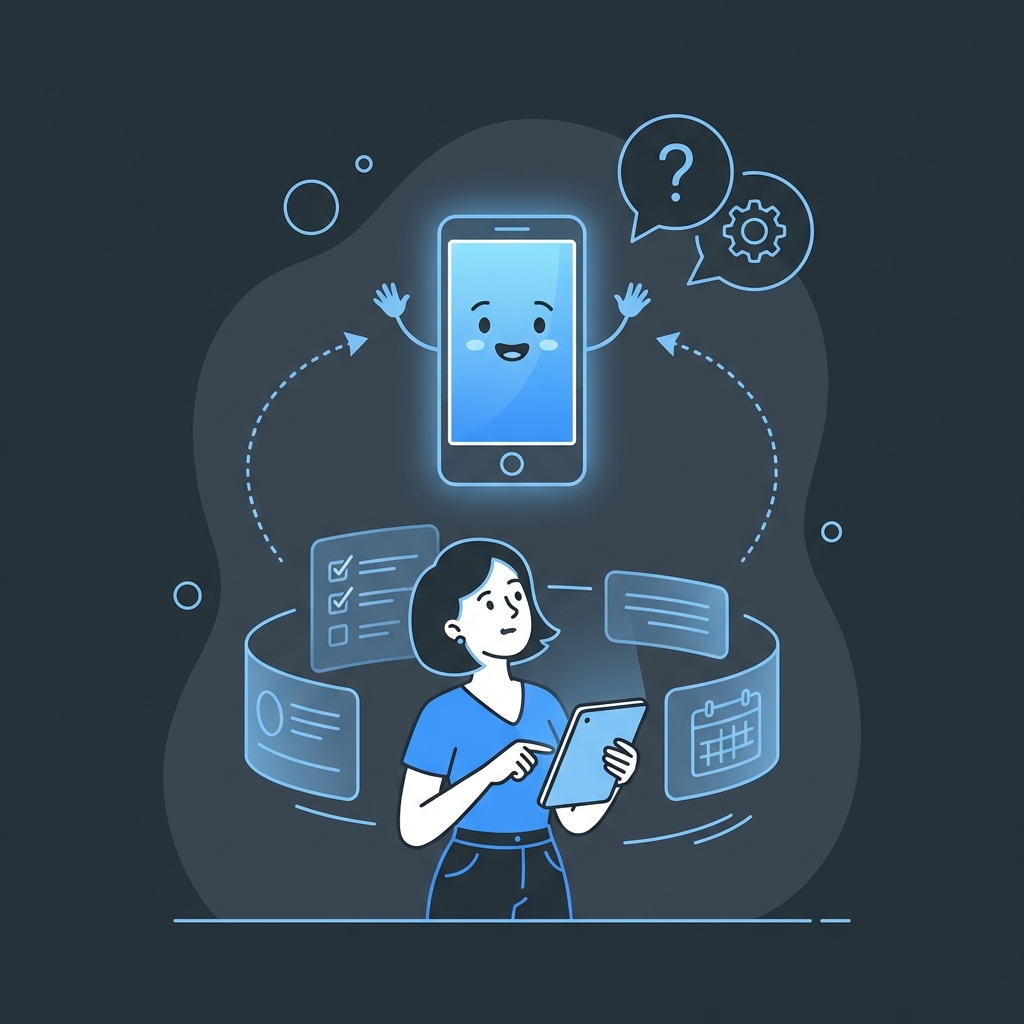
You downloaded the app with such hope. Finally, something to help you stay on top of everything. The reviews were glowing, the interface was clean, and the promise was irresistible: “Get organized. Stay focused. Take control of your life.”
Three weeks later, you’re spending twenty minutes every morning updating your task categories, adjusting priority levels, and syncing data across platforms. The app that was supposed to simplify your life has become another item on your to-do list. You’re not managing your tasks anymore—you’re managing the thing that’s supposed to manage your tasks.
This isn’t personal failure. It’s a design problem masquerading as a solution.
When Your Helper Needs Help
The signs are subtle at first. You start skipping the daily review because it takes too long. You stop tagging things properly because the taxonomy you created three months ago no longer makes sense. You have seventeen different project categories and can’t remember which one “dentist appointment” belongs to.
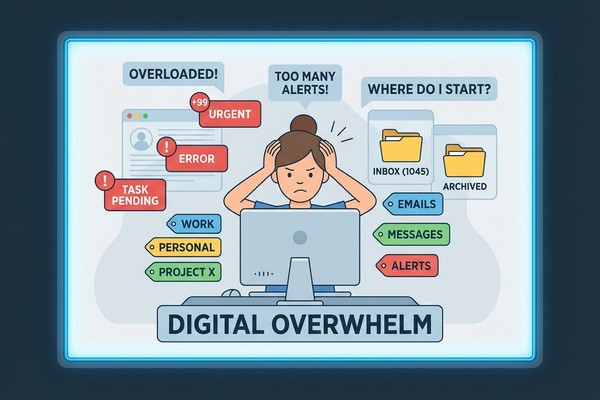
Soon you’re spending more time maintaining the system than the system is saving you. You’re color-coding your color-coding system. You’re creating workflows to manage your workflows. The tool designed to reduce your mental load has become a second job—one that doesn’t pay and never ends.
The cruel irony is that these tools often work beautifully in demos. Watch someone else use a productivity app for five minutes and it looks like magic. Every feature has a purpose, every workflow makes sense, every integration runs smoothly. But demos don’t show you what happens after six months of real life, when your carefully constructed system collides with sick kids, work emergencies, and the basic entropy of being human.
Most productivity tools are built on a fundamental misunderstanding: they assume that people want more control, when what people actually want is less to control.
The Tracking Trap
There’s something seductive about tracking everything. It feels like progress, like taking charge, like finally getting your life together. The numbers don’t lie. The charts show improvement. The streaks create momentum.
But tracking can become its own form of mental load. Every input requires a decision: What category does this belong to? How important is it really? Should I break this down into subtasks? The act of logging becomes as mentally taxing as the original task itself.
The moment you start managing your management system, you’ve lost the plot.
I know someone who spent forty-five minutes every Sunday planning her week in a elaborate productivity system. She had templates for different types of goals, color-coded priorities, and automated reminders that reminded her to set reminders. The weekly planning session was supposed to save time during the week, but it had grown into a complex ritual that required its own preparation and follow-up.
She realized something was wrong when she started procrastinating on her productivity planning. The system designed to prevent procrastination had become something to procrastinate about.
The difference between helpful tracking and burdensome tracking often comes down to one question: Who’s doing the work? If you’re constantly feeding information into a system, categorizing and recategorizing, adjusting and readjusting, then you’re still carrying the mental load. You’ve just shifted it from remembering tasks to remembering how to manage the system that remembers tasks.
Logging vs. Being Supported
True support doesn’t require constant supervision. When your friend offers to pick up your kids from school, you don’t spend the afternoon texting them updates about traffic patterns and optimal routes. You trust them to handle it and let your mind move on to other things.
Most productivity tools don’t work this way. They’re logging systems disguised as support systems. They’ll dutifully record whatever you tell them, but they won’t anticipate what you need or take initiative on your behalf. They’re like having an assistant who only does exactly what you explicitly ask, requiring you to think through every detail and contingency.
Real support is anticipatory. It notices patterns without being told to look for them. It handles routine decisions without consultation. It reduces the number of things you have to actively think about, rather than just organizing the things you’re already thinking about.
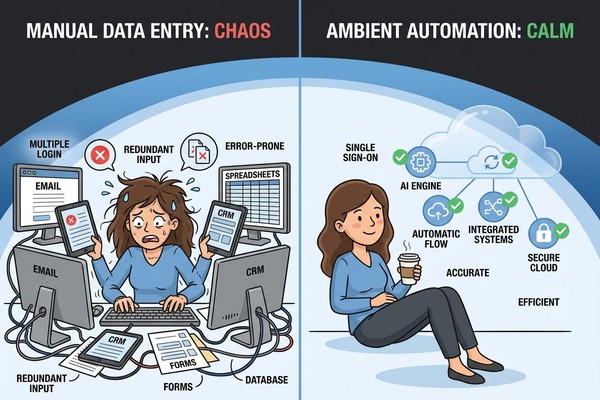
The best tools disappear into the background of your life. You stop noticing them because they’re not constantly asking for your attention. They work while you sleep, connect dots while you’re focused on other things, and surface exactly what you need exactly when you need it.
The Ambient Alternative
Ambient tools operate on a different philosophy entirely. Instead of demanding your constant input and attention, they observe, learn, and act. They understand that the goal isn’t to give you more visibility into your chaos—it’s to reduce the chaos itself.
Consider the difference between a fitness tracker that buzzes every hour asking you to log your mood, energy level, and activity type versus one that simply notices when you’ve been sitting too long and gently suggests a walk. Both are tracking your activity, but only one requires you to become a data entry clerk for your own life.
Ambient tools make assumptions and take action rather than asking you to make decisions. They’re comfortable with imperfection because they understand that a system that works 80% of the time without your intervention is infinitely better than a system that works 95% of the time but requires constant management.
The magic happens in what you don’t have to think about. The meeting that gets rescheduled automatically when your flight is delayed. The grocery item that appears on your list because you mentioned running low in a text message. The follow-up that happens without you having to remember to follow up.
What Works in the Background
The most effective tools share a few key characteristics. They integrate deeply rather than broadly, connecting to the places where you already spend time instead of asking you to visit yet another app. They automate ruthlessly, handling routine decisions without consultation. They capture information with minimal friction, understanding that the easier it is to input something, the more likely you are to actually do it.
The best productivity tool is the one you forget you’re using.
But perhaps most importantly, they’re designed around outcomes rather than processes. They care about whether your important tasks get done, not whether you’ve properly categorized them. They focus on reducing the number of decisions you have to make, not giving you better ways to make those decisions.
This requires a fundamental shift in how we think about productivity tools. Instead of asking “How can I better organize my tasks?” we should ask “How can I have fewer tasks to organize?” Instead of “How can I track everything more efficiently?” we should ask “What can I stop tracking entirely?”
The goal isn’t to become a more efficient manager of your own life. It’s to need less managing in the first place.
The Background Philosophy
This is where tools like Backlit diverge from the traditional productivity playbook. Instead of giving you more ways to organize your mental load, the focus is on reducing the load itself. The system doesn’t ask you to learn its language—it learns yours. It doesn’t require you to change your habits—it adapts to the habits you already have.
The philosophy is simple: work in the background, surface what matters, handle what can be handled automatically. No categories to maintain, no systems to feed, no workflows to optimize. Just the quiet confidence that important things won’t fall through the cracks.
Because the best kind of help is the kind you don’t have to manage.
This article was created with collaboration between humans and AI—we hope you ❤️ it.