
Most of us carry an invisible inventory that we never quite acknowledge. It’s not a to-do list or a project tracker—it’s the mental catalog of everyone we’re taking care of, worrying about, or feeling responsible for. And if you’re reading this, chances are your inventory is longer than you’d like to admit.
This isn’t about the obvious caregiving roles we sign up for. Of course you care for your children, your aging parents, your partner. But what about the colleague who always seems overwhelmed? The friend going through a rough patch? The neighbor whose packages you collect? The family member whose birthday you remember because no one else will?
The care inventory runs deeper than we realize, and for many of us, it’s become dangerously unbalanced.
Mapping the Full Scope of Your Care
When we think about caregiving, we usually picture the big, official roles: parent, spouse, adult child of aging parents. But the reality of modern care is much more complex. We’re often giving care in multiple directions simultaneously, and much of it flies under the radar of our conscious awareness.
Start with the obvious circle: your immediate family. But then expand outward. Who else regularly appears in your mental space? Whose problems keep you up at night? Whose success or failure feels somehow tied to your own sense of responsibility?
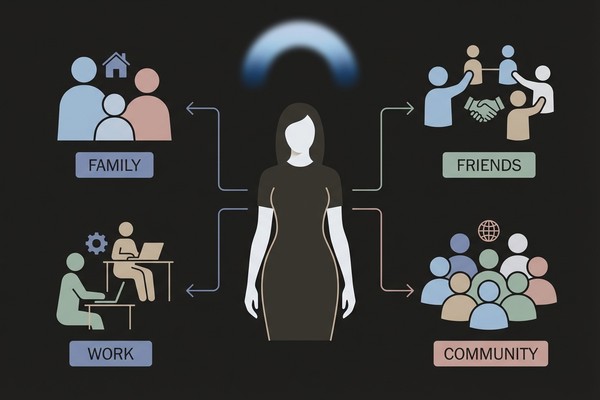
There’s the friend who texts you every crisis because you’re “so good at advice.” The team member whose workload you quietly monitor because you know they struggle. The elderly neighbor whose mail you notice hasn’t been picked up. The sibling whose finances you worry about but never discuss.
Some of this care is practical—you actually do things for these people. But much of it is purely mental and emotional. You carry their concerns, anticipate their needs, remember their important dates, worry about their wellbeing. This invisible caregiving is work, even when it produces no visible output.
The tricky part is that we often don’t recognize this mental caregiving as legitimate labor. We dismiss it as “just caring” or “being thoughtful.” But caring is work. Remembering is work. Worrying is work. And when we don’t acknowledge it as such, we can’t properly account for its cost.
The Invisible Weight of One-Way Care
Here’s what makes the care inventory particularly exhausting: most of it flows in only one direction. You remember everyone else’s needs, but who’s tracking yours? You check in on others, but who’s checking in on you? You anticipate problems for the people in your orbit, but who’s watching out for potential problems in your life?
The most depleting form of care isn’t the hardest tasks—it’s the care that never comes back to you.
This imbalance isn’t usually malicious. The people in your care inventory aren’t necessarily selfish or uncaring. They’ve simply learned that you’re reliable, that you remember things, that you’ll handle the emotional labor of maintaining relationships and managing details. And once someone learns they can count on you for this invisible work, it’s remarkably easy for them to stop doing it themselves.
Think about the friend who never asks how you’re doing but always has a crisis to share. The family member who assumes you’ll remember and organize gatherings but never offers to host. The colleague who relies on your institutional memory but never thinks to document things themselves. These aren’t bad people—they’re people who’ve gotten used to your care without learning to reciprocate it.
The cost of this imbalance compounds over time. When care flows primarily outward, you start operating from an emotional deficit. You’re constantly giving from reserves that aren’t being replenished. Eventually, this shows up as resentment, burnout, or the peculiar exhaustion of feeling simultaneously needed and neglected.
Recognizing Care Without Resentment
One of the most difficult aspects of taking inventory is learning to see your caregiving clearly without immediately drowning in resentment. It’s tempting to catalog all the ways you give and others don’t, to build a case for how unfairly burdened you are. But resentment, while understandable, doesn’t actually solve the problem—it just adds another layer of emotional labor.
Instead, try to approach your care inventory with curiosity rather than judgment. What patterns emerge? Where did you learn that your worth was tied to how much you could handle for others? Which relationships feel genuinely reciprocal, and which ones leave you feeling drained?
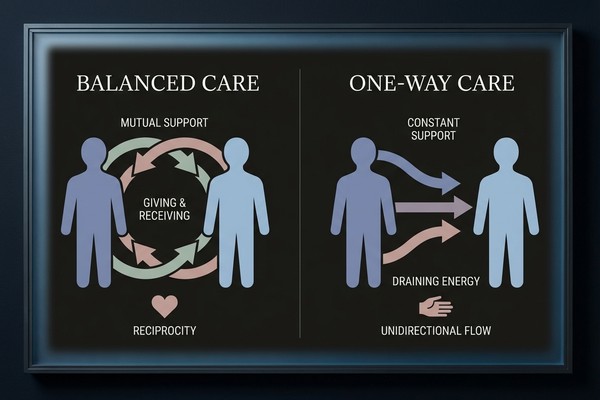
Some one-way care is appropriate and necessary. You don’t expect reciprocal caregiving from your young children or from someone in crisis. But if most of your relationships involve you as the primary giver of care, attention, and emotional labor, that’s not sustainable long-term.
Notice, too, where you might be unconsciously discouraging reciprocal care. Do you deflect when people ask how you’re doing? Do you minimize your own needs or problems? Do you pride yourself on being low-maintenance? Sometimes we train people not to care for us, then wonder why we feel so alone in our caregiving.
The goal isn’t to eliminate all one-way care—it’s to ensure that your overall care ecosystem includes relationships where you’re also the recipient of attention, concern, and practical support.
Drawing Your Care Map
Here’s a simple but revealing exercise: draw your care map. Put yourself in the center of a page, then draw lines outward to represent everyone you regularly care for, worry about, or feel responsible for. Use different colors or line weights to distinguish between different types of care—practical help, emotional support, mental tracking, financial concern.
Now look at your map. Where are the lines flowing back toward you? Who in your network is actively caring for you, remembering your needs, checking in on your wellbeing? The visual representation often makes the imbalances more obvious than any amount of mental analysis.
Don’t be surprised if your map looks lopsided. Most people in high-load phases of life discover they’re giving care in far more directions than they’re receiving it. The revelation isn’t meant to be depressing—it’s meant to be clarifying.
Once you can see the full scope of your care inventory, you can start making more intentional choices about it. Maybe you realize you’re emotionally managing a friendship that hasn’t been reciprocal in years. Maybe you notice you’re carrying mental responsibility for family logistics that other capable adults could share. Maybe you see that you’ve been so focused on caring for others that you’ve forgotten to cultivate relationships where you’re cared for in return.
Asking for care isn’t selfish—it’s sustainable.
Rebalancing the Equation
The point of taking inventory isn’t to cut off care to others or to demand perfect reciprocity in every relationship. It’s to create more awareness around your caregiving patterns so you can make choices that support your long-term sustainability.
This might mean having honest conversations with people who rely heavily on your care but rarely offer it in return. It might mean stepping back from some unofficial caregiving roles you’ve taken on. It might mean actively cultivating relationships with people who are capable of caring for you as much as you care for them.
Most importantly, it means recognizing that your need for care is as legitimate as anyone else’s. You don’t have to earn the right to be cared for by caring for everyone else first. You don’t have to be in crisis to deserve attention and support. You don’t have to handle everything alone to prove your worth.
The care inventory isn’t about keeping score—it’s about creating awareness. And with awareness comes the possibility of building a more sustainable way of caring that includes caring for yourself.
This article was created with collaboration between humans and AI—we hope you ❤️ it.