
The notification pops up while you’re finally sitting down after a long day: “Turn your hobby into a side hustle! Start earning today!” You swipe it away, but the message lingers. Somewhere in the back of your mind, a familiar voice starts up: Shouldn’t you be doing more? Everyone else is monetizing their talents. What’s wrong with you?
Welcome to the cult of the side hustle, where rest is rebellion and every skill must serve capitalism.
We’ve collectively decided that having one job isn’t enough anymore. Not because we don’t work hard enough at our primary jobs, but because we’ve been sold a story that financial freedom comes through grinding harder, not through systemic change. The side hustle has morphed from a practical necessity into a moral imperative, complete with its own gospel of productivity porn and shame-based motivation.
When Survival Became Self-Optimization
The side hustle didn’t start as a lifestyle choice. It began as a response to stagnant wages and rising costs. When one income couldn’t cover rent, groceries, and student loans, people found creative ways to bridge the gap. Driving for rideshare companies, selling crafts online, freelancing in the evenings—these were practical solutions to real financial pressure.
But somewhere along the way, the narrative shifted. What began as economic necessity transformed into personal virtue. The side hustle became proof of your entrepreneurial spirit, your refusal to settle, your commitment to “leveling up.” Suddenly, if you weren’t monetizing your free time, you were lazy. If you weren’t building multiple income streams, you lacked vision.
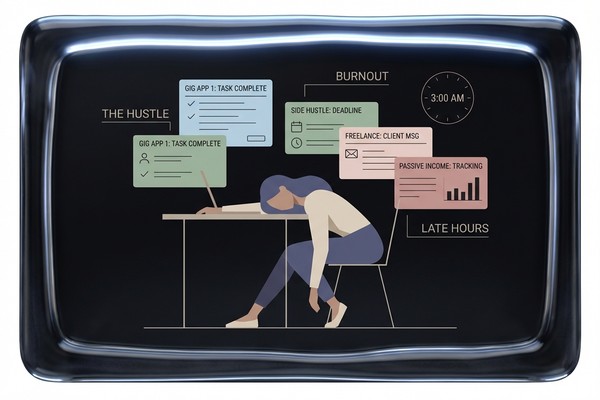
The language around side hustles reveals everything. We don’t call them “second jobs”—that would sound too much like what they actually are. We call them “passion projects” and “income streams” and “building your empire.” The terminology transforms exploitation into aspiration, making it easier to ignore the human cost of working multiple jobs with no benefits, no security, and no boundaries.
The side hustle promises freedom but delivers a second boss you can never escape—yourself.
This rebranding benefits everyone except the people actually doing the work. Companies get access to a flexible workforce without providing healthcare or job security. The gig economy platforms take their cut while workers absorb all the risk. Meanwhile, the broader culture gets to pretend that individual entrepreneurship can solve systemic economic problems.
The True Price of Always Being “On”
Let’s talk about what side hustles actually cost, beyond the obvious time commitment. There’s the mental load of managing multiple income streams, each with its own deadlines, client relationships, and administrative overhead. There’s the emotional labor of constantly marketing yourself, building your personal brand, and staying visible in crowded digital spaces.
Most side hustles require you to be perpetually available. Your Etsy shop doesn’t close. Your freelance clients expect weekend responses. Your rideshare app sends notifications at all hours, making you feel guilty for not capitalizing on surge pricing. The boundary between work time and personal time dissolves completely.
The creativity cost is particularly brutal. When you monetize your artistic skills or hobbies, you transform activities that once brought joy into sources of stress. The painting you used to do for relaxation becomes a product you need to photograph, price, and market. The writing that helped you process emotions becomes content that needs to drive engagement and conversions.
Rest becomes a luxury you can’t afford—literally. Every hour you spend sleeping, reading, or simply existing without producing value is an hour you could have been earning. The side hustle culture reframes basic human needs as character flaws. Need eight hours of sleep? You must not want success badly enough. Want to spend Sunday reading instead of building your brand? You’re not serious about your goals.
The Privilege Hidden in Plain Sight
The most insidious aspect of side hustle culture is how it ignores the infrastructure required to hustle in the first place. The ability to work multiple jobs assumes you have reliable transportation, consistent internet access, a quiet space to work, and the physical and mental capacity to handle additional stress.
It assumes you don’t have young children who need supervision, aging parents who require care, or health conditions that limit your energy. It assumes you have enough financial cushion to invest in equipment, handle irregular income, and weather the inevitable slow periods that come with freelance work.
The side hustle narrative particularly fails parents, especially mothers who are already managing the invisible labor of running households. The suggestion that they should monetize their remaining free hours isn’t empowerment—it’s another item on an already impossible to-do list.
When every spare moment becomes a potential income opportunity, we lose the space where actual life happens.
Single parents working two jobs to make ends meet aren’t building empires—they’re surviving. People caring for elderly relatives while maintaining their careers aren’t lacking ambition when they don’t start drop-shipping businesses. They’re already at capacity, and the side hustle culture’s failure to acknowledge this reality is both cruel and disconnected from how most people actually live.
Breaking the Monetization Trap
Here’s what the side hustle evangelists don’t want you to know: enough is a complete sentence. You don’t owe the world your every skill, talent, or spare hour. You’re allowed to have hobbies that don’t generate revenue. You’re permitted to spend time on activities that serve no purpose beyond your own enjoyment or growth.
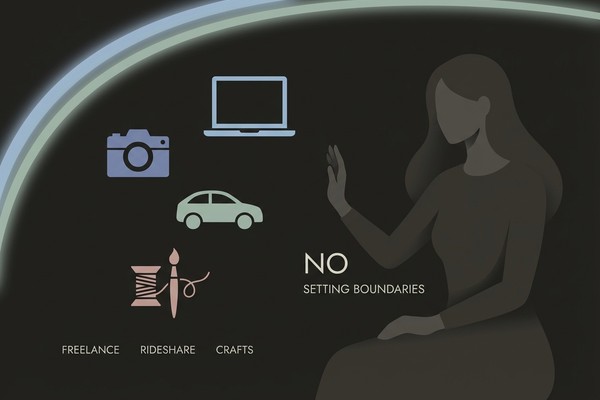
The idea that every passion should become profitable is a recent invention, and it’s not serving us well. When we monetize everything we enjoy, we risk losing the activities that restore us, challenge us in non-productive ways, and connect us to parts of ourselves that exist beyond our economic value.
Some of the most important work you do will never appear on your tax return. The conversations that help friends through difficult times, the creative projects that teach you new ways of seeing, the quiet moments that let your nervous system reset—none of these generate income, but all of them generate the kind of wealth that actually matters.
Protecting Your Non-Negotiable Time
If you’re going to engage with additional income streams, do it from a place of choice rather than compulsion. Start by identifying what you absolutely won’t sacrifice: family dinner time, your morning walk, the hour you spend reading before bed, your weekend rest. These aren’t luxuries to be optimized away—they’re the infrastructure that makes everything else possible.
Consider what you’re actually trying to solve. If it’s financial pressure, a side hustle might help, but it’s worth examining whether there are other solutions: negotiating your salary, reducing expenses, or finding a better-paying primary job. If it’s creative fulfillment, ask whether monetizing that creativity will enhance or diminish the satisfaction you get from it.
The most radical act in a culture obsessed with optimization might be protecting time that serves no productive purpose whatsoever. Time to think without deadlines, create without outcomes, and exist without justification.
Your worth isn’t measured by your output. Your rest isn’t laziness. Your boundaries aren’t character flaws. And your decision to prioritize your well-being over additional income isn’t a failure of ambition—it’s a recognition that you’re already enough, exactly as you are.
The side hustle will always be there if you need it. But your peace of mind, your relationships, and your sense of self are much harder to recover once you’ve traded them away for the promise of financial freedom that may never come.
This article was created with collaboration between humans and AI—we hope you ❤️ it.