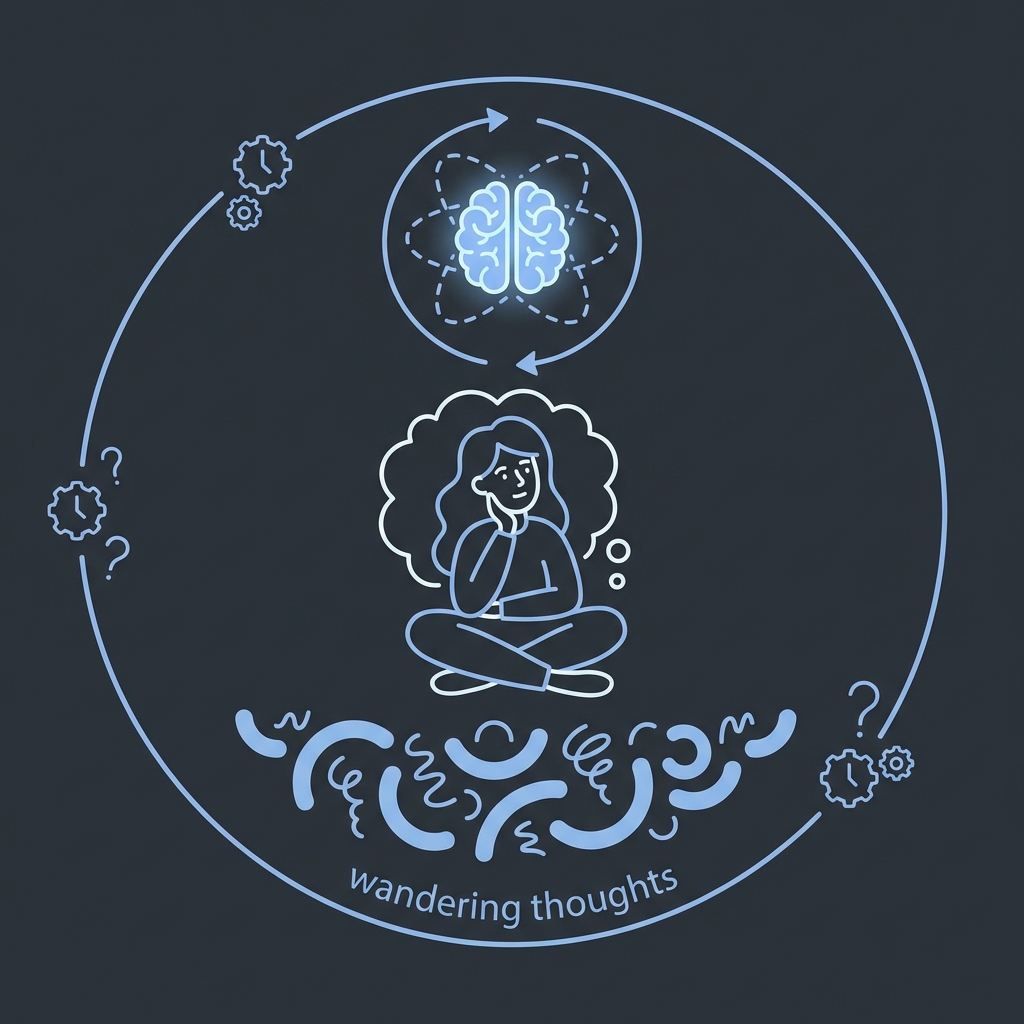
You know that feeling when you finally sit down after a long day, expecting your mind to quiet, but instead it starts cycling through tomorrow’s meeting agenda, the permission slip you forgot to sign, and whether you remembered to pay that bill? Your brain was supposed to rest, but instead it feels like it’s running a marathon of worry.
There’s actually a neurological explanation for this maddening experience, and understanding it changes everything about how we think about rest, mental load, and why our minds feel so restless even when our bodies are still.
Your Brain’s Background Program
Scientists have discovered that when we’re not actively focused on a task, our brains don’t actually power down. Instead, they shift into what’s called the default mode network—a collection of brain regions that becomes active during what researchers call “wakeful rest.” Think of it as your brain’s screensaver, but instead of bouncing geometric shapes, it’s running a complex background program.
Under normal circumstances, this network serves some pretty remarkable functions. It consolidates memories, moving important information from short-term storage into long-term memory. It engages in what neuroscientists call “prospective thinking”—imagining future scenarios and possibilities. It helps us understand other people’s perspectives and maintains our sense of self-identity. In many ways, the default mode network is where creativity, empathy, and self-reflection happen.

This is the brain’s natural restoration process. When functioning properly, default mode activity leaves us feeling refreshed, creative, and emotionally regulated. It’s why some of our best ideas come in the shower or during a walk—our default network is free to make novel connections and process experiences.
But here’s where things get complicated. The default mode network is exquisitely sensitive to our mental state and the cognitive demands we’re carrying. When we’re operating under chronic mental load—constantly tracking deadlines, remembering tasks, anticipating needs—this restorative network gets hijacked.
When Rest Becomes Another Job
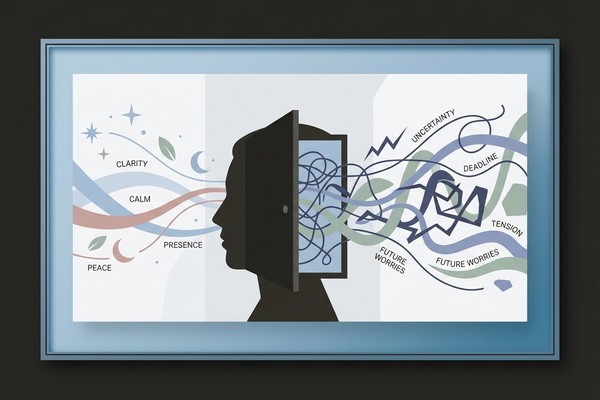
Instead of consolidating memories and sparking creativity, an overloaded default network becomes stuck in what researchers call “perseverative cognition”—basically, repetitive thoughts about problems, threats, and unfinished business. Your brain, instead of using downtime to restore itself, spends it rehearsing conversations you need to have, reviewing lists of things you might have forgotten, and running scenario planning for potential problems.
The default mode network becomes a broken record, playing the same worries on repeat instead of writing new songs.
This explains why rest often doesn’t feel restful anymore. You’re physically still, but neurologically, you’re working overtime. Your brain is trying to solve problems, prevent disasters, and keep track of everything that needs your attention. The very network designed to restore you has become another source of mental labor.
What’s particularly insidious about this hijacked default mode is that it feels productive. You’re “using” your rest time to think through problems and plan ahead. But this kind of rumination is cognitively expensive without being cognitively effective. You’re burning mental energy without actually resolving the underlying issues that are driving the worry cycle.
Research shows that people with higher levels of rumination and worry show increased activation in default mode regions associated with self-referential thinking and decreased activation in areas associated with creative insight and perspective-taking. In other words, mental overload doesn’t just make rest less restorative—it actively impairs the very cognitive functions that rest is supposed to enhance.
The Permission Problem
Here’s what’s fascinating: the default mode network needs permission to do its restorative work. It requires a sense of safety and completion that many of us rarely experience. When your brain perceives that there are open loops, unfinished tasks, or potential threats that require monitoring, it can’t fully shift into restoration mode.
This is why traditional advice about rest—“just relax,” “don’t think about work”—often falls flat. You can’t simply will your default network into restoration mode when it’s genuinely tracking legitimate concerns. Your brain isn’t being difficult; it’s being protective.
The solution isn’t to override this protective instinct but to address its underlying concerns. This is where the concept of “cognitive offloading” becomes crucial. When we externalize the work of remembering and tracking—whether through trusted systems, other people, or tools—we give our default network permission to stop its vigilant monitoring.
Designing True Rest
Understanding the default mode network completely reframes how we think about rest and restoration. It’s not enough to stop doing things; we need to create conditions where our brains feel safe to stop monitoring things.
This means rest isn’t just about what we don’t do—it’s about what we put in place beforehand. Real rest requires what psychologists call “cognitive closure”: the sense that important matters are handled, tracked, or appropriately delegated. Without this closure, our default network remains in protective mode, scanning for threats and rehearsing solutions instead of engaging in restoration.
Consider the difference between lying in bed while mentally reviewing tomorrow’s schedule versus lying in bed knowing that tomorrow’s schedule is captured in a system you trust. The physical posture is identical, but the neurological experience is completely different. In the first scenario, your default network is working. In the second, it’s resting.
This also explains why vacations often don’t feel restorative until several days in. It takes time for your brain to trust that the monitoring can stop, that the urgent concerns are truly paused. Many people report that their best vacation insights and creative breakthroughs happen toward the end of longer trips, when their default network has finally shifted into genuine restoration mode.
The Restoration Revolution
What this neuroscience reveals is that the modern epidemic of restless minds isn’t a personal failing—it’s a predictable response to chronic cognitive overload. When we carry too much mental load, we literally lose access to our brain’s natural restoration processes.
The goal isn’t to think less; it’s to worry less about forgetting.
This understanding suggests a completely different approach to mental health and cognitive wellness. Instead of trying to force our minds to be quiet, we need to address the underlying conditions that keep our default networks in monitoring mode. This means taking seriously the work of remembering, tracking, and anticipating—and finding ways to offload that work so our brains can return to their natural cycles of restoration.
The implications extend far beyond individual wellness. Organizations that understand default mode function might design work cultures that actually allow for cognitive recovery. Families might structure their systems to distribute mental load more equitably. We might stop treating restless minds as a character flaw and start recognizing them as a signal that our cognitive systems are overloaded.
Your restless mind isn’t broken—it’s working exactly as designed under impossible conditions. The solution isn’t to rest harder; it’s to create the conditions where rest can actually do its job. When we offload the open loops that keep our default networks in monitoring mode, we don’t just get our evenings back—we get our creativity, perspective, and sense of possibility back too.
The brain that’s been running surveillance can finally return to writing poetry.
This article was created with collaboration between humans and AI—we hope you ❤️ it.