
The moment you admit you need help, you’re handed a second job: becoming an expert in finding experts.
Your therapist suggests you might benefit from EMDR, but also mentions somatic therapy could be worth exploring. Your nutritionist recommends lab work that your doctor dismisses. Your financial advisor wants you to track every expense while your organizing consultant insists you need different systems entirely. Suddenly, you’re not just managing your original problems—you’re managing a small army of professionals who each see your life through their particular lens.
We’ve built an entire economy around the idea that modern life requires expert intervention. There’s a specialist for everything now: sleep coaches, decluttering consultants, meal planning services, time management gurus. The message is clear: if you’re struggling, you just need to find the right expert. But what happens when the search for help becomes another burden to carry?
The New Category Explosion
Twenty years ago, if you were overwhelmed, your options were relatively straightforward. You might see a therapist, hire a housekeeper, or ask family for help. Today, the landscape has exploded into micro-specializations that promise to optimize every corner of your existence.
There are experts for decision fatigue, experts for digital overwhelm, experts for helping you find other experts. LinkedIn is flooded with coaches who’ve carved out increasingly narrow niches: productivity coaches for creative entrepreneurs, organization specialists for neurodivergent parents, financial advisors who focus exclusively on women in their thirties.
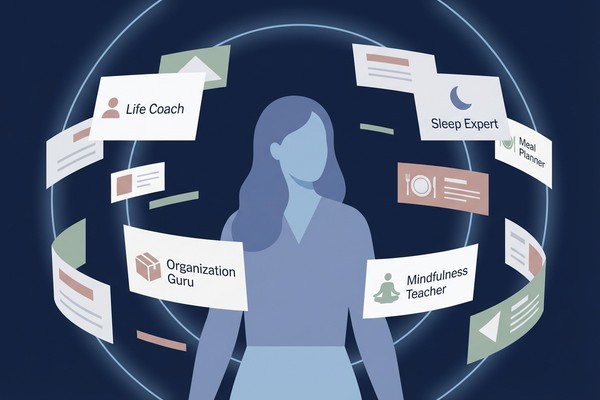
This isn’t inherently bad. Specialization can mean more targeted, effective help. But it also means that getting support now requires you to become fluent in an entirely new vocabulary of wellness and optimization. You need to understand the difference between CBT and DBT, between a nutritionist and a registered dietitian, between a life coach and a business coach and an executive coach.
The proliferation of expert categories reflects real needs—modern life genuinely is more complex than it used to be. But it also creates a new kind of work: the work of figuring out which kind of help you need, who provides it well, and how to coordinate between multiple experts who may never talk to each other.
When Help Becomes Another Project
Sarah hired a professional organizer after months of feeling overwhelmed by her home. The organizer was wonderful—knowledgeable, kind, transformative. But Sarah found herself spending hours preparing for each session, researching container systems between visits, and coordinating with her family about the new systems. The organizing project, meant to reduce her mental load, temporarily increased it.
This is the paradox of expert help: it often requires significant project management from the person who’s already overwhelmed. You have to research providers, schedule consultations, compare approaches, manage appointments, implement recommendations, and follow up on progress. The very people who most need help are often least equipped to manage the complex process of getting it.
The infrastructure of getting help has become so complex that it requires the kind of bandwidth that overwhelmed people don’t have.
Consider the typical process of finding a therapist. You need to understand your insurance coverage, research providers in your network, read reviews, schedule consultations, evaluate fit, and then commit to regular appointments. If the first therapist isn’t right, you start over. The process can take months and requires exactly the kind of executive functioning that depression and anxiety often compromise.
The same pattern repeats across expert categories. Finding a good financial advisor means understanding fee structures, fiduciary responsibilities, and investment philosophies. Hiring a professional organizer requires evaluating different methodologies and determining which approach fits your lifestyle. Each expert category has its own learning curve, its own evaluation criteria, its own ongoing management requirements.
The Contradiction Problem
The more experts you consult, the more likely you are to receive conflicting advice. Your therapist encourages you to set boundaries with work. Your career coach pushes you to take on more visible projects. Your financial advisor wants you to increase your emergency fund. Your business mentor suggests investing more aggressively in your growth.
These contradictions aren’t necessarily wrong—different experts see different aspects of your situation. But reconciling conflicting professional advice becomes another cognitive task. You’re not just implementing solutions; you’re serving as the integration point for multiple expert perspectives that may not align.
This creates a strange inversion where you, the person seeking help, become responsible for synthesizing expert knowledge into a coherent approach. You’re essentially managing a consulting team, except you’re paying them and you’re also the client. The mental load doesn’t decrease; it just shifts from managing your problems directly to managing the people who are supposed to help you manage your problems.
The Access Question
The expert-industrial complex operates on the assumption that everyone can afford both the financial cost and the time investment of professional help. A monthly therapy session, a quarterly financial review, a seasonal organizing consultation—these add up quickly, both in dollars and in calendar management.
This creates a two-tiered system where comprehensive support becomes a luxury good. People with disposable income and flexible schedules can assemble teams of experts. Everyone else gets generic advice and DIY solutions that require them to become experts themselves.
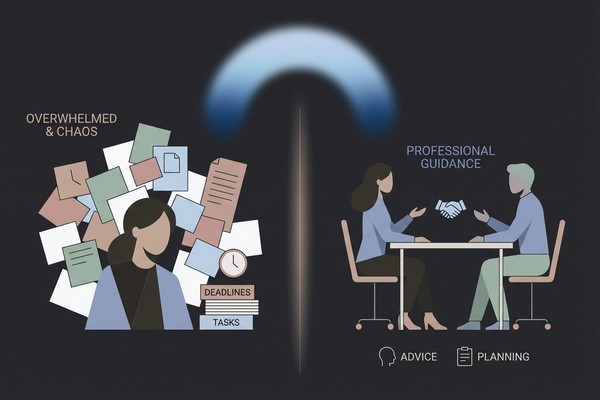
The gap isn’t just about money. It’s about having the cultural capital to navigate expert systems, the time to manage multiple professional relationships, and the cognitive bandwidth to synthesize different approaches. The people who most need support are often least able to access the complex infrastructure that’s been built to provide it.
When Experts Help vs. When They Substitute
Expert help works best when it addresses root causes rather than symptoms, when it builds your capacity rather than creating dependency, and when it simplifies your life rather than adding complexity.
A financial advisor who sets up automated systems that run without your input is different from one who requires monthly check-ins and constant decision-making. A therapist who helps you develop internal resources is different from one who becomes another appointment to manage indefinitely. A professional organizer who creates systems you can maintain is different from one who requires ongoing sessions to keep things functional.
The most valuable experts don’t just solve problems—they transfer capability. They help you develop better judgment, more effective systems, or clearer boundaries. They work themselves out of a job rather than creating ongoing dependency.
But much of the expert economy operates on the subscription model of ongoing engagement. Monthly sessions, quarterly reviews, annual assessments. This can create a situation where expert relationships become another thing to maintain rather than a path to greater autonomy.
The best expert help makes you need experts less, not more.
The Simpler Alternative
What if support didn’t require you to become an expert in finding experts? What if help could be more like infrastructure—reliable, background, requiring minimal management from you?
This looks different from the current model. Instead of requiring you to research, vet, coordinate, and manage multiple expert relationships, truly supportive systems would work more automatically. They’d anticipate needs, handle coordination between different types of support, and reduce rather than increase your decision-making burden.
Think about the difference between having to call multiple specialists to coordinate your healthcare versus having a primary care doctor who manages referrals and follows up on your behalf. The latter reduces your cognitive load; the former increases it.
The same principle applies to other areas of life. Support that truly reduces mental load doesn’t require you to become a project manager. It doesn’t ask you to synthesize conflicting expert advice or coordinate between different professional relationships. It works in the background, handling complexity so you don’t have to.
Holding Less, Not Managing More
The expert-industrial complex promises to help you optimize your life, but it often just gives you more things to optimize. More relationships to manage, more advice to synthesize, more systems to maintain.
Real support should help you hold less, not manage more. It should reduce the number of decisions you need to make, not increase them. It should work automatically in the background, not require constant supervision and coordination.
This doesn’t mean expert help is wrong or unnecessary. Many people genuinely benefit from therapy, coaching, and professional services. But the current model often recreates the problem it’s meant to solve—it gives overwhelmed people more things to be overwhelmed by.
The goal isn’t to eliminate expert support but to reimagine how it works. Support that truly serves overwhelmed people would be more integrated, more automatic, and less demanding of the very cognitive resources that are already stretched thin.
When help requires you to become an expert in getting help, something has gone wrong. The infrastructure meant to reduce your burden has become a burden itself. Real support should be simpler than that—more like a foundation that holds you up, less like a complex system you need to manage.
This article was created with collaboration between humans and AI—we hope you ❤️ it.