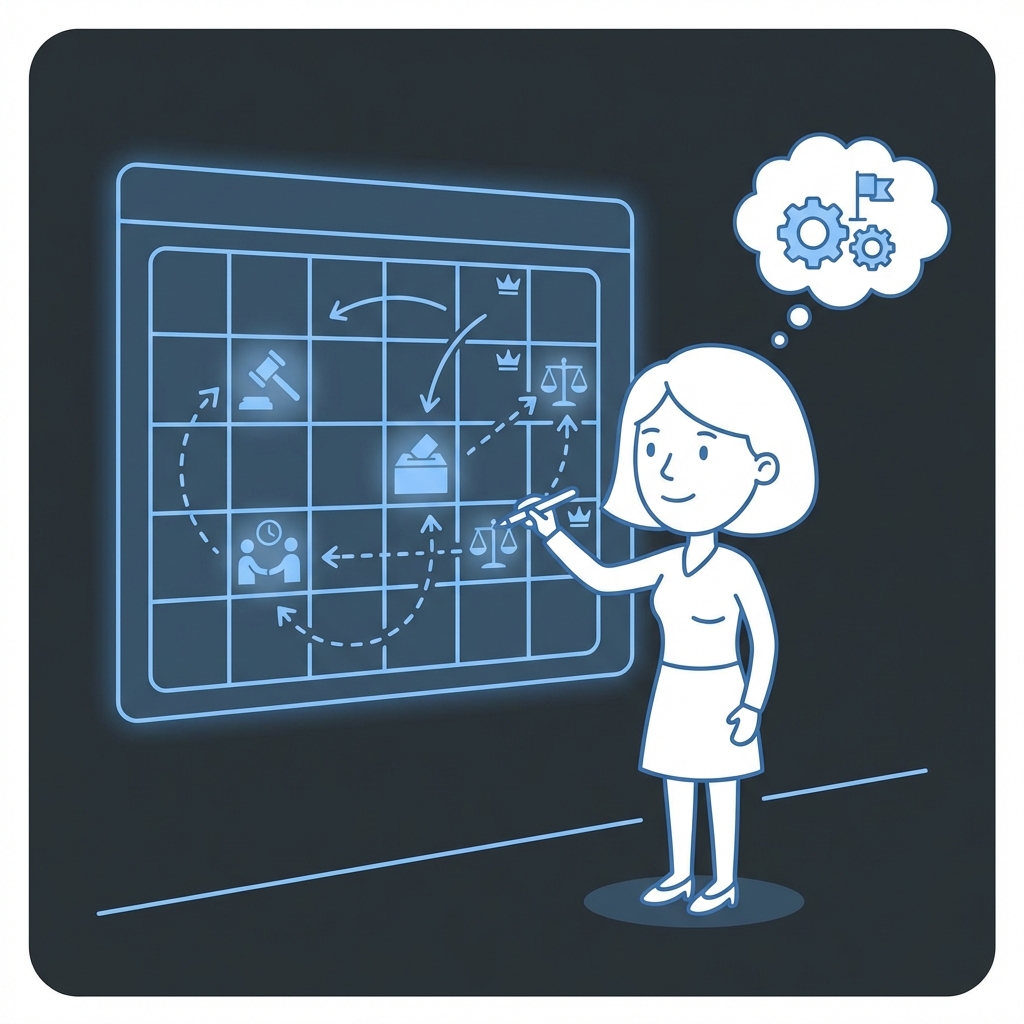
You know that moment when someone in your household says “I’ll put it on the calendar” and you feel a tiny spike of irritation you can’t quite name? That’s the sound of invisible work being volunteered for you. Because putting something “on the calendar” isn’t just typing a few words into an app—it’s becoming the person who remembers, coordinates, and follows up on everything that flows from that single entry.
The family calendar isn’t just a scheduling tool. It’s a power structure. And whoever controls it controls far more than just when things happen.
The Real Work of Calendar Management
When most people think about managing a calendar, they picture the obvious parts: adding events, setting times, maybe sending a reminder. But anyone who’s actually been the family scheduler knows this is like saying “cooking dinner” just means putting food on plates.
Real calendar management starts long before anything gets written down. It begins with being the person who notices that school registration opens next month, who remembers that your partner mentioned wanting to see their college friend “sometime soon,” who keeps track of which weekends work for the family gathering your mother-in-law has been hinting about.
Then comes the invisible choreography of making it all work. You’re not just recording events—you’re solving a complex optimization problem in real time. Soccer practice conflicts with piano lessons. The dentist appointment you booked three months ago now falls on the same day as your partner’s important presentation. Your teenager’s friend’s birthday party is the same weekend as your work retreat, and someone needs to coordinate carpools.
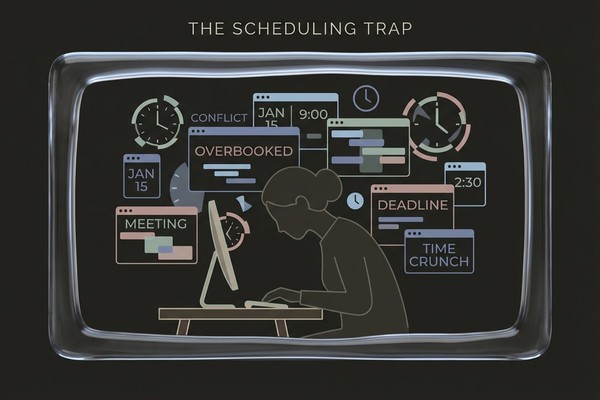
The calendar manager becomes the household air traffic controller, constantly adjusting flight paths to avoid collisions. You’re tracking not just what’s happening, but what could happen, what should happen, and what absolutely cannot happen at the same time.
This work is cognitive, emotional, and relentless. It requires holding multiple people’s preferences, constraints, and needs in your head simultaneously. It means being the person who remembers that your spouse hates morning appointments, that your kid gets cranky if they have back-to-back activities, that Grandma’s birthday dinner needs to happen before her actual birthday because of her travel schedule.
The Default Scheduler Trap
Here’s how it usually happens: someone in the household starts managing the calendar out of necessity or efficiency. Maybe they have more flexible work hours, or they’re naturally organized, or they just got tired of things falling through the cracks. It seems practical, even temporary.
But once you become the calendar manager, you become the calendar manager. The role expands to fill every scheduling need, and everyone else’s scheduling muscles atrophy from disuse. Family members stop tracking their own commitments because they know you’ll remember. They stop thinking ahead about conflicts because they trust you to spot them.
The person who manages the calendar doesn’t just track time—they become responsible for everyone else’s time.
This isn’t just about fairness, though the unequal distribution of labor matters. It’s about the cognitive load of being the person who holds the whole family’s temporal reality in their head. You can’t just show up to your own life—you have to orchestrate everyone else’s too.
The mental weight of this role is exhausting in ways that are hard to articulate. You’re not just busy; you’re responsible for preventing everyone else’s busy from turning into chaos. You’re the early warning system for scheduling conflicts, the buffer between your family and the consequences of poor planning.
When “Shared” Isn’t Actually Shared
Most families think they’ve solved this problem when they create a shared digital calendar. Everyone can see it! Everyone can add to it! Problem solved, right?
Except shared access isn’t the same as shared responsibility. A calendar that everyone can see but only one person actually manages isn’t shared—it’s broadcast. The mental work of coordination, conflict resolution, and follow-up still falls to the same person, just with better visibility into their labor.
True sharing would mean distributing not just the ability to add events, but the responsibility for thinking ahead, spotting conflicts, and solving scheduling puzzles. It would mean everyone taking ownership of their own temporal needs and constraints, not just expecting someone else to work around them.
But most shared calendar systems are designed around the assumption that one person will do the thinking for everyone else. They’re built for delegation, not distribution. The calendar manager can assign tasks and send reminders, but they’re still the one who has to notice what needs assigning and remembering in the first place.
The Politics of Scheduling Power
Control of the calendar is control of the household’s priorities. The person who manages the schedule gets to decide what matters enough to protect, what can be moved, and what gets squeezed out when there’s not enough time for everything.
This power is often invisible, even to the person wielding it. It doesn’t feel like power when you’re stressed about finding a time that works for everyone or staying up late to coordinate carpools. But the ability to shape how a family spends its time—arguably its most precious resource—is profound influence.
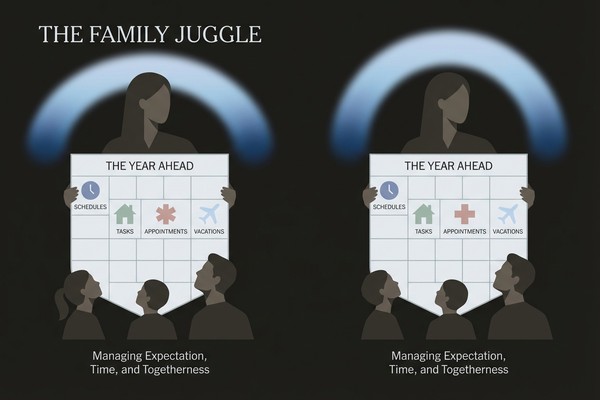
The calendar manager becomes the family’s chief operating officer by default, making decisions about trade-offs and priorities that affect everyone’s quality of life. Should we prioritize the kids’ activities or adult social time? How much buffer do we need between commitments? What’s worth the stress of a packed schedule?
These aren’t just logistical decisions—they’re value judgments about how the family should live. And when one person makes all of them, their preferences and tolerances become the family’s de facto policy.
Redesigning Responsibility
What would it look like if calendar management were actually distributed? Not just shared access to the same tool, but genuine distribution of the cognitive work?
Each family member would own their own scheduling needs and constraints. Instead of one person tracking everyone’s preferences and limitations, each person would be responsible for communicating their own. “I can’t do morning appointments” becomes an active constraint the person manages, not something someone else has to remember about them.
Conflict resolution would become collaborative rather than delegated. When schedules clash, the affected parties would work together to find solutions, rather than expecting the calendar manager to solve the puzzle alone.
Follow-up and reminders would flow from the people who need them, not the person managing the system. If you need to remember to bring something to an event, you’d set your own reminder rather than expecting someone else to think of it for you.
This kind of system would require everyone to develop their own scheduling awareness and skills. It would mean giving up the luxury of having someone else think ahead for you. But it would also mean no one person carries the cognitive weight of the entire household’s temporal coordination.
Real shared calendars would distribute the thinking, not just the viewing.
The technology for this kind of distribution exists, but the social systems don’t. We’re still operating under old assumptions about who should manage family logistics, assumptions that made more sense when one person wasn’t working outside the home. Modern families need modern coordination systems—ones that distribute mental load rather than just digitizing it.
The family calendar will always be political because time is finite and choices have to be made. But those choices don’t have to be made by one person carrying the invisible weight of everyone else’s schedules. The question isn’t whether someone will control the calendar—it’s whether that control will be shared or simply endured.
When we redesign our approach to family scheduling, we’re not just organizing time more efficiently. We’re redistributing one of the most significant forms of invisible labor in modern households. And that’s worth putting on the calendar.
This article was created with collaboration between humans and AI—we hope you ❤️ it.