
You delegate the task. You feel that brief moment of relief—one less thing on your plate. But then it happens: three days later, you’re lying in bed wondering if they actually did it. A week passes, and you’re crafting a “just checking in” message that you rewrite four times to avoid sounding pushy. Two weeks out, you’re doing detective work, scrolling through shared documents or casually asking mutual contacts if they’ve heard anything.
This is the follow-up tax, and it’s one of the most insidious forms of mental load because it masquerades as delegation. You think you’ve handed something off, but what you’ve really done is traded direct responsibility for ongoing surveillance. Instead of doing the work, you’re now managing whether the work gets done—and that management never ends.
The follow-up tax accumulates like compound interest. Each delegated task that lacks a built-in completion signal becomes a recurring mental subscription you didn’t sign up for. Your brain automatically enrolls in a monitoring service, checking and re-checking, wondering and worrying, until you either get confirmation or give up and do it yourself.
The Invisible Work of Verification
Most people don’t recognize follow-up as work because it feels like caring. When you check whether your teenager finished their college application, whether your colleague sent that email, or whether the contractor actually fixed the leak, it seems natural—responsible, even. But caring and working aren’t mutually exclusive, and this particular form of caring is exhausting.

The follow-up tax manifests in dozens of micro-moments throughout your day. You’re in a meeting, but part of your attention is wondering if the babysitter remembered to give your kid their medication. You’re trying to focus on a project, but you keep glancing at your phone to see if your partner responded about dinner plans. You’re falling asleep, but your mind is cycling through all the things you asked other people to handle, trying to calculate which ones might have fallen through the cracks.
This isn’t paranoia or control issues—it’s a rational response to living in a world where delegation often means “I’ll start it” rather than “I’ll finish it.” When people consistently deliver partial completion, your brain learns to stay vigilant. The follow-up tax becomes a protective mechanism, but like most forms of mental armor, it’s heavy to carry.
The Delegation Myth
We’ve been sold a story about delegation that sounds something like this: identify tasks that others can do, hand them off, and free up your mental space for higher-value work. It’s a compelling narrative, especially for overwhelmed parents and entrepreneurs who are drowning in responsibilities.
But here’s what that story gets wrong—it assumes that handing off a task automatically removes it from your cognitive load. In reality, most delegation simply converts direct work into supervisory work. You’re no longer doing the thing, but you’re still thinking about the thing, tracking the thing, and often redoing parts of the thing when it comes back incomplete.
True delegation transfers both the work and the worry.
Real delegation requires what systems thinkers call “closed-loop” processes—mechanisms that not only execute tasks but also confirm completion without requiring your ongoing attention. When you delegate to a closed-loop system, you get actual mental relief because the system owns the verification process.
Think about the difference between asking your partner to “handle dinner tonight” versus having a meal delivery service that automatically charges your card and sends a confirmation when the food is on its way. The first requires follow-up; the second provides closure. The first keeps dinner on your mental roster; the second removes it completely.
The Nagging Trap
The follow-up tax puts you in an impossible position. If you don’t check in, things fall through the cracks and you’re left scrambling to fix them at the last minute. If you do check in, you risk being labeled a micromanager or, worse, a nag.
This is particularly brutal for women, who often carry disproportionate mental load in both professional and personal contexts. When you follow up on delegated tasks, you’re simultaneously accused of not trusting people and blamed when things don’t get done. It’s a lose-lose dynamic that keeps you trapped in the verification loop.
The nagging versus managing distinction is largely about power and perception, not behavior. When a CEO follows up on quarterly reports, it’s called management. When a mom follows up on chores, it’s called nagging. The actions are identical, but the social interpretation varies based on who’s doing the asking and what authority they’re perceived to have.
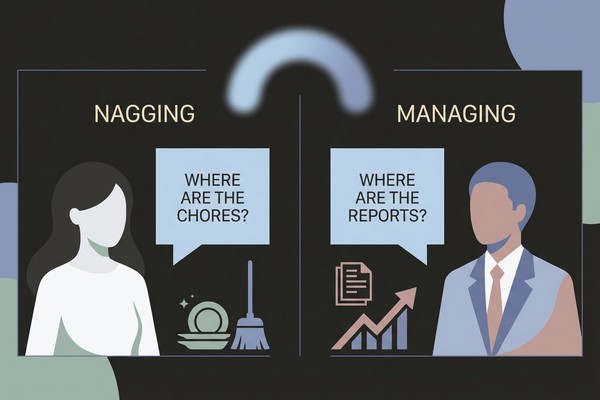
This gendered double standard makes the follow-up tax even more expensive for women, who not only have to do the cognitive work of tracking but also manage the emotional work of being perceived as reasonable while doing it. You have to follow up without seeming controlling, remind without seeming pushy, and verify without seeming paranoid.
The Attention Drain
The real cost of the follow-up tax isn’t just time—it’s attention. Every open loop in your delegation system creates what psychologists call a “Zeigarnik effect,” where unfinished tasks occupy mental bandwidth even when you’re not actively thinking about them.
Your brain treats delegated-but-unverified tasks like active projects. They stay loaded in your working memory, creating a constant low-level anxiety that drains your cognitive resources. You might not consciously think about whether your assistant booked that flight, but your subconscious is definitely tracking it, along with seventeen other delegated tasks in various states of completion.
This is why checking things off your to-do list feels so satisfying—it’s not just about completion, it’s about cognitive closure. But when you delegate without proper follow-up systems, you never get that closure. The tasks migrate from your to-do list to your worry list, where they consume mental energy indefinitely.
The attention drain compounds over time. Each new delegation adds another monitoring process to your mental background tasks. Eventually, you’re running so many verification loops that your brain feels like a computer with too many programs open—slow, overheated, and prone to crashes.
Building Closed-Loop Systems
The solution isn’t to stop delegating or to become a micromanager. It’s to redesign your delegation systems so they provide automatic closure without requiring your ongoing attention.
Closed-loop delegation has three essential components: clear completion criteria, built-in verification, and automatic notification. Instead of “can you handle the marketing report,” you say “can you send me the Q3 marketing report by Friday at 5 PM, with a calendar invite for Monday’s review meeting.” The task includes its own success metrics and creates its own follow-up.
For recurring delegations, you can build even more sophisticated loops. Set up shared documents that automatically notify you when updated. Create calendar reminders that prompt the other person to confirm completion. Use project management tools that require check-offs before moving to the next stage.
The goal is to make follow-up someone else’s job—either the person doing the task or the system managing the task. When your teenager’s college application deadline triggers automatic reminders to both of you, you’re not the one carrying the mental load of remembering. When your team uses a project management system that won’t let them mark tasks complete without uploading deliverables, you’re not the one wondering if things actually got done.
The best delegation systems make follow-up impossible to forget and unnecessary to manage.
Negotiating for Completion
Sometimes the solution isn’t better systems—it’s better conversations about what delegation actually means. Many people think they’re helping by taking tasks off your plate, but they don’t realize they’re leaving the verification work with you.
You can negotiate for true completion by being explicit about what closure looks like. Instead of accepting “I’ll take care of it,” ask “what will I see when this is done?” Instead of “thanks for handling that,” say “I’m marking this complete on my end—let me know if that changes.”
This isn’t about being controlling; it’s about being clear. When both parties understand that delegation includes confirmation, the follow-up tax disappears. The person taking on the task knows they’re not done until they’ve communicated completion, and you know you can stop thinking about it once you get that communication.
The conversation might sound like: “I’m going to take this completely off my mental plate, which means I need you to own not just doing it but also confirming it’s done. Can you send me a quick message when it’s finished so I know I can stop thinking about it?”
Most people are happy to provide closure once they understand why it matters. They just don’t realize that “handling” something includes handling the communication about handling it.
The Path Forward
The follow-up tax is expensive, but it’s not inevitable. By recognizing verification as real work, building closed-loop systems, and negotiating for complete delegation, you can actually achieve the mental relief that delegation promises.
This matters because true delegation—the kind that removes tasks from your cognitive load entirely—is one of the most effective ways to reduce mental burden. But fake delegation, the kind that converts direct work into supervisory work, often makes things worse by adding the stress of uncertainty to the stress of responsibility.
The next time someone offers to “help” by taking something off your plate, remember that real help includes taking the worry with it. Don’t settle for delegation that leaves you managing the management. Your attention is too valuable to spend on wondering whether things you’ve already delegated are actually getting done.
This article was created with collaboration between humans and AI—we hope you ❤️ it.