You know that feeling when you spend twenty minutes crafting the perfect email to decline a social invitation you don’t even want to attend? Or when you reorganize your sock drawer for the third time this month while your important project sits untouched? That’s perfectionism playing tricks on you, clustering in the wrong places like a GPS that keeps routing you through traffic jams.
Most of us don’t apply perfectionism evenly across our lives. Instead, it pools in strange places—often the domains where precision matters least and costs us most. Meanwhile, the areas that could genuinely benefit from our careful attention get whatever energy remains after we’ve exhausted ourselves perfecting things that were already fine.
This misallocation isn’t random. There’s a psychology to where perfectionism lands, and understanding it can help you redirect that energy toward what actually matters.
The Perfectionism Heat Map
Take a moment to map where your perfectionism clusters. Does it show up in your email responses but not your financial planning? In your home organization but not your professional development? In your appearance but not your relationships?
The pattern reveals something important: perfectionism often gravitates toward domains that feel controllable and immediate. It’s easier to perfect your morning routine than to have a difficult conversation with your boss. It’s more satisfying to curate the perfect Instagram post than to work on that creative project that might fail.

But here’s what’s particularly insidious about this pattern: perfectionism in low-stakes domains creates the illusion of progress while actually preventing it. When you spend an hour perfecting a grocery list, you feel productive. You’ve accomplished something. But that hour didn’t move you toward any meaningful goal—it just depleted the cognitive resources you needed for the work that actually matters.
The domains where perfectionism clusters often share certain characteristics. They’re visible to others, which feeds our need for external validation. They’re concrete and finite, which makes them feel manageable when other areas of life feel overwhelming. And crucially, they’re often areas where “good enough” would genuinely be sufficient, but perfectionism makes us believe otherwise.
The Hidden Cost of Misplaced Standards
When perfectionism camps out in the wrong domains, it doesn’t just waste time—it actively undermines your capacity for everything else. Cognitive resources aren’t infinite. The mental energy you spend crafting the perfect thank-you note is energy unavailable for strategic thinking about your career or being present with your family.
This is why so many high-achieving people feel simultaneously accomplished and stuck. They’re executing flawlessly in domains that don’t require flawless execution while letting truly important areas drift on autopilot.
Consider Sarah, who spends forty-five minutes each morning perfecting her daughter’s lunch—cutting sandwiches into perfect shapes, arranging fruit in aesthetic patterns, writing encouraging notes in calligraphy. The lunch looks Instagram-worthy, but Sarah arrives at work frazzled and behind schedule, unable to focus on the presentation that could advance her career. Her daughter, meanwhile, would be equally happy with a simple sandwich and an apple.
Perfectionism often gravitates toward what feels controllable while avoiding what feels consequential.
The cruel irony is that perfectionism in low-stakes domains often stems from anxiety about high-stakes ones. When we feel overwhelmed by big, important challenges, we unconsciously redirect our perfectionist energy toward smaller, more manageable targets. It’s psychological displacement—like cleaning your house when you’re avoiding a difficult phone call.
But this displacement comes with a cost. Every hour spent perfecting something that was already adequate is an hour not invested in areas where excellence actually matters. Every ounce of mental energy devoted to optimizing low-impact decisions is energy unavailable for high-impact ones.
The All-or-Nothing Fear
The biggest obstacle to releasing perfectionism in appropriate domains is the fear that any relaxation of standards will create a slippery slope. “If I let my email responses be just okay, what’s next? Will I stop caring about quality altogether?”
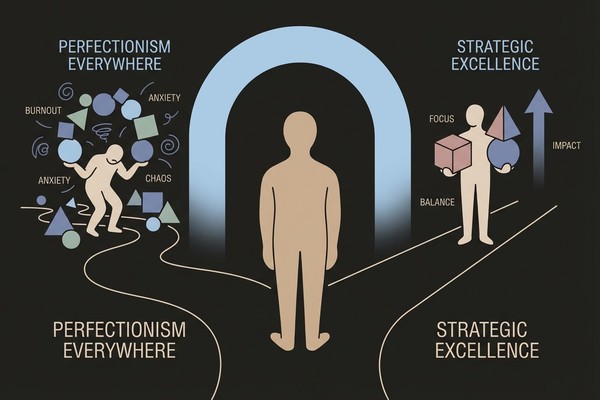
This fear reveals a fundamental misunderstanding about how standards work. Excellence isn’t a character trait that you either have or don’t have—it’s a resource that you allocate. The question isn’t whether you’re a perfectionist or not; it’s where you direct your perfectionist energy.
The most effective people aren’t those who maintain uniformly high standards across all domains. They’re those who maintain very high standards in a few crucial areas while allowing everything else to be good enough. They understand that excellence is about prioritization, not uniformity.
Think about it this way: a master chef doesn’t spend equal attention on every element of a dish. They might obsess over the sauce while using perfectly good but unremarkable vegetables. They know where their attention will have the greatest impact on the final result.
The Good Enough Experiment
Here’s a practical way to test this principle: choose one domain where you currently apply perfectionist standards but where good enough would genuinely be sufficient. Commit to operating at “good enough” in that domain for one month.
The key is choosing the right domain. It should be something that currently consumes disproportionate mental energy relative to its actual importance. Email responses are often a good candidate—most people won’t notice if your emails are 80% as polished as they usually are. Home organization is another common target—your family can function perfectly well with a “good enough” level of tidiness.
During this experiment, pay attention to two things. First, notice what doesn’t happen. Most fears about lowering standards are overblown. Your relationships won’t suffer if your dinner party decorations are simple rather than elaborate. Your professional reputation won’t crumble if your meeting notes are functional rather than perfectly formatted.
Second, and more importantly, notice what becomes possible with the freed mental energy. Do you find yourself more present in conversations? More creative in your work? Better able to tackle challenges you’ve been avoiding?
What Freed Capacity Is For
The goal of releasing perfectionism in appropriate domains isn’t to become lazy or careless. It’s to create capacity for what matters most. When you stop spending mental energy perfecting things that don’t need perfecting, that energy becomes available for areas where excellence actually makes a difference.
This might mean more bandwidth for strategic thinking about your career. It might mean more emotional availability for your relationships. It might mean more creative energy for projects that excite you but feel risky. The freed capacity isn’t meant to be filled with more tasks—it’s meant to enable deeper engagement with fewer, more important things.
The goal isn’t to care less about everything. It’s to care more about the right things.
The most profound shift often happens in your relationship with uncertainty and imperfection. When you practice accepting “good enough” in low-stakes domains, you build tolerance for the imperfection that’s inevitable in high-stakes ones. This makes you more willing to take meaningful risks and pursue ambitious goals, because you’re not paralyzed by the need for everything to be perfect.
Finding Your Good Enough Domain
As you consider where to apply this principle, ask yourself: What currently receives perfectionist attention but would function just fine at 80% of its current quality? What do you spend disproportionate time polishing that nobody else notices or cares about?
Common candidates include email tone and formatting, home organization beyond basic cleanliness, social media presentation, routine meal preparation, and administrative tasks that have clear “done” criteria.
The right domain for you is probably the one that makes you slightly uncomfortable to consider lowering standards in—but where, if you’re honest, you know good enough would genuinely be sufficient.
This isn’t about lowering your standards across the board. It’s about being strategic with where you apply your highest standards so they can have maximum impact. It’s about recognizing that perfectionism is a finite resource and choosing to spend it wisely.
The domains that deserve your perfectionist attention are those where excellence creates meaningful value—for you, for others, or for outcomes you care about. Everything else can be good enough, and good enough is often more than enough.
This article was created with collaboration between humans and AI—we hope you ❤️ it.