
There’s someone in your life who just “knows things.” They know which insurance covers what, where the spare keys live, who’s allergic to what, and when the car registration expires. They remember that your mom prefers texts over calls, that the Wi-Fi password changed last month, and that the good pediatrician books up three weeks out.
If you’re reading this, there’s a good chance that person is you.
This invisible role—being the household or team’s information hub—represents a full-time cognitive job that most people don’t even recognize as work. Yet it requires constant mental processing, pattern recognition, and the emotional labor of anticipating everyone else’s needs before they even know they have them.
The Daily Reality of Being Everyone’s Search Engine
Information management doesn’t look like sitting at a desk with spreadsheets. It looks like your partner asking “What’s the name of that place we went for Sarah’s birthday?” while you’re brushing your teeth. It’s your colleague pinging you because they can’t find the client’s preferred contact method. It’s your teenager wondering aloud about their friend’s address while you’re trying to focus on something else entirely.
The requests feel small and reasonable in isolation. Of course you’d help someone find information they need. But when you’re the designated repository for dozens of these details, the cognitive load compounds in ways that others don’t see.
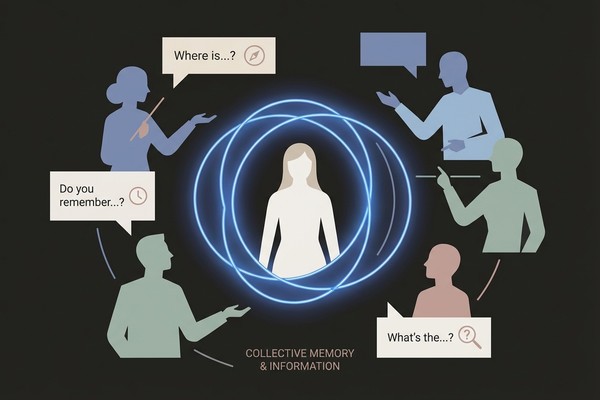
You become a human API—constantly fielding queries, cross-referencing mental databases, and providing context that you’ve accumulated through months or years of paying attention to details others let slide by. The work is real, even when it’s invisible.
Every time someone asks “Do you know where…?” or “What was the name of…?” they’re essentially saying “I’m going to borrow your brain for this task because I didn’t allocate mental resources to remember it myself.” The requester gets their answer and moves on. You get the ongoing responsibility of maintaining that information in case it’s needed again.
When One Person Becomes the Hub
The hub problem emerges gradually. You remember one thing, then another, then suddenly you’re the person everyone turns to for institutional knowledge. Maybe you’re naturally detail-oriented, or maybe you just started paying attention when others didn’t. Either way, you’ve become the single point of failure for information that affects everyone.
This concentration of context creates a peculiar form of inequality. While others can afford to forget details, you can’t. Their mental space stays clear while yours fills up with the overflow of collective memory needs. They can focus fully on their immediate tasks while part of your cognitive capacity is always reserved for fielding information requests.
The mental load isn’t just what you remember—it’s knowing that you’re the only one who remembers it.
The isolation compounds the burden. When you hold unique context, you can’t easily delegate or share the load. You can’t say “ask someone else” because there is no someone else who has that information. You become indispensable in ways that feel more like a trap than a privilege.
Teams and households often develop this pattern unconsciously. One person starts keeping track of a few extra details, others begin to rely on that person’s memory, and soon there’s an unspoken agreement that this person is the go-to source for information. What began as helpfulness becomes an expected service.
The Retrieval Tax: Constant Cognitive Interruptions
Perhaps the most draining aspect of being an information hub isn’t storing the data—it’s the constant retrieval requests. Every “quick question” represents a cognitive interrupt that requires you to pause your current thinking, search your memory, provide context, and then try to resume where you left off.
These interruptions rarely come at convenient times. You’re in the middle of focused work when someone needs the contractor’s phone number. You’re trying to wind down for the evening when your partner remembers they need to know about tomorrow’s schedule. You’re finally getting into a good book when someone can’t find the warranty information.
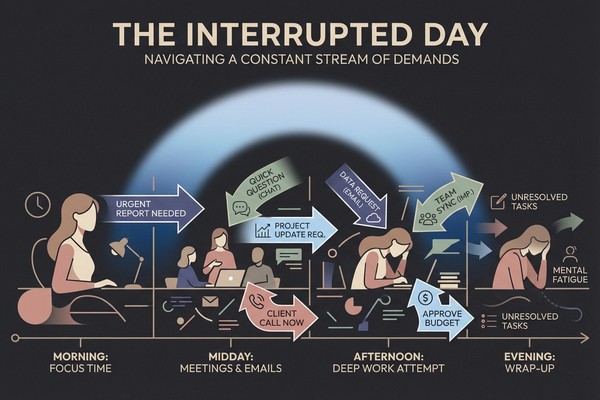
The retrieval tax isn’t just about the time each question takes—it’s about the cognitive switching costs and the background anxiety of knowing more requests are always coming. Your attention becomes partially fragmented because you’re unconsciously prepared to be interrupted at any moment.
Some days feel like being a customer service representative for your own life. You field inquiries, provide information, and troubleshoot problems that others encounter with systems you’ve been silently maintaining. The emotional labor is significant: staying patient and helpful while your own mental space gets constantly invaded.
Why Context Can’t Be Easily Shared
Well-meaning people often suggest solutions: “Why don’t you just write it all down?” or “Can’t you create a shared document?” These suggestions miss the fundamental nature of how information context works in human memory.
The details you hold aren’t just isolated facts—they’re interconnected webs of context, timing, preferences, and nuance. You don’t just know the pediatrician’s name; you know they’re booked out three weeks, they’re better with anxious kids than Dr. Smith, and they have a weird scheduling system that requires calling at exactly 8 AM. You don’t just know where the spare keys are; you know which door they work on, that the back gate key sticks, and that the garage remote is temperamental.
This contextual knowledge develops organically through repeated exposure and attention. It can’t be easily downloaded or transferred because it exists as pattern recognition in your brain, not as discrete data points. When someone else tries to use the “shared system,” they inevitably come back to you for the context that makes the information actually useful.
The tools that promise to solve this problem—shared calendars, family apps, team wikis—often create more work for the information hub rather than less. Now you’re not just remembering everything; you’re also maintaining digital systems that others don’t consistently use or update. The cognitive load increases rather than decreases.
The Cost of Constant Background Processing
Holding institutional knowledge for others means your brain never fully relaxes. There’s always a background process running, scanning for things that might need attention, remembering deadlines that affect other people, and maintaining awareness of systems that others take for granted.
This background processing creates a unique form of mental fatigue. Even when you’re not actively being asked for information, part of your cognitive capacity is allocated to monitoring and maintaining all the details you’re responsible for remembering. It’s like running multiple apps in the background on your phone—everything runs a little slower.
Your mind becomes a shared resource that everyone else gets to use without contributing to its maintenance.
The fear of forgetting adds another layer of stress. When others depend on your memory, the stakes feel higher. Forgetting an appointment doesn’t just affect you—it affects everyone who was counting on you to remember it. This pressure can make relaxation feel irresponsible, as if letting your guard down might cause some important detail to slip through the cracks.
The emotional weight is often heavier than the cognitive load itself. You start to feel responsible not just for remembering things, but for protecting others from the consequences of forgetting. Your mental space becomes a shared resource that everyone else gets to use without contributing to its maintenance.
The Invisible Inventory
Take a moment to consider what you uniquely hold in your head right now. Think about the information that others in your household or team regularly ask you for—details that would cause confusion, delays, or problems if you suddenly weren’t available to provide them.
Your list might include login credentials for shared accounts, the preferences and quirks of family members or clients, historical context about past decisions, the location of important documents, contact information for service providers, upcoming deadlines that aren’t in anyone else’s calendar, or the informal protocols that keep things running smoothly.
The length of this mental inventory often surprises people when they actually sit down to think about it. What felt like “just knowing a few extra things” reveals itself as a substantial database of information that you’re maintaining without compensation or acknowledgment.
Some of these details might seem trivial in isolation—knowing that your partner hates cilantro or that the client prefers morning meetings. But collectively, they represent a sophisticated understanding of the systems and relationships that define your daily environment. You’ve become a living, breathing context engine for everyone around you.
The realization can be both validating and overwhelming. Validating because it confirms that the mental fatigue you feel is real and justified. Overwhelming because it reveals the true scope of invisible labor you’ve been carrying.
Breaking the Hub Dependency
The goal isn’t to hoard information or refuse to help others—it’s to recognize that information management is genuine work that deserves intentional solutions rather than default delegation to whoever happens to have a good memory.
Real solutions involve distributing both the storage and the responsibility for maintaining information. This means creating systems where multiple people can access and update important details, but more importantly, it means shifting the cultural expectation that one person should be everyone’s external memory.
The problem isn’t that you remember too much—it’s that everyone else remembers too little.
Technology can help, but only when it’s designed to truly own the cognitive burden rather than just organizing it. Most apps and systems still require human oversight, maintenance, and interpretation. They shift the format of the work without reducing its mental load.
The most effective solutions combine external storage with genuine responsibility-sharing. When everyone in a household or team has access to important information and feels ownership over keeping it current, the cognitive burden distributes naturally. The hub person can finally step back from being everyone’s memory backup.
This isn’t about becoming less helpful or less engaged. It’s about creating sustainable systems where important information doesn’t live in just one person’s head, where the mental load of tracking and remembering gets shared more equitably, and where your cognitive space can be yours again.
The relief of not being the only person who knows things is profound. Your mind gets to focus on what matters to you instead of constantly managing what matters to everyone else. That’s not selfish—it’s sustainable.
This article was created with collaboration between humans and AI—we hope you ❤️ it.