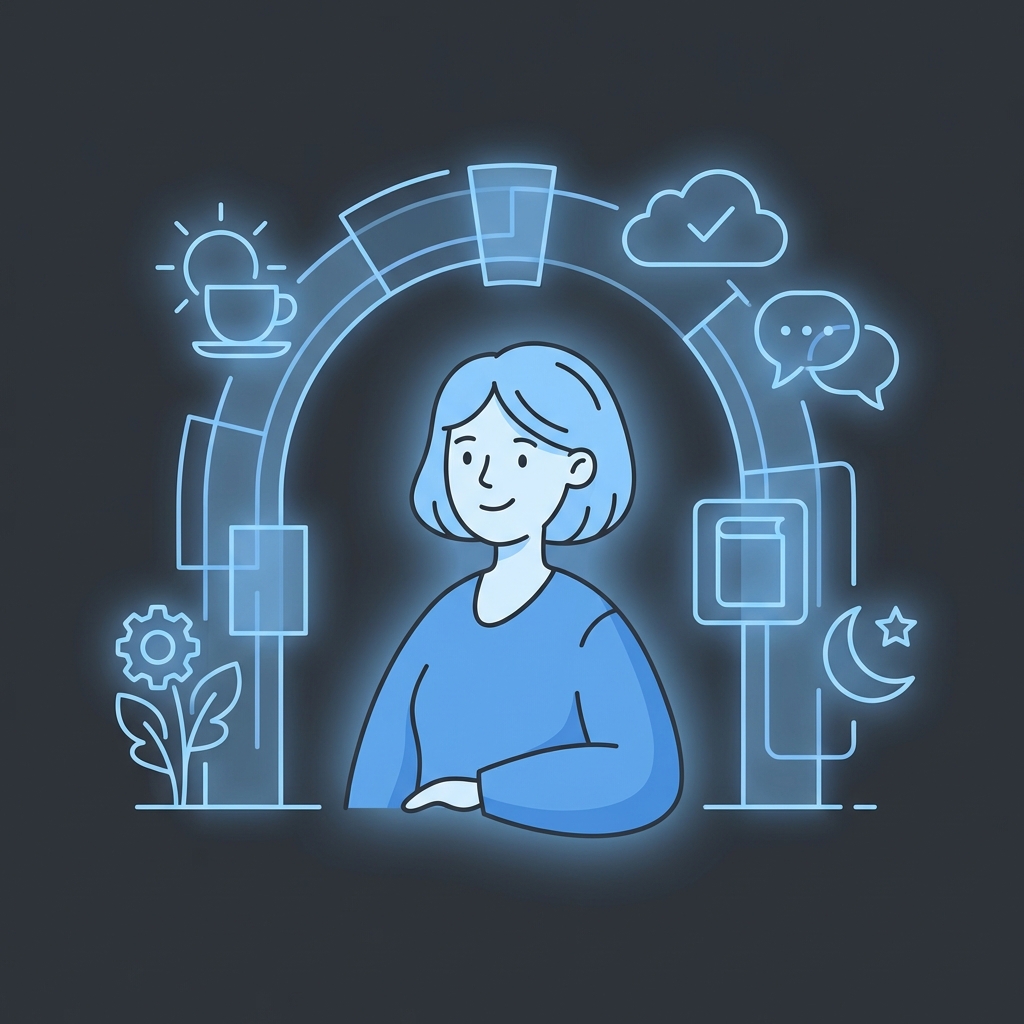
You wake up feeling good. The coffee maker started brewing at 6:47 AM because you set it the night before. Your workout clothes are folded on the dresser where you put them yesterday. Your phone is charging in the kitchen, not on your nightstand, so you don’t immediately fall into the scroll spiral. By 8 AM, you’ve moved your body, caffeinated your brain, and feel ready for whatever the day brings.
This isn’t about willpower or motivation. It’s about design.
Most people think good days happen when we feel motivated enough to make good choices. But behavioral science tells a different story. Our environment—the defaults, frictions, and cues that surround us—shapes our behavior far more than our intentions do. The difference between a day that flows and a day that fights you often comes down to tiny design decisions you made yesterday, last week, or months ago.
We call this choice architecture: the way options are presented and environments are structured to influence behavior. It’s happening whether you’re conscious of it or not. The question is whether you’re designing it intentionally.
The Tyranny of Tiny Decisions
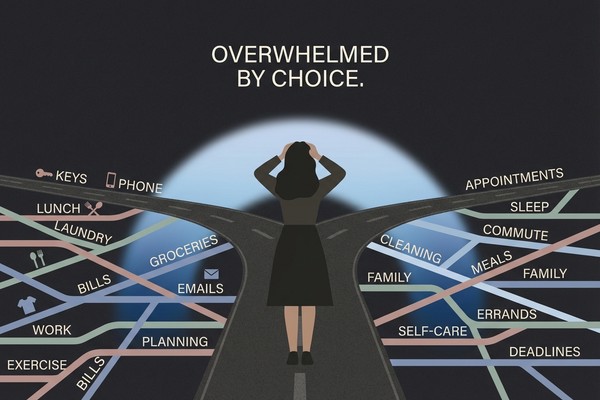
Every day, you make thousands of micro-decisions. Where to put your keys. Whether to check your phone. What to eat for lunch. Whether to fold the laundry now or later. Each decision requires mental energy, and that energy is finite.
When your environment forces you to actively decide everything, you’re essentially running a marathon of choice-making before breakfast. No wonder you feel exhausted by 2 PM.
But here’s what’s fascinating: most of these decisions don’t actually need to be decisions at all. They can be defaults.
The most powerful behavioral lever you’re probably not using is the default option. Defaults work because they eliminate decision-making. When something is set up to happen automatically, it usually does. When it requires an active choice, it often doesn’t.
Think about your retirement savings. If your employer automatically enrolls you in a 401k, you’re likely to participate. If they make it opt-in, requiring you to fill out forms and make investment choices, participation drops dramatically. Same person, same financial incentives, completely different outcomes based on design.
Defaults don’t just influence what we do—they become what we do.
Your daily life is full of these same dynamics. The apps on your phone’s home screen become your default entertainment. The snacks on your counter become your default hunger solution. The chair where you dump your clothes becomes your default “closet.”
Most people have accidentally designed their lives around bad defaults. The good news? You can redesign them.
Friction as Your Friend
Conventional productivity advice treats friction as the enemy. Remove all barriers! Optimize everything! Make it as easy as possible to do the thing!
But friction is actually a design tool. The key is applying it strategically: reduce friction for behaviors you want to encourage, increase friction for behaviors you want to discourage.
Want to eat more vegetables? Wash and chop them when you get home from the grocery store, then put them at eye level in clear containers. Want to eat fewer processed snacks? Put them in the pantry, behind the healthy stuff, in opaque containers.
Want to exercise more regularly? Lay out your workout clothes the night before. Want to scroll social media less? Log out of the apps after each use, or better yet, delete them from your phone entirely and access them only through a browser.
This isn’t about creating impossible barriers. It’s about introducing just enough friction to interrupt automatic behavior and create space for intentional choice.
The magic happens in that tiny pause. When reaching for your phone requires unlocking a drawer, you might notice that you weren’t actually looking for anything specific—you were just seeking stimulation. When making coffee requires grinding beans, you might decide you don’t actually need that third cup.
The Silent Influence of Cues
Your environment is constantly whispering suggestions about what to do next. The book on your nightstand suggests reading. The yoga mat in the corner of your bedroom suggests stretching. The pile of papers on your desk suggests anxiety.
Environmental cues work below the level of conscious awareness. You don’t actively think, “I see running shoes, therefore I should run.” But seeing running shoes makes running slightly more likely than if they were buried in a closet.
This is why organizing isn’t just about aesthetics—it’s about behavior design. When everything has a place and you can see what you have, you’re more likely to use what you intended to use and less likely to buy duplicates or forget about things entirely.
Consider your kitchen. If healthy ingredients are visible and accessible, you’re more likely to cook. If takeout menus are prominently displayed and cooking requires digging through cluttered cabinets, you’re more likely to order delivery.
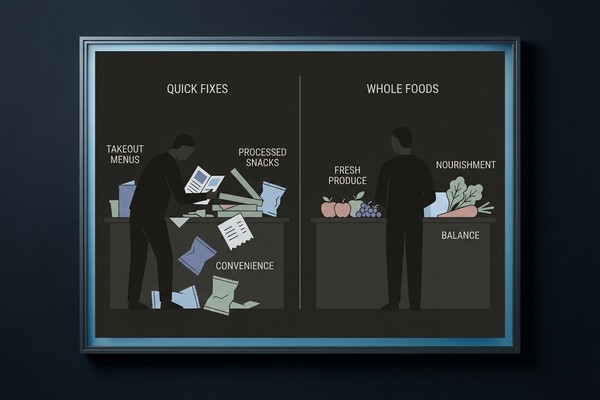
The most effective environmental cues are ones that make good choices obvious and bad choices invisible. This doesn’t mean hiding everything or creating a sterile environment. It means being intentional about what gets prime real estate in your visual field.
Case Study: The Morning Routine That Runs Itself
Sarah used to start every morning in crisis mode. She’d wake up, immediately check her phone, realize she was running late, frantically search for clean clothes, skip breakfast, and arrive at work already depleted.
Her transformation didn’t involve becoming a different person. It involved redesigning her environment.
She moved her phone charger to the kitchen, so checking messages required getting out of bed. She started laying out clothes the night before. She bought a coffee maker with a timer and set it to start brewing ten minutes before her alarm.
But the real breakthrough was the breakfast default. Instead of deciding what to eat each morning, she batch-prepared overnight oats on Sunday. Five jars in the fridge, grab and go.
The goal isn’t to eliminate choice—it’s to eliminate the choices that don’t matter so you can focus on the ones that do.
Now Sarah’s mornings flow. She wakes up to the smell of coffee. Her clothes are ready. Her breakfast is ready. She has mental energy for the decisions that actually matter: how to approach a difficult conversation with her boss, whether to take the new project, what to cook for dinner.
The Redesign Audit
Here’s a simple exercise: pick one area of your life that consistently creates friction or stress. Your morning routine, your workspace, your kitchen, your evening wind-down.
Now audit it for hidden design problems. What requires unnecessary decisions? What makes good choices harder than bad choices? What environmental cues are working against your intentions?
Don’t try to fix everything at once. Pick the smallest change that would create the biggest relief. Maybe it’s putting a water bottle on your desk so you don’t have to remember to stay hydrated. Maybe it’s setting up a charging station by the door so your devices aren’t scattered throughout the house.
The changes that stick are usually smaller than you think they need to be and more powerful than you expect them to be.
Beyond Personal Optimization
This isn’t just about individual behavior change. It’s about recognizing that we’re all operating within systems—and those systems can be designed to support us rather than drain us.
The best tools and services understand this. They don’t just give you features; they embed good defaults. They don’t just remove friction; they add strategic friction in the right places. They don’t just respond to your requests; they anticipate your needs and handle things before you have to think about them.
When you’re evaluating any system in your life—whether it’s a app, a workspace, or a household routine—ask yourself: Is this designed to reduce my mental load, or is it shifting more responsibility onto me?
The difference between a good day and a hard day often comes down to this: how much of your mental energy goes toward making the day work versus living the day itself. Good design handles the mechanics so you can focus on what matters.
Your environment is already shaping your behavior. The question is whether you’re going to be intentional about how.
This article was created with collaboration between humans and AI—we hope you ❤️ it.