
You know that feeling when you’re lying in bed, almost asleep, and suddenly remember you never responded to your friend’s text about dinner plans? Or when you’re in the middle of a work meeting and realize you forgot to follow up on that insurance claim from three weeks ago? Welcome to your invisible inbox—the mental repository of all the conversations, commitments, and loose ends that didn’t make it into your regular email but somehow made it onto your brain’s permanent to-do list.
Unlike your regular inbox, this one doesn’t have a little red notification badge. It doesn’t ping or buzz or demand immediate attention. Instead, it hums quietly in the background of your consciousness, a constant low-level anxiety that something, somewhere, is waiting for you to remember it exists.
The Weight of Unfinished Business
Your invisible inbox is filled with what psychologists call “open loops”—unfinished business that your brain refuses to forget. There’s the text from your sister asking about holiday plans that you read while rushing to a meeting and never answered. The follow-up appointment you need to schedule after your doctor visit last month. The thank-you note you’ve been meaning to send to your neighbor who watched your cat. The colleague who asked for feedback on their presentation, and you said “I’ll get back to you soon.”
Each of these feels small in isolation. None of them would take more than five minutes to handle. But together, they create what researchers call the “unfinished business effect”—our brains literally cannot let go of incomplete tasks. They continue to occupy mental resources even when we’re not actively thinking about them, like apps running in the background of your phone, slowly draining the battery.
The cruel irony is that the more conscientious you are, the heavier this invisible inbox becomes. People who care about maintaining relationships and meeting obligations naturally accumulate more open loops. You remember that you owe someone a response precisely because you care about not letting people down. The person who never follows up? Their invisible inbox is probably blissfully light.

The Anxiety of Always Owing
What makes the invisible inbox particularly exhausting is how it transforms you from someone who has things to do into someone who owes things to others. Regular tasks feel manageable—you can prioritize them, schedule them, or even decide not to do them. But follow-ups carry social weight. Someone is waiting. Someone might be wondering why you haven’t responded. Someone might think you’re rude, unreliable, or just don’t care.
This social dimension creates a specific type of anxiety that productivity systems rarely address. It’s not just about getting things done; it’s about maintaining your reputation as a person who follows through. The stakes feel higher because they involve other people’s perceptions and feelings. You start avoiding certain conversations or delaying responses even further because you feel guilty about how long you’ve already waited.
The invisible inbox doesn’t just track what you need to do—it tracks who you’re disappointing.
The avoidance cycle is particularly vicious with follow-ups. The longer you wait to respond to something, the more awkward the response becomes, which makes you want to wait even longer until you can craft the perfect apology-response hybrid. Meanwhile, the open loop grows heavier in your mental space, taking up more emotional energy than the original task ever would have required.
When Being Reliable Becomes Unreliable
Here’s the paradox that nobody talks about: the very quality that makes you accumulate follow-ups—being someone who cares about relationships and commitments—is the same quality that makes you feel terrible when you can’t keep up with them all. You become unreliable not because you don’t care, but because you care so much that you’ve overloaded your system.
Most advice about follow-ups focuses on efficiency: batch your responses, set reminders, use templates. But efficiency misses the emotional core of the problem. You’re not struggling with follow-ups because you need better time management. You’re struggling because you’re trying to maintain connection and care for others while managing everything else in your life, and there’s no system that acknowledges how much emotional labor that requires.
The people who seem effortlessly good at follow-ups often have something the rest of us don’t: either fewer competing priorities or a higher tolerance for letting some things slide. They’re not necessarily more organized—they’re just operating with different constraints or different standards.
A Gentler Approach to the Invisible Inbox
Instead of trying to optimize your way out of follow-up overload, what if you approached your invisible inbox with the same compassion you’d show a friend who was overwhelmed? The goal isn’t to become a follow-up machine; it’s to find a sustainable way to maintain relationships without sacrificing your mental health.
Start by making the invisible visible. Take fifteen minutes to brain-dump everything you can remember that’s waiting for a response. Don’t organize it yet—just get it out of your head and onto paper or into a document. You’ll probably feel simultaneously relieved and overwhelmed. That’s normal. You’re seeing the full weight of what your brain has been carrying.
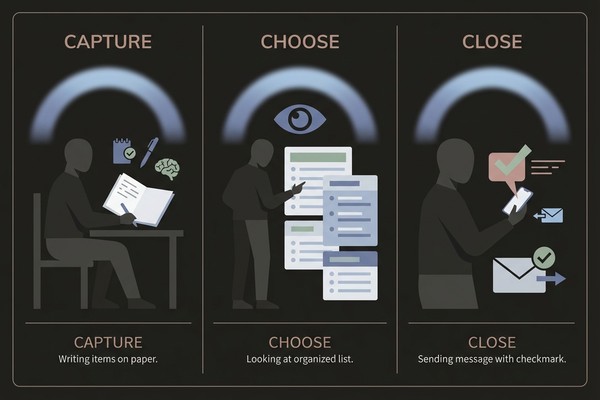
Now comes the crucial part: categorizing not by urgency, but by emotional weight. Some follow-ups are light—a quick “thanks for thinking of me” or “let me check my calendar and get back to you.” Others are heavy—they require emotional energy, careful wording, or significant time investment. Honor this distinction instead of treating all follow-ups as equal.
For the light ones, batch them during a time when you have decent energy but don’t need to think deeply. Friday afternoons work well for many people. For the heavy ones, schedule them like you would any other important task, with adequate time and mental space.
Scripts for Closing Loops
One of the biggest barriers to clearing your invisible inbox is not knowing what to say, especially when you’ve waited longer than feels comfortable. Here’s the secret: most people are more understanding than you think, and a slightly late response is almost always better than no response.
For delayed responses, acknowledge the delay without over-apologizing: “Thanks for your patience on this—I wanted to give your question the attention it deserves.” For requests you can’t fulfill: “I wish I could help with this, but I don’t have the bandwidth right now. Hope you find a great solution.” For social invitations you’ve missed: “Just saw this—sounds like it was wonderful! Hope we can catch up soon.”
The key is to respond in a way that closes the loop definitively. Vague responses like “I’ll think about it” or “maybe later” just create new open loops. If you’re not sure about something, say so clearly: “I’m not sure about my availability yet, but I’ll know by Friday and will let you know then.”
A clear no closes a loop. A maybe keeps it spinning.
Beyond Personal Systems
The truth is, individual follow-up systems can only take you so far when you’re operating in a world that generates infinite opportunities for connection and obligation. Every social media platform creates new ways to accumulate follow-ups. Every relationship in your life has the potential to generate open loops. Every professional interaction can spawn a trail of next steps and check-ins.
What we really need are systems that understand the emotional labor of follow-ups and can help carry some of that load. Not just reminders to respond, but gentle nudges that account for your capacity and energy levels. Systems that can distinguish between the quick responses and the ones that need your full attention. Tools that help you maintain relationships without turning you into a productivity machine.
Your invisible inbox isn’t a personal failing—it’s a natural result of being someone who cares about others in a world that generates endless opportunities for caring. The goal isn’t to empty it completely, but to make it feel manageable rather than overwhelming. Sometimes the most productive thing you can do is acknowledge that you can’t respond to everything, and that’s okay too.
The people who matter will understand. The ones who don’t probably weren’t worth the mental space anyway.
This article was created with collaboration between humans and AI—we hope you ❤️ it.