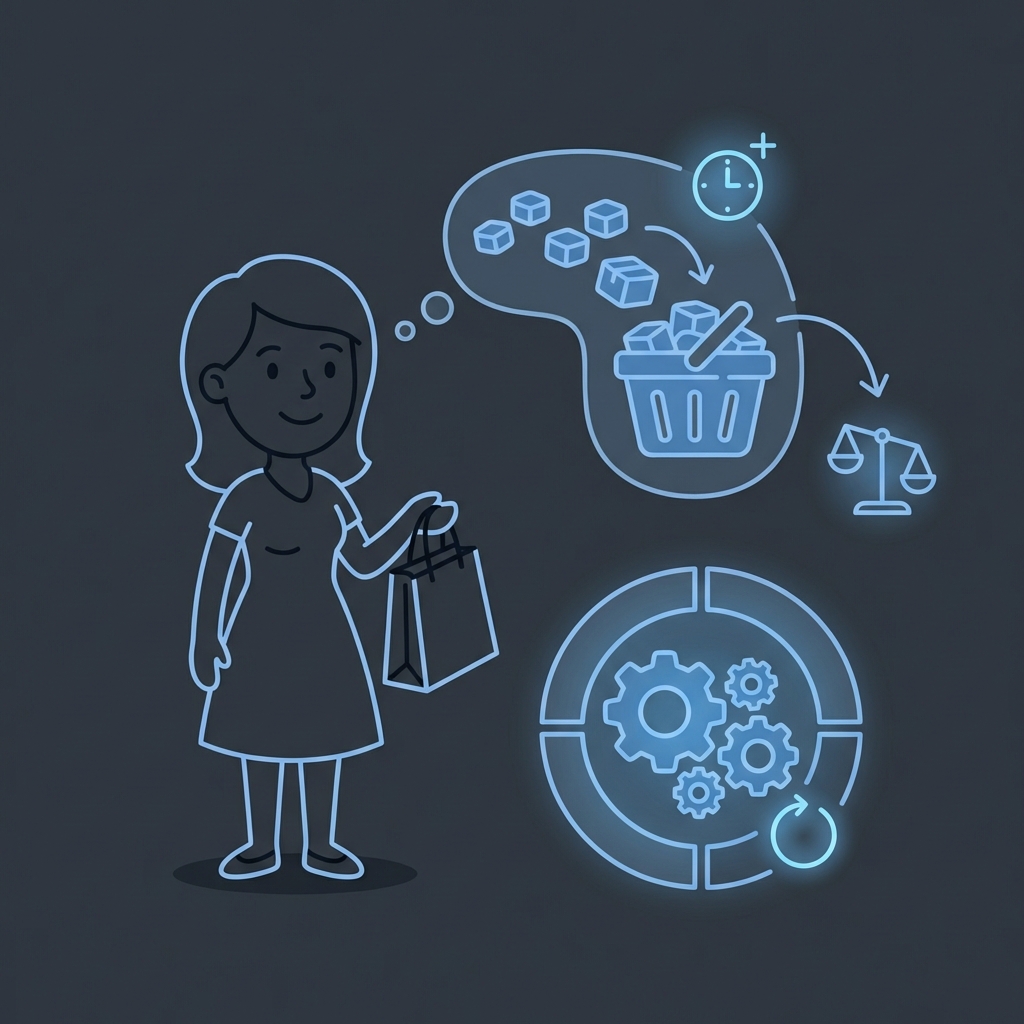
You know that moment when someone says “this will just take five minutes” and suddenly your entire afternoon has vanished? That’s the ‘just one more thing’ tax in action—the hidden cost of tasks that masquerade as quick wins but actually hijack your mental bandwidth for hours.
I used to think I was terrible at time management because a simple email reply would somehow consume my entire morning. Turns out, I wasn’t broken. I was experiencing what happens when we treat cognitive work like it’s invisible.
The truth is, there are no truly “quick” tasks when you’re already carrying mental load. Every small thing comes with setup, decisions, and cleanup that nobody talks about. And the real kicker? These tiny tasks don’t just steal time—they fragment your attention in ways that make everything else harder.
The Hidden Architecture of “Simple” Tasks
Let’s take something genuinely simple: returning an online order. In productivity land, this gets filed under “quick errand” and assigned maybe fifteen minutes. But here’s what actually happens.
First, you need to find the order confirmation email, which means remembering which email account you used and searching through weeks of messages. Then you discover the return window is closing tomorrow, so now there’s urgency. You start the return process but realize you need the original packaging, which is somewhere in the garage. While looking for the box, you find three other things that also need to be returned, and suddenly you’re managing a whole return operation.
But wait—there’s more. The return requires printing a label, but your printer is out of ink. Adding printer ink to your mental list triggers the memory that you also need to pick up dry cleaning, and oh right, you were supposed to call about that insurance thing. What started as a five-minute return has become a sprawling web of related tasks, each carrying its own cognitive weight.
The ‘just one more thing’ tax isn’t about the task itself—it’s about everything the task pulls into orbit.
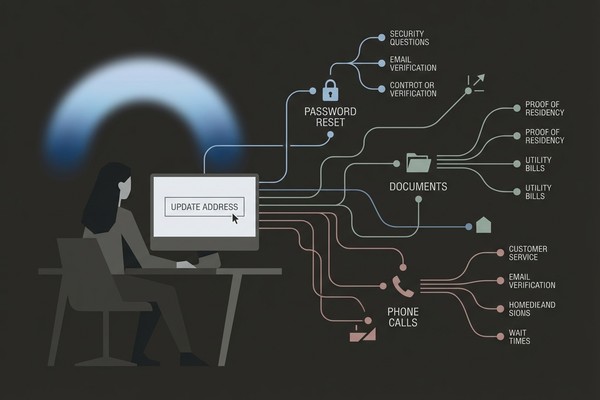
This is why productivity systems that treat tasks as isolated units miss the point entirely. They ignore the gravitational pull that small tasks have on everything around them. When you sit down to “quickly” update your address with the bank, you’re not just filling out a form. You’re entering a decision tree that branches into password resets, security questions, document uploads, and follow-up calls.
The Fragmentation Effect
Here’s where it gets worse. These micro-tasks don’t just expand—they fragment your attention in ways that make everything else harder. Cognitive scientists call this “task-switching cost,” but that clinical term doesn’t capture the exhaustion of constantly pivoting between different types of thinking.
When you interrupt focused work to “quickly” respond to a text, you’re not just losing those two minutes. You’re losing the mental thread you were following, the context you had built up, the flow state you were entering. Research shows it can take up to 23 minutes to fully refocus after an interruption, but most of us get interrupted again long before we’ve recovered.
The cruel irony is that we often tackle these small tasks precisely because we think they’ll clear our mental space for bigger work. Instead, they fill our heads with loose ends and half-finished processes. You send that “quick” email but now you’re waiting for a response. You make that brief call but need to follow up next week. You order that replacement item but have to track the delivery.
Each micro-task becomes a tiny subscription to future mental load. And unlike a streaming service you can cancel, these cognitive subscriptions auto-renew every time you glance at your phone or remember something you forgot to do.
Why Batching Isn’t Enough
The standard productivity advice here is batching—group similar tasks together and knock them out in focused blocks. This works better than scattered micro-tasking, but it still misses something crucial about how these tasks actually behave.
Batching assumes that tasks stay the same size when you group them. But often, the opposite happens. When you sit down to batch all your “quick calls,” you discover that three of them require information you don’t have, two need to be rescheduled, and one connects you to a phone tree that takes twenty minutes to navigate. Your efficient batch becomes a frustrating marathon of problem-solving and decision-making.
The other issue with batching is that it still puts you in charge of remembering, organizing, and executing everything. You’re the project manager of your own micro-task collection, which means mental load hasn’t actually decreased—it’s just been reorganized.
Batching organizes the work, but it doesn’t eliminate the cognitive overhead of being the person who remembers and manages everything.
A Better Approach: The Micro-Task Inbox
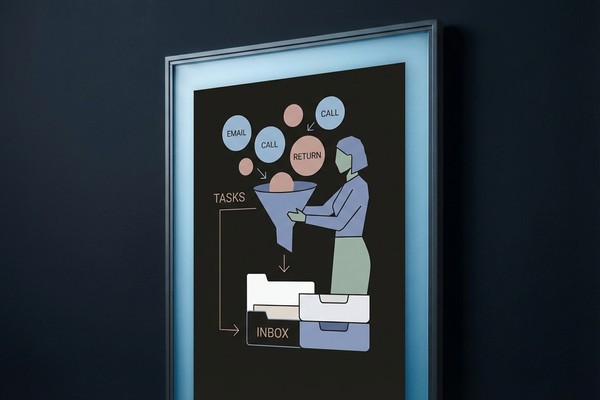
Instead of trying to optimize micro-tasks, what if we treated them like what they really are—cognitive interruptions that need to be captured and processed systematically? This is where the concept of a micro-task inbox becomes useful.
The idea is simple: when a small task pops into your head or gets dropped on you, you don’t do it immediately and you don’t try to schedule it. You capture it in a dedicated space with enough context that you can process it later without having to re-remember everything.
This isn’t just another to-do list. It’s a holding pattern for cognitive interruptions. When someone asks you to “quickly” send them that document, instead of stopping what you’re doing, you note: “Send Q3 report to Sarah - it’s in the shared drive under 2024 folders, she needs it for the board meeting prep.” Now you can return to your actual work without losing the thread.
The key difference is that you’re not trying to make these tasks more efficient. You’re trying to make them less disruptive. The goal isn’t optimization—it’s containment.
The Weekly Sweep Strategy
Once a week, you process the micro-task inbox in a dedicated session. This isn’t about powering through everything—it’s about triaging what actually needs your personal attention versus what can be delegated, automated, or eliminated.
During the weekly sweep, you’ll often discover that tasks have resolved themselves, become irrelevant, or can be combined with other things you’re already doing. That “urgent” form you captured on Tuesday might have been superseded by a new process announced on Thursday. The call you thought you needed to make might have been handled by someone else.
This approach acknowledges something that traditional productivity advice ignores: not all tasks that feel urgent actually need to be done by you, or done at all. The micro-task inbox creates space between the initial trigger and your response, which often reveals better solutions than immediate action.
What to Hand Off
The real power of this system comes from recognizing which parts of micro-tasks can be offloaded entirely. Most small tasks have three components: preparation (gathering information, finding documents), execution (making the call, filling the form), and follow-up (tracking responses, scheduling next steps).
You might need to be the one who makes the decision or provides the information, but you don’t necessarily need to be the one who researches the phone number, schedules the call, or follows up on the response. A good assistant—human or AI—can handle the preparation and follow-up, leaving you to focus on the parts that actually require your judgment.
The preparation work is often the most time-consuming part anyway. Finding the right contact information, locating the relevant documents, understanding the requirements—this research phase is where “quick” tasks balloon into hour-long projects. When someone else handles this groundwork, your five-minute task actually becomes five minutes.
The Background Assistant Advantage
This is where the concept of a background assistant becomes compelling. Unlike traditional AI tools that require you to remember to use them, a background assistant can monitor your micro-task inbox and proactively handle the preparation work.
When you capture “need to dispute this charge on credit card,” a background assistant can look up the dispute process for that specific card, find the relevant phone numbers, gather the transaction details, and prepare a summary of the key information you’ll need for the call. When you’re ready to make the call, everything is organized and waiting for you.
The assistant doesn’t make the call for you—it removes the friction that makes simple calls complicated. It handles the cognitive overhead so you can focus on the actual communication or decision-making that requires your personal attention.
The goal isn’t to eliminate micro-tasks entirely—it’s to eliminate the mental fragmentation they create.
Holding Less, Not Doing More
The ‘just one more thing’ tax is ultimately about cognitive burden, not time management. When we treat small tasks as if they exist in isolation, we miss the way they interconnect and multiply in our minds. The solution isn’t to get better at juggling—it’s to recognize that some things don’t need to be juggled by you at all.
The next time someone says “this will just take five minutes,” remember that they’re only counting the execution time. They’re not counting the setup, the decisions, the follow-up, or the mental space that task will occupy until it’s completely resolved. Those hidden costs are real, and they add up faster than we realize.
The micro-task inbox isn’t about becoming more productive—it’s about becoming more intentional about what deserves your mental bandwidth. Some things are worth the cognitive investment. Most things aren’t. The trick is creating enough space between the ask and your response to tell the difference.
This article was created with collaboration between humans and AI—we hope you ❤️ it.