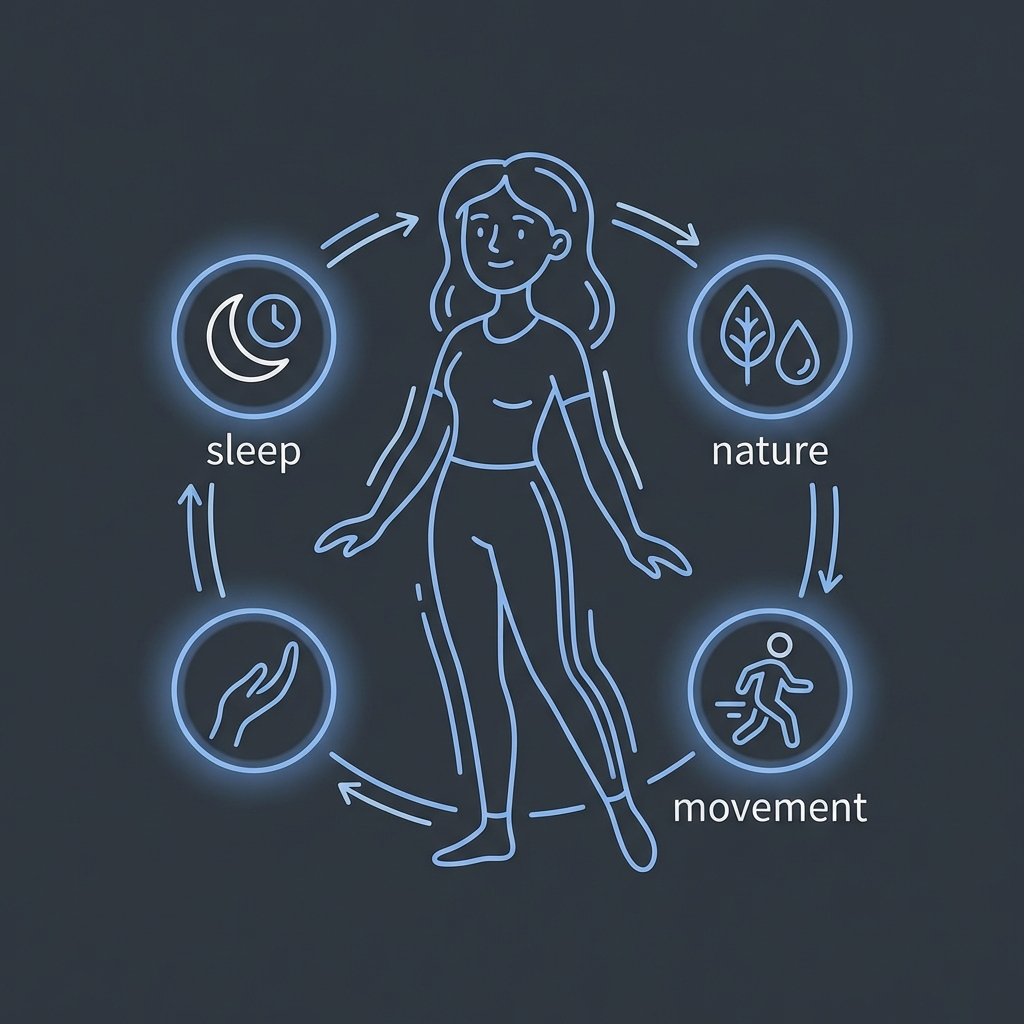
The productivity world wants you to believe that the right morning routine will solve everything. Wake at 5 AM, meditate for twenty minutes, journal three pages, work out for an hour, drink your green smoothie, and somehow you’ll transform into a person who has their life together. But what happens when your toddler has a meltdown at 5:15 AM? When you’re traveling for work? When you’re managing a family crisis or your own mental health struggles?
The truth is, most routine advice is built for people living in controlled environments with predictable schedules. It assumes you have the bandwidth to maintain elaborate systems when life gets messy. But real life—especially for working parents, caregivers, and anyone juggling multiple responsibilities—is inherently unpredictable.
Instead of chasing the perfect routine that crumbles at the first sign of chaos, what if we built something more resilient? Something that could bend without breaking, that could shrink down to almost nothing on hard days and expand when we have more capacity?
The Problem with Rigid Routines
Traditional routine advice treats humans like machines that need optimization. It assumes that if you just find the right sequence of activities and stick to them religiously, you’ll achieve some state of perpetual productivity and wellness. But humans aren’t machines. We have emotions, relationships, bodies that get sick, lives that shift unexpectedly.
The people who need routines most—those carrying heavy mental loads, managing complex family dynamics, or navigating demanding careers—are often the ones for whom rigid routines feel most impossible. You start with the best intentions, maybe even succeed for a few days, but then life happens. A work deadline hits. A child gets sick. Your energy crashes. The routine falls apart, and you’re left feeling like you’ve failed at something that was supposed to help you.
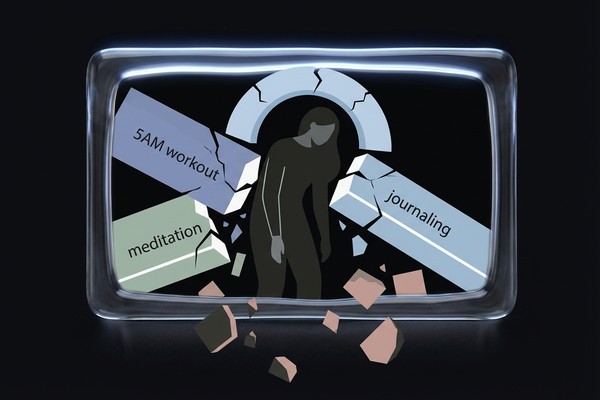
The guilt compounds the original problem. Not only are you dealing with whatever disrupted your routine, but now you’re also carrying the shame of being someone who “can’t stick to anything.” The routine that was meant to reduce your mental load has actually added to it.
This is where the minimal routine concept comes in. Instead of building an elaborate structure that requires perfect conditions to maintain, we create a few anchor points that can hold steady even when everything else is shifting.
Building Your Anchor System
Think of anchors as the non-negotiable foundations that keep you tethered to stability, even in rough waters. They’re not about optimization or improvement—they’re about basic human maintenance. The goal isn’t to become a better version of yourself; it’s to remain a functioning version of yourself when life gets overwhelming.
There are five main categories of anchors, and the key is choosing just two or three that matter most for your current season of life.
Sleep anchors are about protecting your rest, not perfecting it. This might mean a consistent bedtime, a phone-free bedroom, or simply ensuring you get horizontal for a certain number of hours each night. It’s not about becoming a sleep optimization expert; it’s about acknowledging that your brain and body need recovery time.
Meal anchors ensure you’re feeding yourself regularly and adequately. This could be as simple as eating something within an hour of waking up, having protein with lunch, or keeping emergency snacks in your car. It’s not about meal planning or nutrition optimization—it’s about preventing the blood sugar crashes that make everything else harder.
Movement anchors keep your body from completely seizing up under stress. This might be a five-minute walk after lunch, stretching before bed, or dancing to one song in your kitchen. The goal isn’t fitness; it’s maintaining the basic mind-body connection that stress tends to sever.
Connection anchors protect your relationships and sense of belonging. This could be texting one friend each day, having dinner at the table instead of in front of screens, or scheduling weekly calls with family. It’s not about networking or social optimization—it’s about remembering you’re not alone in the world.
Admin anchors handle the basic maintenance of adult life. This might be checking your calendar each morning, dealing with mail as it arrives, or spending ten minutes each evening preparing for the next day. It’s not about productivity systems or life hacking—it’s about preventing small administrative tasks from becoming overwhelming emergencies.
The goal isn’t to become a better version of yourself; it’s to remain a functioning version of yourself when life gets overwhelming.
The Hard Day Version
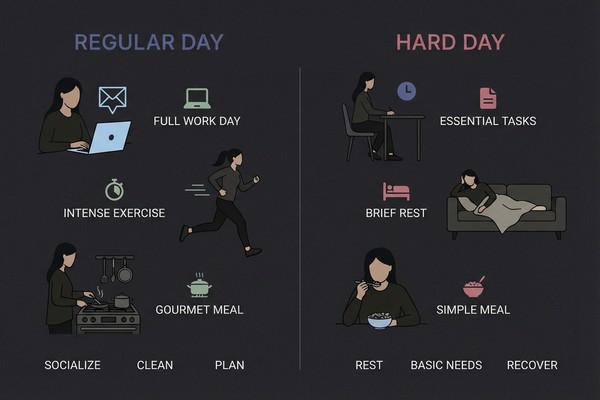
Here’s where the minimal routine concept really shines: every anchor needs a “hard day” version. This is the absolute minimum you can do to maintain that anchor when everything is falling apart. It’s your emergency protocol, designed for when you’re sick, overwhelmed, traveling, or dealing with a crisis.
If your usual sleep anchor is being in bed by 10 PM with a book, your hard day version might be just setting a phone alarm to remind yourself to consider going to sleep. If your movement anchor is normally a 20-minute walk, your hard day version could be standing up and stretching for 30 seconds.
The hard day version isn’t about maintaining standards—it’s about maintaining connection. It keeps the anchor from disappearing entirely during difficult periods, which makes it easier to return to the full version when you have more capacity.
This is revolutionary because most routine advice treats any deviation as failure. But the minimal routine framework expects disruption and plans for it. It removes the shame spiral that typically accompanies broken routines and replaces it with a practical fallback plan.
Choosing Your Starting Anchors
The question isn’t which anchors are objectively most important—it’s which ones would most protect your nervous system right now. This requires honest self-assessment about where you’re most vulnerable.
If you’re someone who skips meals when stressed and then crashes hard in the afternoon, a meal anchor might be your priority. If you’re isolated and feeling disconnected from the people you care about, a connection anchor could be most stabilizing. If you’re constantly forgetting important tasks and then scrambling to catch up, an admin anchor might give you the most relief.
Start with just one anchor for the first week. Notice how it feels to have that one stable point in your day. Pay attention to how it affects your overall sense of groundedness. Only after that anchor feels natural should you consider adding a second one.
This goes against every productivity instinct that tells you to optimize everything at once. But the minimal routine isn’t about optimization—it’s about sustainability. One anchor that you actually maintain is infinitely more valuable than five anchors that you abandon after three days.
Optional Layers Without Guilt
Once your anchors are stable, you can experiment with optional layers—additional practices that enhance your life when you have the capacity for them, but don’t create guilt when you don’t.
Optional layers might include things like journaling, elaborate meal preparation, longer workouts, creative projects, or social activities. The key difference is in how you relate to them. Anchors are non-negotiable maintenance; optional layers are bonuses that come and go based on your energy and circumstances.
This framework gives you permission to be human. Some weeks you’ll have energy for optional layers. Some weeks you’ll barely maintain your anchors. Both are completely normal and expected. The goal is to have a sustainable foundation that doesn’t require perfect conditions to maintain.
One anchor that you actually maintain is infinitely more valuable than five anchors that you abandon after three days.
When Systems Remember for You
The beauty of the minimal routine concept is that it’s designed to work with tools that can remember and adapt alongside you. Instead of requiring you to maintain complex systems in your head, the right support can help you stay connected to your anchors without adding mental overhead.
This is where the difference between productivity optimization and mental load reduction becomes clear. Productivity tools often add complexity in the name of efficiency. But tools designed for mental load reduction understand that the goal is to help you hold less, not do more.
When a system can remember your anchors, adapt them to your current circumstances, and gently remind you without creating pressure, it becomes an extension of your own capacity rather than another thing to manage. It’s the difference between a demanding taskmaster and a supportive friend who helps you stay grounded.
The Permission to Start Small
The minimal routine concept is ultimately about giving yourself permission to be a whole human with variable capacity, changing circumstances, and real limitations. It’s about building stability without rigidity, structure without shame.
You don’t need to overhaul your entire life or commit to elaborate systems. You just need to identify a few anchor points that will keep you tethered to basic human maintenance, even when everything else is in flux.
Start with one anchor. Create a hard day version. Notice how it feels to have that stability. Trust that this small foundation is enough to build on when you’re ready.
The proof won’t be in dramatic transformation or optimized performance. The proof will be in the quiet moments when you realize you’re still taking care of yourself, even when life got complicated. The proof will be in your nervous system recognizing that it’s safe to relax because the basics are handled.
That’s not a small thing. That’s everything.
This article was created with collaboration between humans and AI—we hope you ❤️ it.