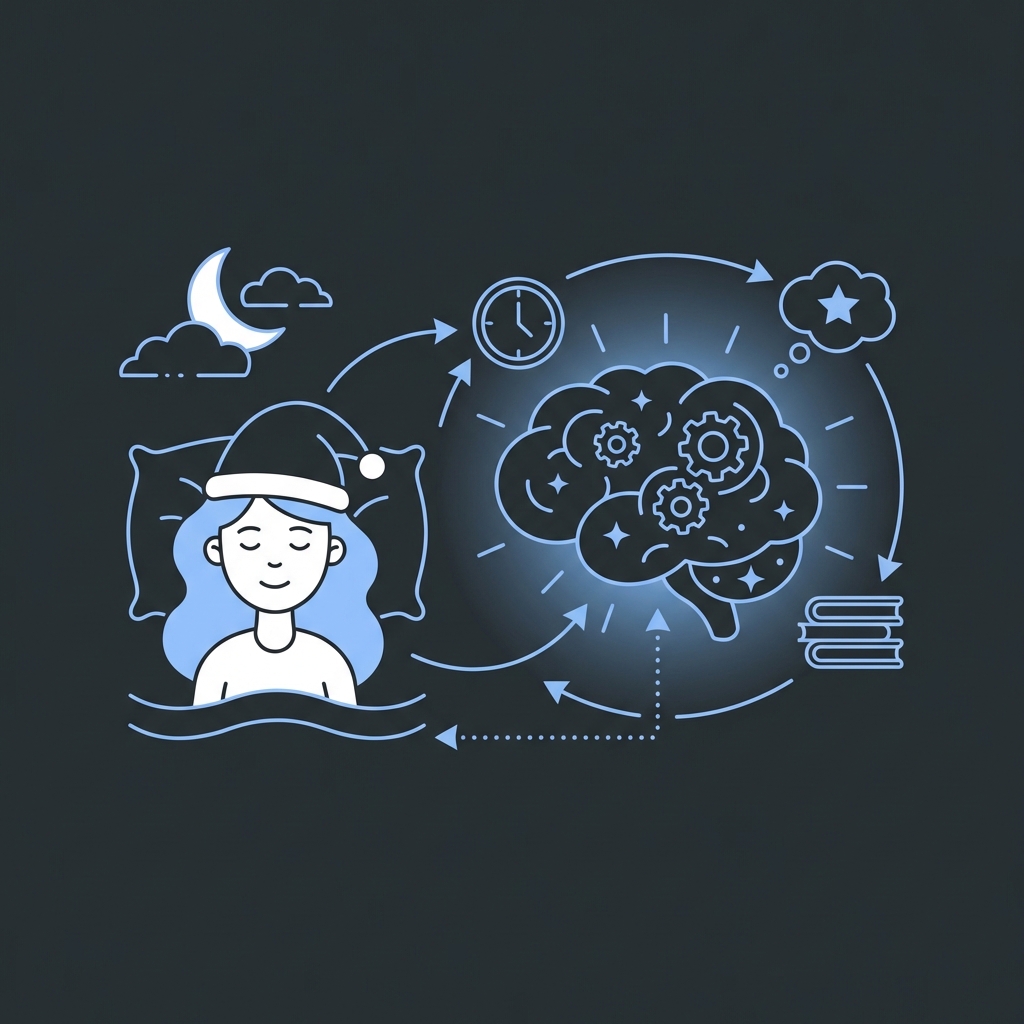
It’s 11:47 PM and your body is exhausted, but your mind has other plans. The moment your head hits the pillow, it’s like someone flipped a switch in mission control. Suddenly you’re running through tomorrow’s presentation, remembering you forgot to respond to that email, calculating whether you have enough groceries for the week, and wondering if your kid’s cough sounds worse than it did at dinner.
Welcome to the night brain—that relentless cognitive companion that treats bedtime as prime time for mental housekeeping.
The night brain isn’t broken or malfunctioning. It’s actually doing exactly what it’s designed to do: process, plan, and problem-solve. The trouble is, it’s chosen the worst possible moment to get productive. While you’re desperately trying to wind down, your brain is winding up, treating the quiet darkness as an invitation to tackle every unresolved thread from your day.
When Quiet Becomes Loud
The cruel irony of the night brain is that it emerges precisely because you’ve finally stopped moving. All day long, you’ve been in execution mode—responding to emails, managing crises, shuttling between meetings and obligations. Your conscious mind has been fully occupied with the immediate demands in front of you. But those deeper cognitive processes? They’ve been running in the background, accumulating a backlog of unfinished business.
When the external stimulation finally stops, that backlog surges forward. It’s like walking into a quiet room and suddenly hearing the hum of the refrigerator that was always there but drowned out by daytime noise. Except instead of a gentle hum, it’s the full orchestra of your mental load playing fortissimo.
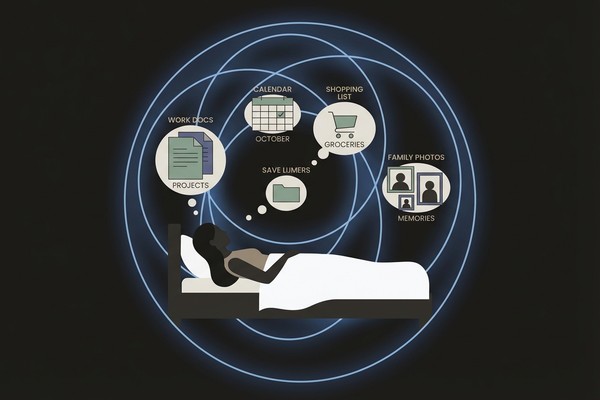
Your night brain doesn’t understand that 11 PM isn’t an appropriate time for strategic planning. It just knows there are open loops that need attention, and finally—finally!—it has your undivided attention to work on them. The fact that you’re horizontal and hoping for sleep is irrelevant to its agenda.
This is why exhaustion doesn’t automatically shut down mental activity. Physical tiredness and cognitive tiredness operate on different systems. You can be bone-deep weary and still have a mind that’s spinning like a hamster wheel. In fact, sometimes the more depleted you feel, the more urgent your brain’s need to process and plan becomes. It’s as if your mind is saying, “We’re running on fumes, which means we need to figure everything out right now.”
The Unfinished Business Department
The night brain has a particular obsession with unfinished loops—those tasks, conversations, and decisions that got started but never reached completion. During the day, you might successfully push these aside to focus on more immediate priorities. But at night, they return with compound interest.
That text you read but didn’t respond to becomes a relationship emergency. The project deadline that’s still two weeks away becomes an urgent crisis requiring immediate mental rehearsal. The casual comment your colleague made starts feeling like a coded message that needs decryption. Your brain treats every unresolved item as a potential threat that requires active monitoring.
The night brain doesn’t distinguish between urgent and important—everything feels like both.
This is where the planning-worrying-reviewing cycle kicks into high gear. Your mind bounces between trying to solve tomorrow’s problems (planning), catastrophizing about things that might go wrong (worrying), and replaying today’s interactions to analyze what you could have done differently (reviewing). It’s an exhausting mental triathlon that can continue for hours.
The reviewing function is particularly insidious because it masquerades as productivity. Your brain convinces you that replaying that awkward conversation or rehashing that meeting is useful analysis. But most of the time, it’s just rumination wearing a business suit. You’re not actually solving anything—you’re just burning mental energy on problems that either don’t have solutions or don’t require solutions at 1 AM.
The Capture Practice
One of the most effective ways to negotiate with your night brain is to give it what it’s actually asking for: acknowledgment that these thoughts matter and will be addressed. This doesn’t mean solving everything before bed—it means creating a reliable system for capturing and containing these concerns so your brain can release them.
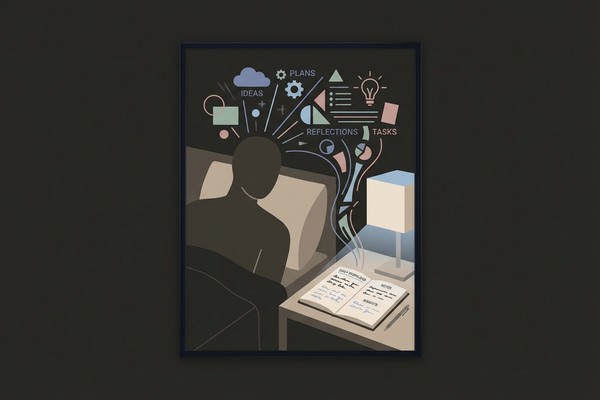
The brain dump is a simple but powerful practice. Keep a notebook or phone by your bed and when the mental chatter starts, write it down. Not in organized categories or prioritized lists—just stream-of-consciousness capture of whatever is cycling through your mind. The goal isn’t to create a perfect to-do list; it’s to externalize the thoughts so they stop ping-ponging around your skull.
What makes this work isn’t the writing itself—it’s the implicit promise you’re making to your brain that these items won’t be forgotten. Your night brain is often activated by the fear that important things will slip through the cracks. When you capture them externally, you’re essentially telling your brain, “I’ve got this handled. You can stand down.”
Some nights, you might fill pages with seemingly random thoughts and concerns. Other nights, just the act of reaching for the notebook is enough to quiet the mental noise. Your brain learns that there’s a reliable system in place, which reduces the urgency it feels to keep everything actively loaded in working memory.
Creating Boundaries Between Day and Night
Beyond the immediate capture practice, the night brain responds well to clear boundaries between day mode and night mode. These boundaries need to be both temporal and physical—rituals that signal to your mind that the workday is over and the transition to rest has begun.
This isn’t about perfect sleep hygiene or elaborate bedtime routines. It’s about creating consistent cues that help your brain shift gears. Maybe it’s changing into specific sleepwear that you only wear for sleep. Maybe it’s a five-minute walk around the block to physically separate yourself from the day’s energy. Maybe it’s a simple ritual of writing down three things that went well today and three priorities for tomorrow—a controlled handoff between today-brain and tomorrow-brain.
The key is consistency and intentionality. Your night brain needs to learn that there’s a designated time and place for processing, and bedtime isn’t it. When you create reliable patterns, your brain starts to trust that there will be appropriate opportunities to address its concerns.
Physical cues can be particularly effective because they engage your body in the transition process. The act of washing your face, dimming lights, or even just putting your phone in another room sends clear signals that the day’s responsibilities are being set aside. Your brain is remarkably responsive to these environmental changes when they’re consistently applied.
The Decompression Gap
One of the reasons the night brain becomes so active is that we often go directly from high-demand activities to attempted sleep without any buffer zone. You’re answering emails until 10 PM, then expecting your mind to immediately shift into rest mode. That’s like flooring the accelerator on the highway and then expecting to smoothly glide into a parking space.
Building in decompression time—even just 15-30 minutes—can dramatically reduce nighttime mental activation. This isn’t time for more productivity or catching up on tasks. It’s intentionally unproductive time that allows your mind to gradually slow down. Reading fiction, gentle stretching, listening to music, or even just sitting quietly can help create the transition your brain needs.
The decompression period also gives your mind permission to process the day’s events while you’re still awake and alert, rather than saving it all for when you’re trying to sleep. It’s like giving your night brain a designated office hours instead of letting it work overtime in your bedroom.
Rest isn’t the absence of mental activity—it’s the presence of mental safety.
When Systems Hold the Load
The ultimate goal isn’t to eliminate the night brain—it’s serving an important function by trying to keep track of everything that matters to you. The goal is to create systems reliable enough that your brain can trust them to hold these concerns without constant active monitoring.
This is where external systems become crucial. When you have trusted methods for capturing, organizing, and following up on the things that matter, your brain doesn’t need to work so hard to keep everything loaded in active memory. It can relax its vigilant grip because it knows nothing important will be lost.
The most effective systems don’t just organize tasks—they actively follow up and remind you about things before they become urgent. They take on the cognitive work of remembering and monitoring so your brain doesn’t have to. When your mind learns that there’s a reliable external system handling the details, it becomes much more willing to power down at bedtime.
Your night brain isn’t your enemy—it’s an overworked employee trying to keep everything together with inadequate tools. Give it better tools, clearer boundaries, and the assurance that important things won’t fall through the cracks, and it might finally be willing to clock out when the day is done.
The quiet you’re seeking isn’t the absence of thoughts—it’s the presence of trust that everything important is being held safely while you rest.
This article was created with collaboration between humans and AI—we hope you ❤️ it.