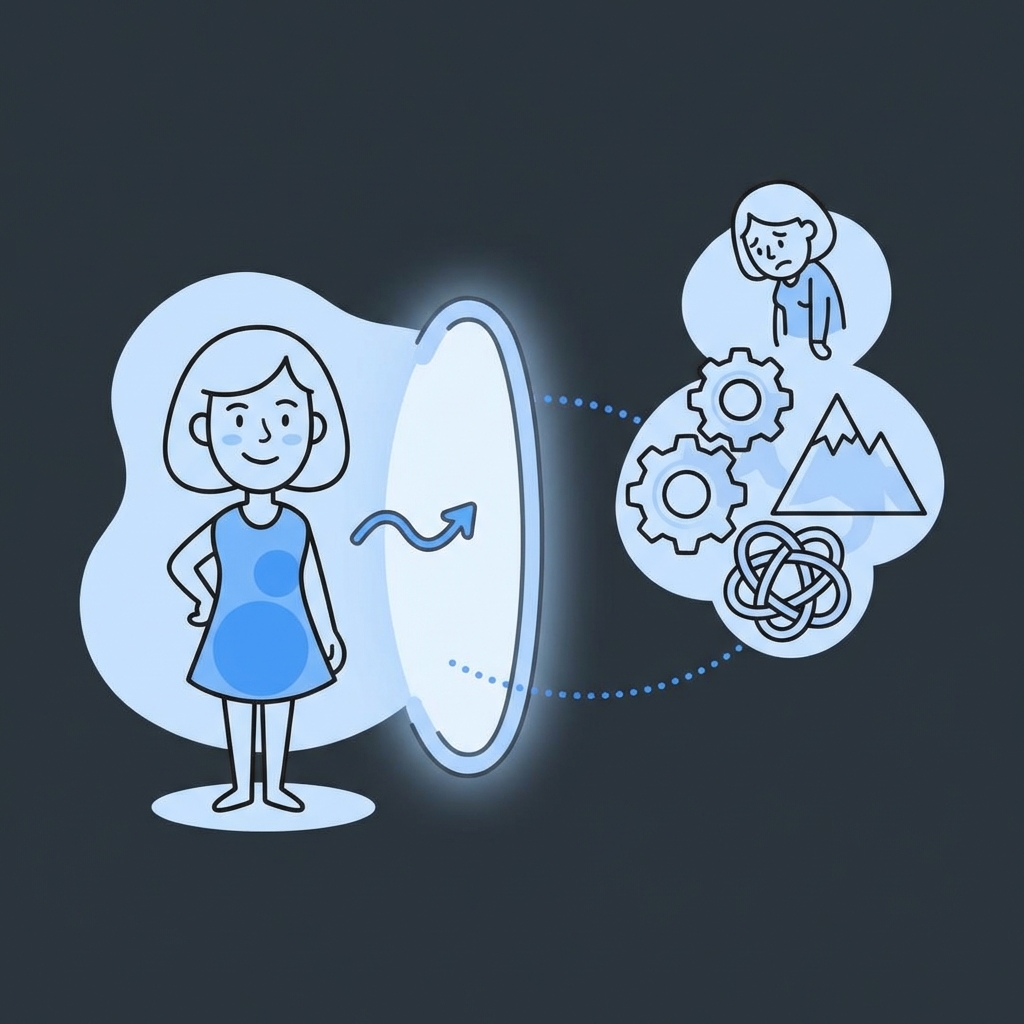
You used to paint on Sunday mornings. Or maybe you were the person who could spend three hours in a bookstore, emerging with an armful of novels and a head full of possibilities. Perhaps you were the friend who organized spontaneous road trips, or the one who knew every hiking trail within fifty miles, or the person who could lose themselves for hours in the garden, hands deep in soil, mind blissfully quiet.
That person feels like a stranger now, doesn’t it?
When life gets heavy—when the demands pile up and the mental load becomes a constant hum in the background—we don’t just lose time. We lose pieces of ourselves. The parts that weren’t strictly necessary for survival get quietly shelved, one by one, until we look in the mirror and barely recognize who’s looking back.
This isn’t about productivity or time management. This is about something deeper: what happens to our sense of self when we spend years in survival mode, and how we might find our way back to wholeness.
When High Load Rewrites Your Story
The transformation happens so gradually you barely notice it. First, you skip the Saturday morning art class because work is crazy. Then you stop buying books because when would you read them? The hiking boots gather dust in the closet. The guitar case becomes a very expensive shelf decoration.
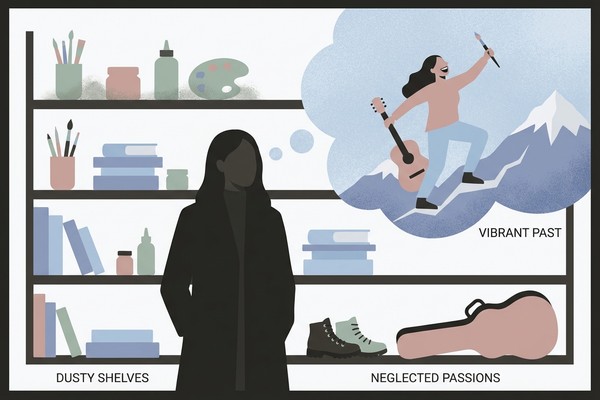
You tell yourself it’s temporary. Just until this project wraps up. Just until the kids are older. Just until things calm down. But “temporary” has a way of becoming permanent when you’re not paying attention.
What’s particularly insidious about this process is how functional it feels. You’re not losing essential skills—you can still do your job, manage your household, meet your obligations. In fact, you might even be more efficient without all those “distractions.” The person you’re becoming is leaner, more focused, more responsible.
But efficiency isn’t the same as wholeness. And somewhere along the way, you realize you’ve become a very competent stranger to yourself.
The parts of us that get buried aren’t just hobbies or interests—they’re entire dimensions of our identity. The creative self. The adventurous self. The contemplative self. The playful self. These aren’t luxury add-ons to who we are; they’re integral threads in the fabric of our identity. When we lose them, we don’t just become busier. We become smaller.
The Gradual Disappearance of Joy
There’s a particular kind of grief that comes with recognizing how much of yourself you’ve lost along the way. It’s not the sharp pain of sudden loss, but the dull ache of realizing something precious has been slowly slipping away while you weren’t looking.
You remember being the person who would spend an entire Saturday afternoon trying a new recipe, not because anyone needed feeding, but because the process itself brought you joy. You remember having opinions about music, about books, about art. You remember feeling excited about things that had nothing to do with productivity or achievement.
The person you were before this got hard didn’t optimize for efficiency. They optimized for aliveness.
The cruel irony is that the very qualities that made life feel rich and meaningful—curiosity, spontaneity, creative expression—are often the first casualties when life gets overwhelming. They feel like luxuries we can’t afford, indulgences that responsible adults don’t have time for.
But what if we’ve got it backwards? What if these aren’t luxuries at all, but necessities? What if the reason we feel so depleted isn’t just because we’re doing too much, but because we’ve stopped doing the things that fill us up?
The creative part of you didn’t disappear because it wasn’t important. It disappeared because you convinced yourself it wasn’t essential. The adventurous part of you didn’t vanish because it was childish. It vanished because adventure felt incompatible with responsibility.
Why Wholeness Matters More Than Efficiency
Here’s what the productivity culture gets wrong: it treats human beings like machines that can be optimized by removing “unnecessary” parts. Strip away the hobbies, the meandering conversations, the time spent staring out windows, and what’s left is a more efficient human, right?
Wrong. What’s left is a person running on empty, wondering why success feels so hollow.
The parts of yourself you’ve buried aren’t decorative. They’re not optional extras that you can do without indefinitely. They’re sources of renewal, creativity, and meaning. They’re what make you feel like yourself instead of just a very capable robot moving through your days.
When you reconnect with these buried parts, something shifts. Not just in how you spend your time, but in how you feel about your life. The mother who starts sketching again doesn’t just gain a hobby—she gains access to a part of herself that sees the world differently. The executive who returns to hiking doesn’t just get exercise—they reconnect with a sense of wonder and perspective that informs everything else they do.
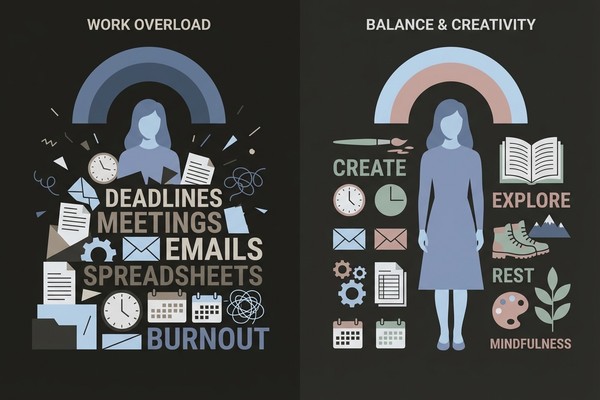
This isn’t about work-life balance or finding more hours in the day. It’s about remembering that you are more than the sum of your responsibilities. You are more than your to-do list, your calendar, your obligations. You are a complex, multifaceted human being, and you deserve to know all of yourself.
The Barriers We Build
Of course, knowing you want to reconnect with buried parts of yourself and actually doing it are two different things. The barriers feel real because they are real.
There’s the guilt. The voice that says you’re being selfish for wanting to spend time on “frivolous” things when there’s so much that needs doing. The voice that says other people are counting on you to be the responsible one, the reliable one, the one who keeps everything together.
There’s the time. Or rather, the perceived lack of it. When every moment feels spoken for, when your calendar is a game of Tetris with no empty spaces, the idea of carving out time for yourself feels impossible.
There’s the fear that you’ve been away too long. That you won’t be good at the things you used to love. That you’ll sit down at the piano and your fingers won’t remember the songs. That you’ll pick up the paintbrush and nothing beautiful will emerge.
And then there’s the biggest barrier of all: the belief that you’ll do it “when things calm down.” When the project is finished. When the kids are older. When life is less demanding. This is perhaps the cruelest lie we tell ourselves, because things don’t calm down. They just change shape.
Waiting for life to get easier is like waiting for the ocean to get less wet.
Small Doors Back to Yourself
The good news is that reconnection doesn’t require a complete life overhaul. It doesn’t require finding twenty hours a week or making dramatic changes. It requires something much simpler and much scarier: permission.
Permission to spend twenty minutes doing something that serves no purpose other than bringing you joy. Permission to be bad at something you used to be good at. Permission to prioritize a part of yourself that has nothing to do with your productivity or usefulness to others.
Start small. Impossibly small. Not because small is all you deserve, but because small is sustainable. Because small doesn’t trigger the guilt or the overwhelm or the voice that says you don’t have time for this.
Maybe it’s ten minutes of sketching while your coffee cools. Maybe it’s one song on the guitar before bed. Maybe it’s a single chapter of poetry, read slowly, without the pressure to finish the whole book.
The goal isn’t to become the person you were before—that person lived in different circumstances, with different responsibilities. The goal is to invite parts of that person into who you are now. To create space for the creative you, the curious you, the playful you to coexist with the responsible you, the capable you, the person who gets things done.
You don’t have to choose between being reliable and being whole. You don’t have to earn the right to enjoy your life by first completing an impossible list of obligations. You can be both the person who takes care of everyone else and the person who has interests, passions, and dreams that have nothing to do with anyone else’s needs.
The Invitation
So here’s the question that matters: What part of yourself would you like to spend time with again?
Not the part that would make you more productive or more valuable to others. Not the part that would help you achieve some goal or complete some project. Just the part that would make you feel more like yourself.
Maybe it’s the person who used to write terrible poetry and loved every minute of it. Maybe it’s the person who could spend hours in nature, collecting interesting rocks and watching clouds. Maybe it’s the person who danced in the kitchen while cooking dinner, who sang along to the radio without caring who heard.
That person is still there, buried under years of responsibility and efficiency and the belief that joy is something you earn rather than something you deserve. They’re waiting for you to remember them, to make space for them, to invite them back into your life.
You don’t need permission from anyone else to reconnect with yourself. You don’t need to wait for the perfect moment or the ideal circumstances. You just need to decide that wholeness matters more than optimization, that being fully yourself is worth twenty minutes of your day.
The person you were before this got hard isn’t gone. They’re just sleeping. And it’s time to wake them up.
This article was created with collaboration between humans and AI—we hope you ❤️ it.