
“Just ask for help.” Three words that sound so reasonable, so obvious, so simple. They roll off tongues at dinner parties and fill self-help articles with the confidence of people who’ve never actually tried to delegate anything meaningful. But if you’ve ever been the person carrying the invisible weight of remembering everything, you know the truth: asking isn’t the hard part. It’s everything that comes before, during, and after the asking that makes delegation feel like more work than just doing it yourself.
The advice assumes asking is a single action—a quick conversation, a text message, maybe an email. In reality, delegation is a complex system of cognitive labor that starts long before you open your mouth and continues well after someone says yes.
The Hidden Architecture of Asking
Before you can ask anyone for anything, you have to become an architect of other people’s understanding. You need to scope the task, which means breaking down something that lives seamlessly in your head into discrete, transferable pieces. You have to anticipate questions, provide context, and translate your internal shortcuts into step-by-step instructions that make sense to someone who doesn’t live inside your particular chaos.
Take something as simple as asking your partner to handle the kids’ dentist appointments. On the surface, it’s straightforward. But the actual handoff requires you to explain which dentist, when the last cleaning was, that Emma needs a fluoride treatment but Jake is scared of the hygienist with the red hair, that the office requires 24-hour cancellation notice, and that you’ll need to coordinate with soccer practice schedules that live in a different app entirely.

You’re not just asking someone to make a phone call. You’re asking them to temporarily hold a piece of your mental model of how your family operates. The “simple” request requires you to externalize knowledge that took months or years to accumulate, organize it in a way that makes sense to someone else, and then trust that they’ll execute it according to standards you’ve never had to articulate because you just knew.
This is why competent people are notoriously bad at asking for help. It’s not pride or control issues—it’s a rational calculation. They can see the full scope of what delegation actually requires, and often the math doesn’t work out in their favor.
The Emotional Tax of Imposing
Beyond the logistical complexity, there’s an emotional layer to asking that productivity advice conveniently ignores. When you ask someone to take something off your plate, you’re not just requesting action—you’re entering into a social contract with invisible terms and conditions.
You’re asking someone to care about something they didn’t choose to care about. You’re imposing your timeline, your standards, your definition of “done” onto someone else’s already-full life. Even when people say yes willingly, you can feel the weight of that imposition. You’ve added to their mental load in order to reduce your own.
The people most capable of helping are often the people whose plates are already the fullest.
Then there’s the follow-up labor. Asking doesn’t end when someone agrees to help—it opens up a new channel of responsibility. You need to check in without seeming like you’re micromanaging. You need to be available for questions without defeating the purpose of delegation. You need to express gratitude in a way that acknowledges their effort without making them feel like they’re doing you a personal favor rather than contributing to shared responsibilities.
And if something goes wrong? You’re back to square one, except now you’ve also used up social capital and created potential relationship friction. The thing you were trying to get off your plate has generated even more emotional labor.
When the Math Doesn’t Add Up
There’s a cruel irony in delegation advice: the people who need it most are often the people for whom it works least effectively. If you’re already managing multiple complex systems—work projects, family logistics, household operations—you’ve likely developed efficient internal processes that are nearly impossible to transfer.
Your brain has become a sophisticated database of exceptions, preferences, and contextual knowledge. You remember that the pediatrician’s office doesn’t answer phones during lunch, that your boss gets cranky about deadline changes on Fridays, that the grocery store runs out of the good bread by 3 PM. This institutional knowledge didn’t accumulate overnight, and it can’t be downloaded into someone else’s head with a quick conversation.
When you delegate tasks that depend on this accumulated knowledge, you often end up in a supervisory role that requires more active attention than just doing the work yourself. You become a help desk for your own life, fielding questions and providing guidance while trying to maintain the illusion that you’ve actually offloaded the responsibility.
The most frustrating part? People will often frame your reluctance to delegate as a personal failing. You’re “too controlling” or “don’t trust others” or “need to let go of perfectionism.” But perfectionism isn’t the issue—it’s that you can see the full system, and you know that most delegation attempts will create more work, not less.
Beyond Permission: Designing for Handoff
Real delegation isn’t about getting permission to ask—it’s about designing systems that don’t require asking in the first place. Instead of “just ask for help,” the focus should be on creating structures that naturally distribute responsibility without requiring constant negotiation and explanation.
This means thinking about handoffs at the system level, not the task level. Rather than asking someone to handle a specific appointment, you might redesign how appointments get scheduled in your household. Instead of delegating individual work projects, you might restructure how information flows within your team so that context isn’t trapped in one person’s head.
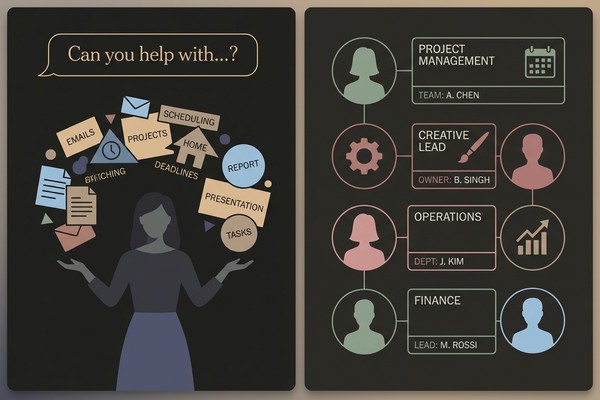
The goal isn’t to become better at asking—it’s to reduce the amount of asking required. When systems are designed well, responsibility flows naturally to the people best positioned to handle it, without requiring the mental load manager to constantly orchestrate handoffs.
What Real Support Actually Looks Like
The most valuable support doesn’t wait to be asked. It anticipates needs, takes ownership of outcomes, and reduces the cognitive burden on the person who’s been holding everything together. Real support looks like someone noticing that school forms are due and handling them completely—not just when reminded, but as part of taking genuine responsibility for that area of family life.
It looks like colleagues who proactively share context and updates, so you don’t have to constantly check in or piece together information from multiple sources. It looks like systems that capture and preserve institutional knowledge, so it doesn’t live exclusively in one person’s overwhelmed brain.
The best help doesn’t require management—it requires trust and genuine ownership.
When someone truly takes something off your plate, you feel it immediately. There’s a lightness, a sense of space opening up in your mental landscape. You’re not wondering if it’s getting done or how it’s getting done—you simply know that it’s handled, completely and competently, by someone who has genuinely assumed responsibility.
This kind of support is rare because it requires the helper to do all the invisible work that “just ask” advice assumes away. They have to learn the context, develop the systems, and take ownership of the outcomes. They have to become fluent in a piece of your world, not just execute tasks within it.
The Real Work of Unloading
The problem with “just ask” isn’t that it’s wrong—it’s that it’s incomplete. It focuses on the moment of request while ignoring everything that makes delegation actually work. Real mental load reduction happens when the systems around you are designed to hold knowledge, track progress, and own outcomes without requiring you to be the central coordinator.
Until we acknowledge the full scope of what delegation actually requires—the scoping, the context-sharing, the follow-up, the emotional labor—we’ll keep giving advice that sounds helpful but leaves the most burdened people feeling even more alone. The solution isn’t to get better at asking for help. It’s to build structures that make asking unnecessary, and to recognize that the person who’s been holding everything together deserves support that truly lightens their load, not just redistributes the work of managing it.
This article was created with collaboration between humans and AI—we hope you ❤️ it.