
You finished your morning coffee, checked a few emails, answered some texts, helped your kid find their backpack, responded to three Slack messages, and fielded two “quick questions” from your partner. It’s barely 9 AM and you already feel drained. You haven’t crossed anything meaningful off your to-do list, yet somehow you’re exhausted.
This isn’t laziness or poor time management. It’s the quiet cost of interruptions—a tax on your cognitive resources that compounds throughout the day until you’re left wondering why you feel so tired when you “didn’t really do much.”
The Hidden Work of Starting Over
Every interruption forces your brain to perform what researchers call “task switching”—but that clinical term doesn’t capture the full weight of what’s actually happening. When someone pulls you away from what you’re doing, you don’t just pause and resume. You have to reconstruct your entire mental context.
Think about the last time you were deep in writing an email and someone asked you a question. After you answered, you didn’t just pick up where you left off. You had to remember what you were writing about, why you were writing it, what tone you were going for, and where you were in your train of thought. That reconstruction work? It’s invisible, unpaid labor that your brain performs dozens of times a day.
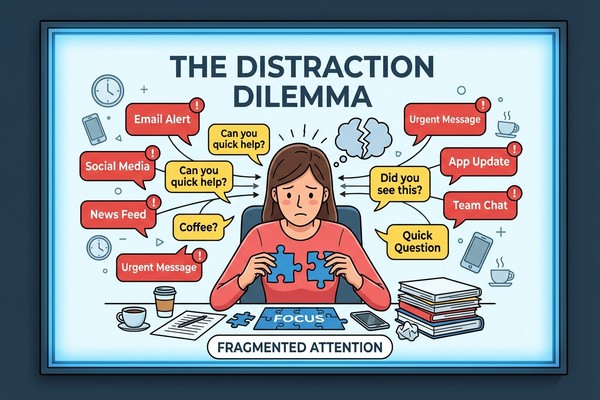
The research on this is stark: it can take up to 23 minutes to fully regain focus after an interruption. But even if you get back on track faster, there’s still a cognitive residue—part of your attention remains stuck on the interruption, making you less effective at everything that follows.
Every “quick question” is actually a request for you to rebuild your entire mental workspace from scratch.
This explains why a day full of small interruptions can leave you more exhausted than a day spent tackling one big, difficult project. The difficult project requires sustained effort, but interruptions require repeated reorientation—and reorientation is surprisingly expensive work.
Why the Burden Isn’t Distributed Fairly
Here’s what makes interruptions particularly brutal: they don’t land randomly. They cluster around certain people—usually the ones who’ve become the unofficial “managers” of their households, teams, or social circles.
You know who you are. You’re the person people come to with questions because you “always know where things are.” You’re the one who gets copied on emails “just in case.” You’re the default point person for scheduling, coordinating, and remembering the details that keep everything running smoothly.
This isn’t an accident. It happens because you’ve proven yourself reliable, knowledgeable, and responsive. But what starts as helpfulness gradually becomes a trap. The more interruptions you handle gracefully, the more interruptions you receive. Soon, you’re not just doing your own work—you’re serving as a human search engine and coordination center for everyone around you.
The cruel irony is that the people interrupting you often don’t realize the cost they’re imposing. That “quick question” feels quick to them because they’re not the ones who have to rebuild their focus afterward. They get to hand off their cognitive burden and walk away, while you’re left holding both your original task and the mental residue of their request.
The Productivity Illusion
This dynamic creates a particularly insidious problem: it makes you look less productive than you actually are. When your day is fragmented by interruptions, you struggle to make visible progress on big projects. Your calendar might show open blocks of time, but those blocks are riddled with invisible context switches that drain your effectiveness.
Meanwhile, the people who interrupt you get to point to their completed tasks and feel accomplished. They asked their questions, got their answers, and moved on. The fact that their productivity came at the expense of yours remains hidden from view.
The most exhausting days are often the ones where you helped everyone else move forward while your own work stood still.
This is why so many capable, hardworking people feel like they’re failing at productivity despite being incredibly busy. They’re not failing—they’re subsidizing everyone else’s focus with their own cognitive resources.
The Two Levers of Relief
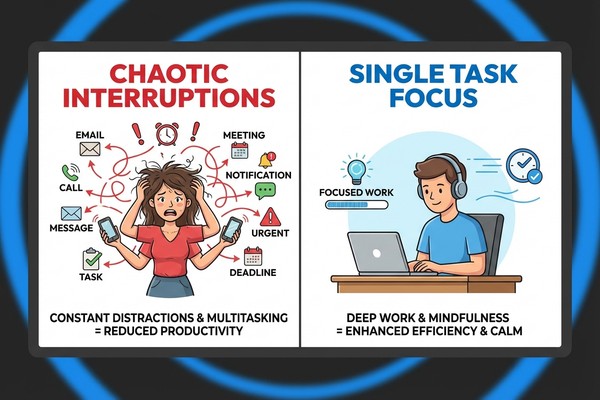
If you recognize yourself in this pattern, you have two main levers to pull: boundaries and routing.
Boundaries mean protecting blocks of time when you’re genuinely unavailable for interruptions. This isn’t about being antisocial or unhelpful—it’s about preserving your ability to do deep work. You might designate certain hours as “focus time,” put your phone in another room, or use noise-canceling headphones as a visual signal that you’re not available for questions.
The key is communicating these boundaries clearly and consistently. People can’t respect limits they don’t know exist. A simple “I’m in focus mode until 11 AM, but happy to help after that” gives people clarity about when they can access your attention.
Routing is about changing where interruptions go. Instead of serving as the default destination for every question, you can redirect people to other resources. This might mean pointing teammates to documentation instead of answering the same questions repeatedly. It could mean asking your partner to write down non-urgent requests instead of interrupting your work. Or it might involve teaching your kids to check a shared calendar before asking about weekend plans.
A Script That Works
One of the most effective phrases you can learn is: “Can you write that down for me?” or “Let me park that for later.” These responses acknowledge the request without immediately derailing your focus. They create a small buffer that allows you to finish your current thought before context switching.
When someone approaches you with a question, try: “I want to give this proper attention—can you put it in our shared doc and I’ll get back to you by [specific time]?” This response shows you care about helping while protecting your current focus. It also creates a record of the request, which prevents the same question from coming up again later.
For family interruptions, you might say: “I’m in the middle of something that requires focus. Can you write it down or wait fifteen minutes?” This teaches the people around you that your attention has value and that interruptions have a cost.
Rerouting to Systems, Not People
The ultimate goal isn’t to become unavailable or unhelpful—it’s to route interruptions through systems instead of through you. This might mean creating shared calendars, establishing regular check-in meetings, or setting up simple processes that answer common questions without requiring your input.
When you become the system for handling interruptions, you’re always on call. When you build actual systems to handle them, you can step back and focus on work that only you can do.
The goal isn’t to eliminate all interruptions—it’s to make sure they’re worth the cognitive cost they impose.
This shift requires some upfront investment. You’ll need to create documentation, establish new routines, and train people to use different channels for their requests. But this investment pays dividends in reclaimed focus and reduced mental load.
The quiet cost of interruptions isn’t just about lost time—it’s about the invisible work of constantly rebuilding your attention. When you start treating your focus as a finite resource that deserves protection, you can begin to reclaim the energy that interruptions have been quietly stealing all along. Your future self, arriving at the end of the day with energy left over, will thank you for making this shift.
This article was created with collaboration between humans and AI—we hope you ❤️ it.