
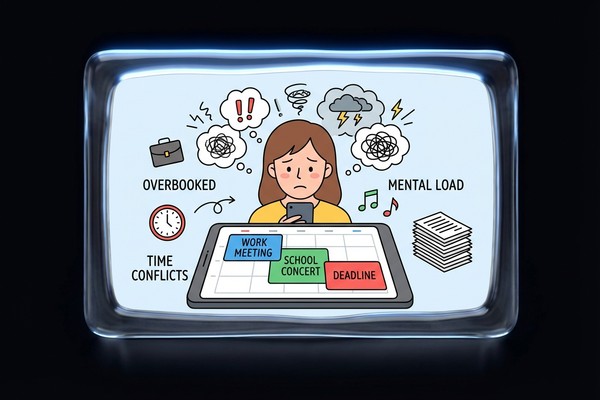
You’re staring at the calendar on your phone, that familiar knot forming in your stomach. Thursday has three things scheduled for the same time slot: your quarterly review at work, your daughter’s spring concert, and the deadline for the insurance paperwork that’s been sitting on your desk for two weeks. The little colored blocks overlap like a tiny digital car crash, and somehow, you’re the only one who seems to notice.
This is the moment when coordination stops feeling like love and starts feeling like a trap.
We talk about shared calendars like they’re the solution to family chaos, but we rarely acknowledge what they actually reveal: the profound inequality in who notices, who remembers, and who ultimately bears the weight of making it all work. That shared calendar isn’t really shared at all—it’s a monument to one person’s mental labor, dressed up in cheerful pastels and notification pings.
The Invisible Orchestra
The double-booking didn’t happen in a vacuum. It’s the culmination of dozens of tiny, invisible decisions that led to this moment. You remembered to add the concert date when the school sent the email three weeks ago. You scheduled the quarterly review during what looked like an open slot, forgetting that “open” doesn’t mean “available” when you’re the family’s cognitive load-bearer. The insurance deadline has been floating in your awareness for days, not urgent enough to prioritize but persistent enough to create background stress.
Your partner probably knows about the concert—they might have even said “sounds great” when you mentioned it. But they didn’t add it to their calendar. They didn’t cross-reference it with their work schedule. They didn’t think about who would leave work early, who would handle pickup, or whether this conflicts with anything else that week. That cognitive work defaulted to you, as it always does.
This is what makes the shared calendar quietly infuriating. It looks collaborative, but it often just makes visible how much invisible work one person is doing. Every event you add represents not just the thing itself, but all the thinking around the thing—the preparation, the logistics, the contingency planning that happens in your head without anyone asking you to do it.
The rage isn’t really about the calendar. It’s about being the only one who sees the whole picture, who holds the family’s temporal reality together, who notices when things don’t fit. It’s about love expressed through remembering, and the exhaustion that comes with being the keeper of everyone else’s time.
When Caring Becomes a Burden
There’s something particularly cruel about how coordination work gets framed as an expression of love. “She’s so organized,” people say, as if your ability to remember everyone’s schedules is a charming personality trait rather than unpaid labor. “He’s lucky to have someone who keeps track of everything,” as if your mental bandwidth is a renewable resource that exists for others’ convenience.
But here’s what happens when caring becomes your job: the caring starts to feel compulsory rather than chosen. You begin to resent not just the work, but your own impulse to do it. You catch yourself thinking, “What would happen if I just… didn’t?” But you already know the answer. Things would fall through the cracks. Someone would miss something important. The family ecosystem you’ve built through constant attention would start to fray.
The shared calendar reveals who’s really doing the thinking—and who’s just showing up.
This is the emotional complexity that productivity culture completely misses. Most advice about family organization treats it as a simple coordination problem: get everyone on the same system, set up notifications, color-code by person. But these solutions ignore the deeper issue of ownership. They assume that once you have the right tool, the work will magically distribute itself evenly.
It doesn’t. What usually happens is that one person becomes the administrator of the system, the one who ensures everyone else uses it correctly, the one who notices when things go wrong. The tool gets shared, but the responsibility remains concentrated.
The System Is the Problem
When your Thursday implodes, the instinct is often to blame yourself. You should have noticed the conflict sooner. You should have been more careful when scheduling. You should have communicated better with your partner. This self-blame is natural but misguided—it treats a systems problem as a personal failing.
The real issue isn’t your organizational skills or your communication style. It’s that you’re operating within a system that assumes one person will handle the cognitive overhead of coordination. The shared calendar is just a tool; it can’t change who takes responsibility for making sure the tool works.
Think about it this way: your partner probably has their own complex professional calendar, full of meetings and deadlines they track meticulously. They understand the cognitive work involved in managing competing priorities and time conflicts. But somehow, when it comes to family coordination, that same awareness disappears. The assumption becomes that someone else—usually you—will handle the thinking.
This isn’t necessarily malicious. It’s often unconscious, a product of how we’ve been socialized to think about domestic responsibility. But the impact is the same: one person carries the mental load of keeping everyone’s life organized, while others benefit from the organization without contributing to the cognitive work that makes it possible.
Renegotiating Ownership
The solution isn’t to abandon coordination or to suffer in silence. It’s to renegotiate who owns what parts of the system. This conversation is delicate because it requires acknowledging an inequality that might have been invisible to everyone except the person doing the work.
Start with naming the pattern, not attacking the person. “I’ve noticed I’m the one who usually catches scheduling conflicts and figures out solutions. I’d like to share that responsibility differently.” This frames it as a system issue rather than a character flaw.
Then get specific about what ownership actually looks like. It’s not enough for your partner to “help” with the calendar—that still leaves you as the manager, delegating tasks to an assistant. True shared ownership means they take responsibility for noticing conflicts, thinking through solutions, and initiating conversations about scheduling challenges.
This might mean dividing domains: one person owns all medical appointments and school events, the other owns social plans and household maintenance scheduling. Or it might mean alternating who’s responsible for the weekly calendar review, with the understanding that whoever’s “on duty” that week owns any conflicts that arise.
The key is moving from “helping with your system” to “owning part of the system.” This shift in language might seem small, but it represents a fundamental change in who bears the cognitive load.
The Weekly Ops Check-In
One practical approach that many families find helpful is instituting a weekly operations check-in—ten minutes every Sunday where you both look at the upcoming week together. This isn’t about reviewing what’s already scheduled; it’s about actively thinking through potential conflicts, logistics, and contingencies.
During this check-in, you’re both responsible for spotting problems and proposing solutions. If there’s a conflict, the person who notices it doesn’t automatically become responsible for solving it. Instead, you solve it together, or the person whose commitment created the conflict takes ownership of the solution.
This small ritual can shift the dynamic from reactive problem-solving (usually done by one person) to proactive planning (done together). It also creates a designated space for the kind of thinking that usually happens invisibly in one person’s head.
The check-in works because it makes the cognitive work visible and shared. Instead of one person constantly scanning for problems, you both engage in that scanning process together, at a predictable time, with clear shared responsibility for what you discover.
Beyond Better Tools
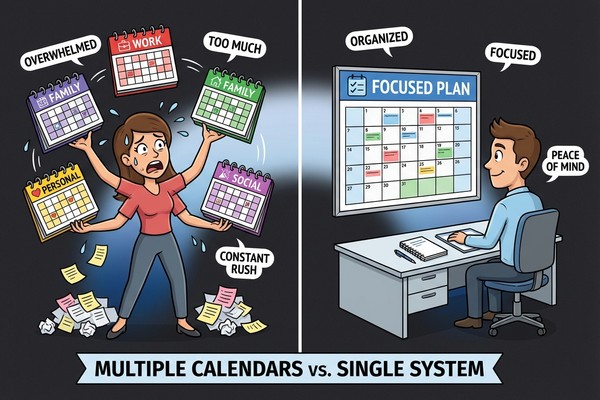
Most discussions about family coordination eventually turn to tools: which app to use, how to set up notifications, whether to go digital or stick with paper. But tools alone can’t solve an ownership problem. A shared calendar managed by one person isn’t really shared—it’s just accessible.
The real shift happens when you move from tools that help one person coordinate everyone else to systems that distribute the cognitive work itself. This might mean separate calendars with regular sync points rather than one master calendar. It might mean each person taking full ownership of their own scheduling, with clear protocols for how to handle conflicts when they arise.
Coordination is love. But love shouldn’t be a one-person job.
The goal isn’t perfect coordination—it’s sustainable coordination. A system where the mental load is shared, where noticing and remembering aren’t concentrated in one person, where the work of keeping everyone organized is recognized as work and distributed accordingly.
This is where technology could actually help, but only if it’s designed with the right understanding of the problem. Instead of tools that make it easier for one person to manage everyone else’s schedule, we need tools that help families develop shared awareness and distributed responsibility. Tools that notice when coordination work is becoming unbalanced and suggest ways to redistribute it.
The Proof Is in What Doesn’t Happen
The success of truly shared coordination isn’t measured in what gets accomplished—it’s measured in what doesn’t fall on one person’s shoulders. When both people notice the scheduling conflict before it becomes a crisis. When someone other than the usual coordinator remembers to plan for the school holiday. When the mental work of anticipating and preventing problems gets distributed instead of concentrated.
This kind of change is hard to measure because the best coordination work is invisible. The proof is in what didn’t happen: the crisis that was prevented, the stress that was avoided, the mental space that was preserved for other things.
But you’ll feel it. In the moment when you realize you’re not the only one thinking ahead. In the relief of sharing not just the calendar, but the responsibility for making sure the calendar works. In the quiet satisfaction of coordination that truly feels collaborative rather than extractive.
The shared calendar can be a tool for equity, but only if we’re willing to share more than just the calendar itself. We have to share the noticing, the remembering, and the cognitive work that makes coordination possible. Only then does the calendar become what it promises to be: a genuine collaboration rather than a beautiful display of one person’s invisible labor.
That Thursday with three overlapping commitments? It’s not a personal failure—it’s a system crying out for change. The question isn’t how to prevent every conflict, but how to ensure that preventing conflicts isn’t always the same person’s job.
This article was created with collaboration between humans and AI—we hope you ❤️ it.