You know that feeling when you’ve finally carved out time to rest, but somehow you don’t feel restored? You’ve spent the evening scrolling on your phone, or binge-watched three episodes of something forgettable, or just sat there feeling guilty about all the things you should be doing instead. You got your “downtime,” but you wake up tomorrow feeling just as depleted as before.
Here’s what nobody talks about: rest isn’t just the absence of work. It’s not a void you fill with whatever requires the least effort. Real rest—the kind that actually restores you—is as intentional and specific as the work that depletes you in the first place.
We’ve been sold this idea that any time spent not actively producing is restorative. That if you’re tired, you just need to do less. But what if the exhaustion weighing you down isn’t the kind that sleep can fix? What if your nervous system is asking for something entirely different than what you’re giving it?
The Collapse Trap
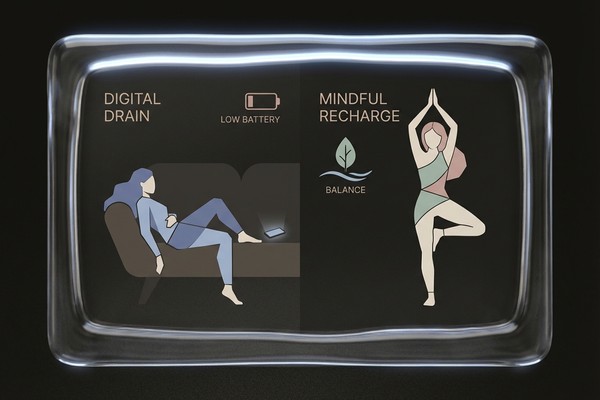
Most of us have learned to rest by collapsing. We push through until we can’t anymore, then we fall into whatever requires the least cognitive load. The couch becomes our default recovery position. The phone becomes our escape hatch. We mistake numbness for restoration.
But here’s the thing about collapse—it’s not actually rest. It’s just your nervous system hitting the emergency brake. You’re not recovering; you’re just stopping the hemorrhage of energy long enough to get back up and do it again.
Real rest is active. It’s choosing specific activities that replenish the exact resources you’ve been spending. It’s understanding that your mind, body, and spirit get depleted in different ways and need different kinds of restoration.
Think about it this way: if you’ve been lifting heavy boxes all day, your arms need physical rest. But if you’ve been managing difficult conversations and making complex decisions all day, your arms are fine—it’s your emotional and mental reserves that are empty. Lying down won’t refill what’s actually depleted.
Reading Your Depletion Signals
The first step to rest that actually restores is getting honest about what kind of tired you are. Your body is constantly sending you signals about what it needs, but we’ve been trained to ignore the subtlety and just push through until we crash.
Physical exhaustion feels different than mental fog, which feels different than emotional overwhelm, which feels different than social burnout. When you’re physically depleted, your body feels heavy. Your muscles ache. You want to lie down and let gravity win for a while.
Mental depletion shows up as difficulty concentrating, decision fatigue, or that feeling like your brain is full of cotton. You might find yourself reading the same sentence three times or standing in the kitchen forgetting why you came in there.
Emotional exhaustion is that raw, exposed feeling—like your skin has been removed and everything feels too much. You might cry at commercials or feel irritated by sounds that normally wouldn’t bother you.
Social depletion happens when you’ve been “on” for too long—performing, managing other people’s emotions, or just being around humans when your social battery is empty. You crave solitude like a physical need.
The quality of your rest should match the quality of your depletion.
Then there’s sensory overload—when your nervous system has been processing too much input. The fluorescent lights feel aggressive. The background noise feels invasive. You need quiet and dim spaces like medicine.
Creative depletion happens when you’ve been consuming but not creating, or when you’ve been so focused on practical tasks that the part of you that imagines and plays has gone dormant.
And spiritual exhaustion—that disconnection from meaning, from something larger than yourself, from the sense that what you’re doing matters beyond just checking boxes.
Designing Rest That Matches the Load
Once you can identify what kind of tired you are, you can choose rest that actually addresses it. This isn’t about adding more to your to-do list—it’s about being strategic with the recovery time you already have.
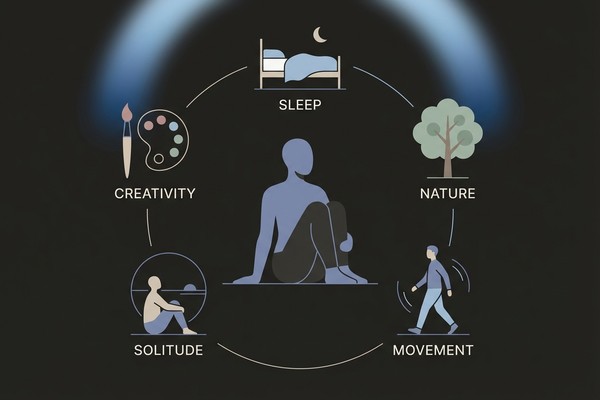
If you’re physically depleted, yes, sleep and stillness help. But so does gentle movement that feels good in your body—stretching, walking, swimming. Physical rest isn’t always about being sedentary; sometimes it’s about moving in ways that restore rather than deplete.
For mental exhaustion, you need activities that give your thinking brain a break. This might be meditation, but it could also be gardening, cooking something simple, or doing a jigsaw puzzle. The key is engaging your hands or senses while letting your analytical mind rest.
Emotional rest often requires connection—with yourself or others. Sometimes it’s journaling or therapy. Sometimes it’s calling a friend who really gets you. Sometimes it’s crying to a sad movie and letting yourself feel things you’ve been holding back.
Social rest means solitude, but quality solitude. Not just being alone while your mind races about all your relationships and obligations, but being alone in a way that feels nourishing. Reading a book. Taking a bath. Sitting in nature without your phone.
Sensory rest is about reducing input. Dim lights, quiet spaces, soft textures. It’s about giving your nervous system permission to stop processing so much information.
Creative rest involves making something, even if it’s small and imperfect. Doodling. Singing in the car. Rearranging a room. It’s about remembering that you’re not just a productivity machine—you’re a creative being.
Spiritual rest reconnects you with meaning. It might be traditional prayer or meditation, but it could also be stargazing, volunteering, or having deep conversations about what matters. It’s about remembering why you’re here beyond just getting things done.
The Domain-Specific Nature of Recovery
Here’s what the wellness industry gets wrong: they treat all exhaustion like it’s the same. Take a bath, get more sleep, practice gratitude—as if every type of depletion can be solved with the same generic self-care prescription.
But recovery is domain-specific. You can’t heal emotional wounds with physical rest alone. You can’t solve creative stagnation with more sleep. You can’t fix social burnout by meditating in isolation.
This is why that weekend getaway sometimes doesn’t help, or why a full night’s sleep doesn’t always make you feel rested. You’re trying to solve the wrong problem with the wrong solution.
Rest is not one-size-fits-all. Your exhaustion has a signature, and your recovery needs to match it.
The most restorative rest happens when you match the type of recovery to the type of depletion. If you’ve been emotionally supporting everyone around you, you need emotional rest—time to feel your own feelings without managing anyone else’s. If you’ve been making decisions all day, you need mental rest—activities that don’t require analysis or planning.
Why This Matters for Mental Load
When you’re carrying mental load—remembering, tracking, anticipating, managing—you’re depleting multiple domains simultaneously. You’re mentally tired from all the planning and remembering. You’re emotionally drained from caring about everyone else’s needs. You’re socially exhausted from being the person everyone comes to with their problems.
This is why generic self-care advice falls flat for people carrying mental load. You need rest that addresses the specific ways you’re being depleted, not just rest that looks restful from the outside.
Maybe you need creative rest because you’ve been so focused on practical tasks that you’ve forgotten what it feels like to play. Maybe you need spiritual rest because you’ve been so busy managing everyone else’s lives that you’ve lost touch with your own sense of purpose.
The goal isn’t to add seven different types of rest to your already overwhelming schedule. It’s to become more intentional about the recovery time you already have. Instead of defaulting to collapse, you can choose rest that actually restores what’s been depleted.
Protecting Your Recovery Time
The hardest part isn’t identifying what kind of rest you need—it’s protecting the time and space to actually get it. Rest that restores requires some level of intentionality and boundaries, which can feel impossible when you’re already stretched thin.
But here’s the thing: if you don’t protect your recovery time, if you don’t insist on rest that actually restores you, you’ll keep cycling through depletion and collapse without ever feeling truly rested. You’ll keep pushing through until you can’t, then falling into whatever requires the least effort, then waking up tomorrow just as depleted as before.
Real rest—rest that actually restores—is not a luxury. It’s a necessity. It’s the difference between surviving and thriving, between pushing through and feeling genuinely energized.
So ask yourself: which type of rest have you been skipping? What kind of tired are you that sleep alone can’t fix? What would it look like to rest in a way that actually matches what you’ve been giving?
Your nervous system is trying to tell you what it needs. The question is: are you ready to listen?
This article was created with collaboration between humans and AI—we hope you ❤️ it.