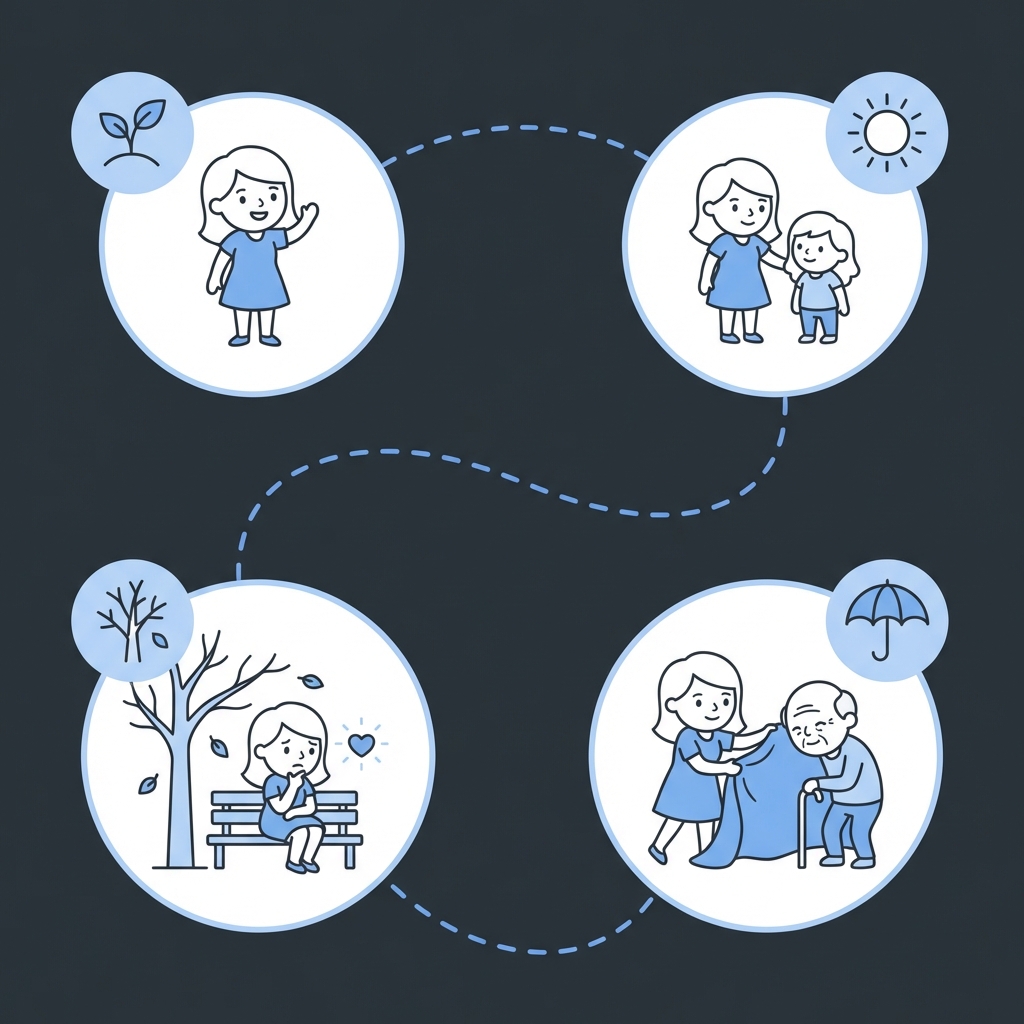
There’s a moment when you realize your life has reorganized itself around someone else’s needs. Not in the beautiful, chosen way of early parenthood or new love, but in the deeper, more permanent way that happens when caregiving becomes your new operating system. It might be gradual—the slow accumulation of doctor’s appointments and medication schedules. Or it might be sudden—the phone call that changes everything. Either way, you wake up one day and discover that your time, your energy, your very sense of self has been quietly restructured around keeping another person safe, healthy, and functioning.
This is what the caregiving years look like from the inside. Not the hallmark card version where love conquers all, and not the tragedy narrative where everything falls apart. Just the daily reality of what happens when someone else’s survival becomes your responsibility.
When Everything Gets Reorganized
The first thing caregiving changes is time itself. Not just your schedule—though that gets obliterated—but your relationship with time. You stop making plans more than a few days out because you never know when the next crisis will hit. You learn to exist in a state of constant low-level alertness, even during the quiet moments, because part of your brain is always monitoring, always ready to spring into action.
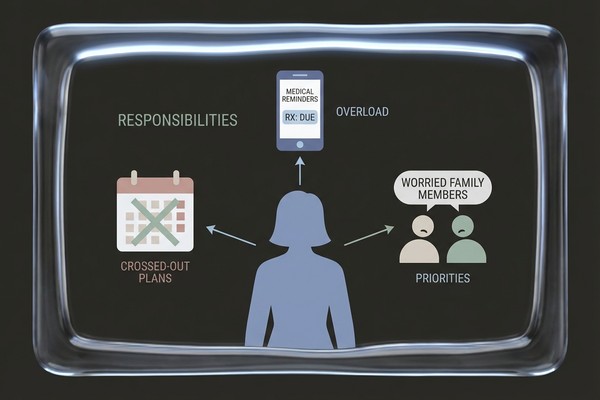
Your priorities don’t just shift; they get completely rewritten by forces outside your control. The presentation you’ve been preparing for weeks gets abandoned because your aging parent fell and needs someone to navigate the emergency room bureaucracy. The weekend getaway you planned gets cancelled because your child’s chronic condition flares up. The book you were finally going to read sits unopened because by the time everyone else’s needs are met, you barely have the cognitive capacity to scroll through your phone.
The proof of caregiving isn’t in what you accomplish—it’s in what you prevent from falling apart.
Your relationships change too, often in ways that surprise and hurt you. Some friends drift away, not out of malice but because your availability has become so unpredictable that maintaining the friendship requires more flexibility than they can offer. Others reveal themselves to be exactly the people you need, showing up with practical help and emotional support without being asked. You learn the difference between people who say “let me know if you need anything” and people who just show up with groceries.
The Invisible Architecture of Care
What people don’t see is the administrative load that comes with caregiving. It’s not just the hands-on care—the feeding, the bathing, the driving to appointments. It’s the invisible infrastructure you build and maintain to keep another person’s life functioning.
You become an expert in insurance networks and prior authorization requirements. You learn to speak the language of medical bureaucracy, to advocate fiercely while staying polite enough that the gatekeepers will actually help you. You maintain spreadsheets of medications and dosages, create systems for tracking symptoms and side effects, become fluent in the particular vocabulary of whatever condition you’re managing.
You hold the emotional weather of the household. You’re the one who notices when your aging parent seems more confused than usual, when your chronically ill partner is pushing too hard and heading for a crash, when your special needs child is overwhelmed by changes in routine. You become a translator, helping your person navigate a world that wasn’t designed for their particular needs.
The coordination alone is a part-time job. Scheduling appointments across multiple specialists, making sure prescriptions are filled on time, arranging transportation, communicating with schools or employers about accommodations needed. You become the central hub through which all information flows, the person everyone calls when they need to know what’s going on.
The Person You Used to Be
Perhaps the most disorienting part of the caregiving years is watching your own identity shift and blur. You don’t stop being yourself, exactly, but you become yourself-in-relation-to-someone-else’s-needs in a way that can feel consuming.
Your professional identity might take a backseat as you turn down opportunities that would require too much travel or flexibility you no longer have. Your social identity shifts as your availability becomes unpredictable and your conversation topics increasingly revolve around medical updates and care logistics. Your sense of autonomy erodes as more and more of your decisions are constrained by someone else’s limitations and needs.
This isn’t necessarily tragic—many caregivers find deep meaning and purpose in their role. But it’s a profound change that deserves acknowledgment. You’re not the same person you were before, and you’re not the person you might have become if circumstances were different. You’re someone new, shaped by the demands and gifts of caring for another human being.
Caregiving doesn’t just change what you do—it changes who you become.
The hardest part might be that this identity shift often happens in isolation. While new parents get baby showers and congratulations, while people starting new jobs get celebration dinners, caregivers often slip into their new role quietly, without fanfare or recognition. The magnitude of what you’ve taken on becomes clear only gradually, and by then you’re too deep in it to step back and process what’s happened to your life.
The Loneliness No One Talks About
There’s a particular kind of loneliness that comes with caregiving, and it’s hard to name because it exists alongside love and purpose and connection. You can be deeply bonded with the person you’re caring for and still feel profoundly alone in carrying the weight of their needs.
Part of this loneliness comes from the way caregiving can isolate you from your peer group. Your friends are talking about career moves and vacation plans while you’re researching respite care options and learning about Medicare coverage. Your concerns have become so specific and urgent that casual conversation feels impossible.
Another part comes from the emotional labor of staying positive and strong for your person while having nowhere to process your own fear, grief, and exhaustion. You become skilled at managing everyone else’s anxiety about the situation while your own feelings get pushed aside. You learn to say “we’re doing fine” when people ask, because the real answer is too complicated and too heavy for most casual interactions.
The Compound Exhaustion
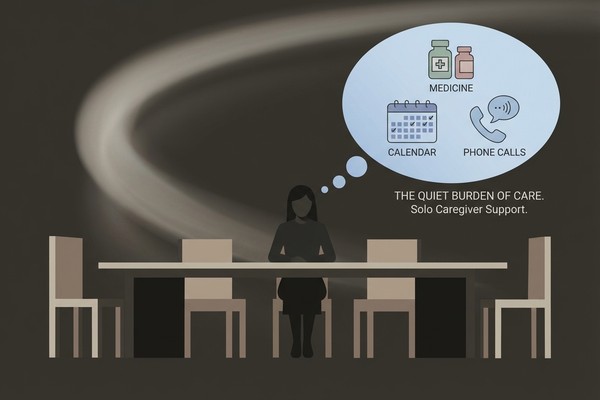
The tiredness that comes with caregiving isn’t just physical, though that’s certainly part of it. It’s the compound exhaustion of carrying multiple types of load simultaneously.
There’s the physical tiredness of broken sleep, of lifting and transferring, of being constantly on call. There’s the emotional exhaustion of holding space for someone else’s pain and fear while managing your own. There’s the cognitive fatigue of making endless decisions, learning new information, staying organized across multiple complex systems.
But perhaps most draining is the hypervigilance—the way your nervous system stays activated, always scanning for problems, always ready to respond to the next crisis. Even when things are going well, part of you remains alert, waiting for the other shoe to drop. This state of chronic activation is exhausting in a way that’s hard to explain to people who haven’t experienced it.
The exhaustion compounds because there’s rarely a clear endpoint. Unlike other challenging life phases that have natural conclusions, caregiving often stretches indefinitely into the future. You can’t just push through for a few more weeks or months—you have to find a way to sustain this level of engagement for years or even decades.
What Real Support Looks Like
When people offer support to caregivers, they often focus on the visible tasks—offering to bring meals or provide a few hours of respite. These gestures are valuable, but they don’t address the deeper structural challenges of caregiving.
Real support for caregivers means acknowledging the administrative burden and offering to help with that invisible work. It means someone else learning the insurance system, researching treatment options, or making the phone calls to coordinate care. It means recognizing that the caregiver needs their own medical care, their own social connections, their own space to exist as a person rather than just a support system.
It means understanding that caregivers need to talk about their experience without being told they’re heroes or saints, without being given advice about self-care, without being reminded how lucky their person is to have them. Sometimes they need to express frustration or grief without being made to feel guilty about it.
The best support doesn’t try to fix or minimize—it just witnesses and holds space.
Most importantly, real support recognizes that caregiving changes you permanently. Even when the intensive phase ends, you don’t just go back to who you were before. You carry the knowledge, the skills, the altered priorities, the deepened understanding of fragility and resilience. Support means helping caregivers integrate this experience into their ongoing sense of self rather than treating it as a temporary detour from their “real” life.
The Unacknowledged Weight
What part of caregiving has no one acknowledged for you? Maybe it’s the way you’ve become an expert in things you never wanted to learn about. Maybe it’s the grief of watching someone you love struggle while being powerless to fix it. Maybe it’s the way your own dreams have been quietly set aside, not dramatically abandoned but slowly eroded by the daily demands of keeping someone else afloat.
Perhaps it’s the strange guilt of sometimes resenting a role that’s also meaningful to you, or the way you’ve learned to find joy in small victories that no one else would even notice. Maybe it’s the loneliness of carrying information about prognoses and limitations that you can’t share with the person you’re caring for.
The caregiving years are a season of life that deserves recognition for what it actually is—not a noble calling or a tragic burden, but a profound reorganization of existence around someone else’s vulnerability. It’s work that matters deeply and costs tremendously, often simultaneously. And like all seasons, it shapes you in ways that persist long after it ends.
In a culture obsessed with optimization and achievement, caregiving stands as a reminder that some of life’s most important work is invisible, unmeasurable, and irreducible to productivity metrics. It’s the work of holding someone else’s life together when they can’t do it themselves. It’s ordinary and extraordinary, exhausting and meaningful, isolating and connecting all at once.
The seasons of caregiving teach you things you never wanted to learn and give you strength you never knew you needed. They’re not a detour from your real life—they are your real life, as valid and significant as any other chapter in your story.
This article was created with collaboration between humans and AI—we hope you ❤️ it.