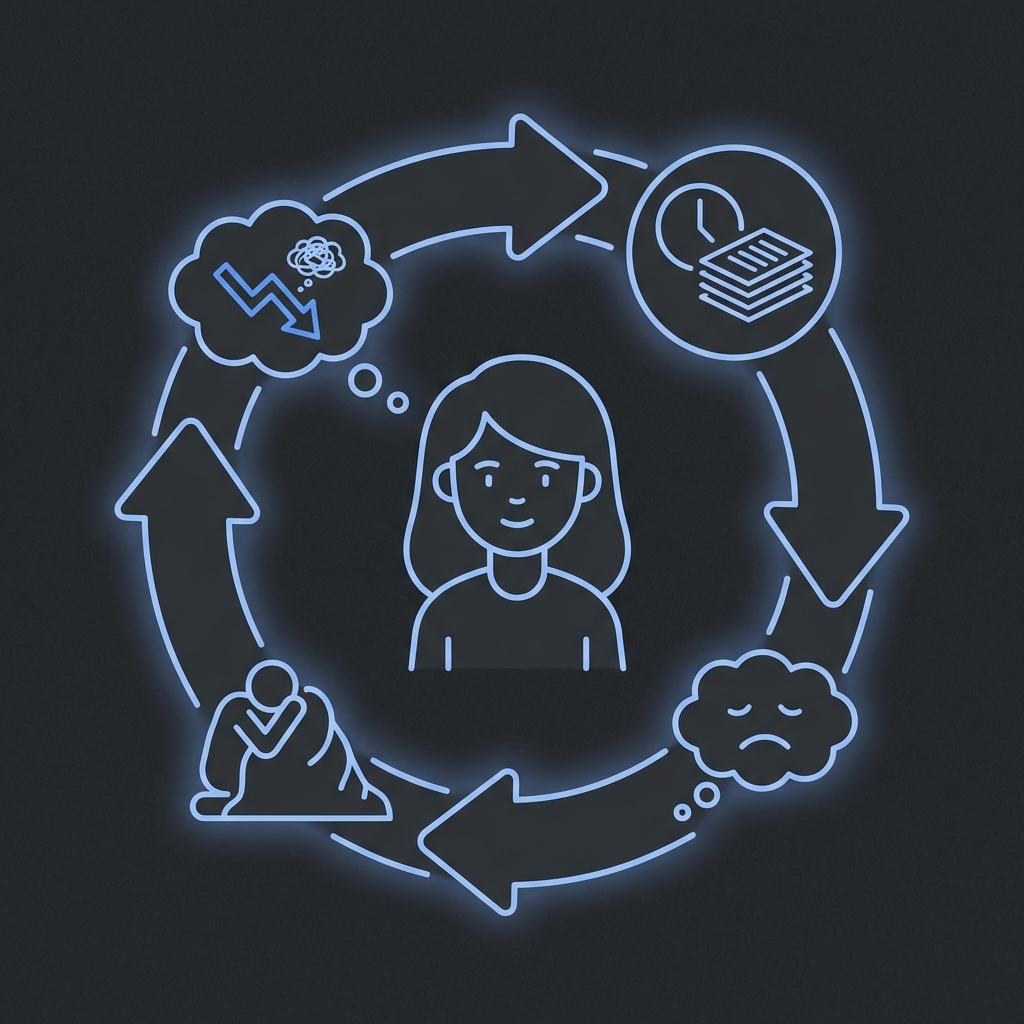
You know that feeling when you’ve been doing so well—staying on top of emails, meal planning, remembering appointments—and then life happens. Maybe you get sick, or work explodes, or your kid has a crisis. Suddenly you’re behind on everything, and instead of just catching up, you spiral into a familiar pattern of self-attack.
”I always do this.” “Why can’t I just stay organized?” “Everyone else manages better than me.”
Sound familiar? You’ve just entered what I call the shame loop, and it’s one of the most destructive forces working against your mental wellbeing. The cruel irony is that shame—the very emotion we think will motivate us to do better—actually creates the exact behavior we’re trying to avoid.
The Architecture of the Shame Loop
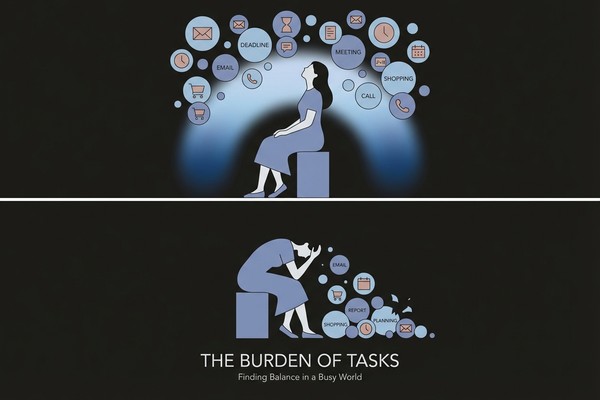
The shame loop has a predictable structure, and understanding it is the first step to breaking free. It starts with overload. You’re managing more than any reasonable human should handle, but you’re making it work through sheer determination and mental gymnastics. Everything feels precarious, but you’re keeping all the plates spinning.
Then comes the inevitable lapse. Maybe you forget to pay a bill, miss a deadline, or let the laundry pile up until everyone’s out of clean socks. In a healthy system, this would be information—a signal that you’re carrying too much and need to adjust. But instead of seeing it as data, you see it as evidence of your personal failure.
This is where the self-attack begins. Your inner critic comes out swinging with a greatest hits compilation of your perceived inadequacies. The language is always absolutist: “always,” “never,” “can’t even,” “should be able to.” This isn’t constructive feedback—it’s character assassination.
Here’s what makes the shame loop so insidious: shame doesn’t energize most people. It paralyzes them. When you’re in shame, your attention narrows dramatically. Instead of seeing the situation clearly—recognizing that you’re overwhelmed and need support—you can only see your own supposed deficiencies. Your problem-solving capacity plummets just when you need it most.
The result? You stay stuck in the exact behavior you’re criticizing yourself for. The shame that was supposed to motivate you to get organized actually prevents you from taking the clear-headed action that would help you catch up. You spend more energy beating yourself up than you do addressing the actual situation.
Why Shame Shrinks Your World
Shame operates like a cognitive straightjacket. When you’re in it, you lose access to your full range of options and resources. Your brain gets hijacked by the urgent need to defend against the attack—even when the attack is coming from inside your own head.
Think about the last time you were really behind on something important. Were you able to think creatively about solutions? Could you easily reach out for help? Did you feel capable of making good decisions about what to prioritize? Probably not. That’s shame doing its work.
When you’re in shame, you can’t see the forest for the trees—or even the trees for the branches you’re hitting yourself with.
The “should” thoughts are particularly toxic. “I should be able to handle this.” “I should have remembered.” “I should be more organized.” These thoughts masquerade as motivation, but they’re actually tiny acts of violence against your own humanity. They assume that you’re operating in a vacuum, with unlimited capacity and no competing demands.
But here’s what those “should” thoughts ignore: you’re not a productivity robot. You’re a human being with a finite amount of mental energy, operating in a complex system with unpredictable variables. When you shame yourself for being human, you’re not just being unkind—you’re being illogical.
The Kinder Interruption
Breaking the shame loop requires a different kind of self-talk, one that treats you like a person you actually care about. Instead of character attacks, try systems thinking. Instead of moral judgments, try practical assessment.
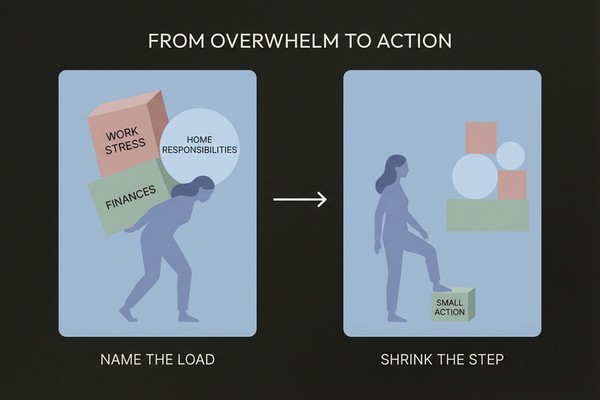
When you notice yourself spiraling into shame, pause and try this reframe: name the load, then shrink the next step.
Naming the load means acknowledging the real conditions you’re operating under. “I’m managing three work projects, two sick kids, and a broken washing machine” is not an excuse—it’s context. It helps you see that your lapse wasn’t a character flaw but a predictable outcome of being stretched too thin.
Once you’ve named the load honestly, you can shrink your next step down to something manageable. Not “get completely caught up on everything,” but “send one email” or “put one load of laundry in.” The goal isn’t to solve everything at once—it’s to take one small action that moves you forward without overwhelming your already taxed system.
Rewriting the Script
Here’s a practical exercise that can help interrupt the shame loop in real time. Take one of your recurring shame thoughts—you know, one of those greatest hits that plays on repeat when you’re behind—and rewrite it as a systems statement.
For example:
- Shame thought: “I always forget important things because I’m so disorganized.”
- Systems statement: “I’m tracking too many things in my head without external support systems.”
Or:
- Shame thought: “I should be able to keep up with everything like other people do.”
- Systems statement: “I need to adjust my commitments to match my actual capacity.”
Notice how the systems statement removes the moral judgment and points toward actionable solutions? That’s the difference between shame (which paralyzes) and assessment (which empowers).
The goal isn’t to eliminate all lapses—it’s to build systems that can handle them gracefully when they inevitably occur.
Designing for Human Reality
The most sustainable systems are designed with lapses built in. They assume you’ll sometimes forget, sometimes get overwhelmed, sometimes need to step back. Instead of requiring perfection, they create gentle ways to get back on track.
This might mean building buffer time into your schedules, creating backup plans for your backup plans, or setting up automatic systems that don’t rely on your memory. It definitely means abandoning the fantasy that you’ll ever reach a state of perfect organization where nothing ever falls through the cracks.
Think about the systems in your life that work best. I bet they’re not the ones that require constant vigilance and perfect execution. They’re probably the ones that are forgiving, that bend without breaking, that help you recover quickly when things go sideways.
The same principle applies to how you talk to yourself. The most effective self-talk isn’t the harshest—it’s the most helpful. It’s the voice that helps you dust yourself off and try again, not the one that keeps you on the ground.
Building Support That Honors Humanity
Real support doesn’t punish you for being human. It doesn’t make you jump through hoops to prove you deserve help, and it doesn’t withdraw when you’re struggling most. Unfortunately, many of the systems we rely on—both technological and social—do exactly the opposite.
They work great when you’re already on top of things but abandon you precisely when you need them most. They require you to remember to use them, to maintain them, to feed them information consistently. When you inevitably lapse, they make you start over from scratch, adding insult to injury.
The antidote is to seek out and create systems that understand human reality. Tools that pick up where you left off without judgment. People who offer help without lectures. Structures that make it easy to restart without shame.
This isn’t about lowering standards or accepting mediocrity. It’s about designing for the reality of human capacity and the inevitability of human limitation. It’s about recognizing that the shame loop doesn’t make you stronger—it makes you smaller.
When you break free from the shame loop, something remarkable happens. You don’t become perfect, but you become resilient. You don’t stop making mistakes, but you stop letting mistakes define you. You don’t suddenly have unlimited capacity, but you learn to work skillfully within the capacity you have.
And maybe most importantly, you model for everyone around you that being human isn’t something to apologize for—it’s something to work with, skillfully and kindly.
This article was created with collaboration between humans and AI—we hope you ❤️ it.