
There’s something quietly devastating about realizing you’re the only person who knows where the spare keys are kept, when the car registration expires, and which kid has which after-school activity on Thursday. Not because you’re uniquely gifted at remembering these things, but because somehow, over time, all the practical details of keeping life running have settled into your hands like sediment.
Practical support isn’t about emotional validation or someone listening to your problems—though those matter too. It’s about the concrete, tangible help that actually lightens your load. Someone who picks up your prescription when you’re swamped. A neighbor who can grab your kid from school when you’re stuck in a meeting that ran long. The friend who shows up with a drill when your bookshelf arrives in seventeen pieces.
Most of us are drowning in practical tasks we handle alone, not because we’re control freaks, but because we’ve never systematically looked at where support exists in our lives and where it doesn’t.
What Practical Support Actually Looks Like
Practical support is refreshingly concrete. It’s the friend who brings dinner after your surgery, not just flowers. It’s your sister watching the kids so you can go to a doctor’s appointment without negotiating childcare logistics. It’s the colleague who covers your client call when your babysitter cancels last minute.
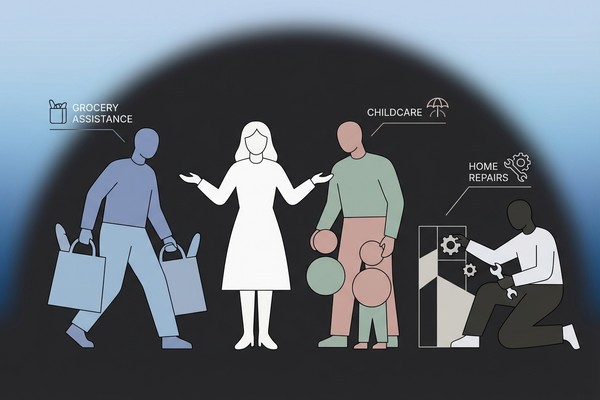
But here’s what practical support isn’t: advice about how you should handle things differently. It’s not your mother-in-law explaining how she managed three kids without help back in her day. It’s not a friend suggesting you should meal prep on Sundays to solve your dinner stress. Practical support is someone actually doing something that makes your life materially easier, not telling you how to optimize your way out of needing help.
The difference matters because so much of what passes for “support” in our culture is actually just more mental load disguised as helpfulness. When someone offers to “help you get organized” instead of just taking something off your plate, they’re adding a project to your list, not subtracting one.
Taking Inventory of Your Support Network
Think about the last month. Who actually helped you with concrete, practical tasks? Not who offered to help “if you need anything,” but who showed up and did something specific that saved you time, energy, or stress.
Your partner probably handles some things—though if you’re like most people, you might discover the division isn’t as even as you assumed. Maybe they handle car maintenance while you handle everything involving the kids’ schedules, school communications, and social calendar management. The mental load of tracking, remembering, and coordinating often lands heavily on one person even when tasks get divided.
Extended family might provide practical support, but it often comes with strings attached. Your mom might watch the kids, but then you spend emotional energy managing her opinions about screen time or bedtime routines. Your in-laws might help with home repairs, but you end up coordinating their schedules and preparing your house for their visit.
Friends can be incredible sources of practical support, but friendship practical support often operates on informal, reciprocal systems that can be hard to navigate. You pick up their kid from soccer practice when they’re traveling for work; they grab your groceries when you’re sick. But what happens when the giving and receiving feels unbalanced?
Most of us are drowning in practical tasks we handle alone, not because we’re control freaks, but because we’ve never systematically looked at where support exists in our lives and where it doesn’t.
Professional services count as practical support too, though we don’t always think of them that way. Your housekeeper, dog walker, grocery delivery service, and babysitter are all providing practical support. But relying entirely on paid services can create its own stress—financial pressure and the mental load of managing multiple service providers.
The Gaps That Reveal Everything
The most telling part of this audit isn’t who helps you—it’s what you handle entirely alone that you probably shouldn’t have to. These gaps reveal where your support system has holes and where cultural expectations have convinced you that certain responsibilities are inherently yours.
Maybe you’re the only person who remembers to schedule annual checkups for everyone in the family. You handle all communication with teachers, coaches, and other parents. You’re the one who notices when household supplies are running low, researches big purchases, and manages the family calendar. You plan all social activities, remember birthdays, and coordinate holiday logistics.
These tasks didn’t naturally gravitate toward you because you’re better at them. They landed in your lap because someone has to do them, and our culture has decided that someone is usually the woman in the relationship, the primary parent, or the person who “cares more” about the outcome.
The gaps often cluster around invisible work—the tasks that prevent problems rather than solve them. Nobody notices when you renew the car registration on time, but everyone notices when it expires and you get pulled over. Nobody celebrates your proactive scheduling of the furnace maintenance, but everyone would complain if the heat went out in January.
The Barriers to Building Support
Asking for practical help triggers a complicated mix of emotions that advice about “just ask for help” completely ignores. There’s the vulnerability of admitting you can’t handle everything alone. There’s the fear of being judged as incompetent or lazy. There’s the anxiety about owing someone something you can’t repay.
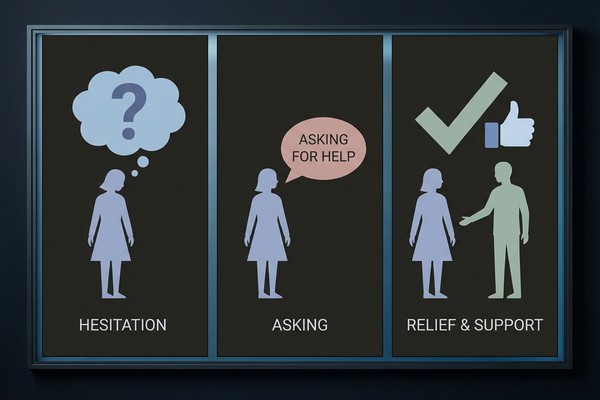
Trusting someone else to handle tasks you normally do requires letting go of control over outcomes. If your friend picks up groceries for you, they might not get the exact brand you prefer. If your partner handles the school pickup, they might not remember to ask the teacher about the upcoming field trip. Learning to accept “good enough” when someone else helps is its own skill.
Then there’s the reciprocity anxiety. Most practical support operates on informal exchange systems, but keeping track of who owes what to whom can turn helpful relationships into transactional scorekeeping. You helped me move, so I owe you dinner. I watched your kids last weekend, so you should be available when I need childcare. This mental accounting can make asking for help feel like taking on debt.
Some people seem naturally better at both asking for and offering practical support. They’re comfortable saying, “Hey, I’m going to Target—need anything?” or “I’m picking up lunch for myself, want me to grab you something?” They treat practical support as a normal part of community rather than a favor requiring elaborate justification.
When Support Feels Unbalanced
Practical support asymmetry is real and exhausting. You’re always the one offering to help others, but when you need something, everyone seems suddenly busy. Or you’re constantly managing logistics for your family while your partner handles discrete, bounded tasks that have clear endpoints.
This imbalance often reflects deeper cultural patterns about whose time and energy are considered more valuable or flexible. The person with the “more flexible” schedule (often meaning they work from home, work part-time, or have a job perceived as less demanding) becomes the default coordinator for everything requiring weekday availability.
The person who remembers everything becomes responsible for everything, even when other people are theoretically willing to help.
The person who remembers everything becomes responsible for everything, even when other people are theoretically willing to help. If you’re the one who knows when the dog needs to go to the vet, you end up scheduling the appointment, arranging time off work, and taking the dog—even if your partner could have handled any of those steps if reminded.
Breaking these patterns requires more than just redistributing tasks. It requires redistributing the mental load of tracking, anticipating, and coordinating. Your partner can’t just agree to “help more with kid stuff”—they need to take ownership of specific domains so you can actually stop thinking about them.
Building Reciprocal Support Without Scorekeeping
The healthiest practical support systems operate on generalized reciprocity rather than tit-for-tat exchanges. You help when you can, others help when they can, and over time it roughly balances out without anyone keeping detailed accounts.
This works best in communities where people have different strengths, schedules, and resources. Your neighbor who works from home might be great at accepting deliveries and handling weekday emergencies. You might be better at weekend projects or evening childcare swaps. Your friend with the pickup truck helps people move; you help people with technology problems.
The key is making support requests and offers specific and low-pressure. Instead of “let me know if you need anything,” try “I’m going to the grocery store Sunday morning—want me to pick up anything for you?” Instead of asking for general help with a big project, ask for specific assistance: “Could you watch the kids for two hours Saturday morning so I can deep-clean the kitchen?”
Building practical support also means being willing to receive help imperfectly. If someone offers to bring dinner, say yes even if you’re not sure what they’ll bring. If your teenager’s friend’s parent offers to drive both kids to practice, accept even if it means giving up control over timing and logistics.
The goal isn’t to eliminate all practical tasks from your life, but to create enough support that you’re not carrying the entire load alone. When practical support works well, it doesn’t just save time—it reduces the constant low-level anxiety of knowing that everything depends on you.
Take a moment to think about one practical task you’re handling alone that you’d genuinely like help with. Not something you think you should want help with, but something that would actually make your life easier if someone else could handle it occasionally. That’s where your support audit can turn into action.
This article was created with collaboration between humans and AI—we hope you ❤️ it.