
Five weeks. That’s how long you’ve been sitting with the question of support—turning it over in your mind like a stone you found on the beach, examining its weight, its texture, the way light catches its surface differently depending on how you hold it.
If you’ve been following along with the Support Audit, you’ve looked at your practical support (who helps with the actual stuff), your emotional support (who really listens), your logistical support (the systems that hold your life together), and your social support (the people who make you feel less alone). You’ve probably discovered some things that surprised you. Maybe you found support in places you hadn’t noticed before. Maybe you realized how much you’ve been carrying alone.
But now what? Now comes the part that matters most: the part where reflection becomes action. Not massive, life-altering action—that’s productivity culture talking. Just one small, deliberate change that acknowledges what you’ve learned about yourself and what you need.
What Your Audit Actually Revealed
The patterns that emerged during your audit probably weren’t what you expected when you started. Most people begin this process thinking they’ll discover they need more help with tasks—more hands to fold laundry, more people to share the grocery runs, more systems to track the endless details of daily life.
But what usually surfaces is more nuanced. Maybe you realized that you have plenty of practical support, but you’re terrible at using it. Or that your logistical systems are actually pretty solid, but you’re emotionally depleted because you don’t have anyone who truly understands the weight of what you’re managing. Perhaps you discovered that you’re surrounded by people who care about you, but none of them really know how to help in ways that actually reduce your mental load.

The audit isn’t about finding deficiencies to fix—it’s about finding the truth of how support actually works in your life right now. And the truth is usually messier and more interesting than “I need more help.”
One pattern that emerges consistently is the gap between having support and feeling supported. You might have a partner who does their share of household tasks but still feel like you’re the one holding all the worry about whether things get done. You might have friends who would drop everything to help you in a crisis but feel hesitant to reach out when you’re just… tired. You might have excellent systems for managing your calendar and tasks but still wake up at 3 AM thinking about everything you might be forgetting.
The Gap That Costs You Most
Of the four types of support, one probably stood out as the place where you’re running the biggest deficit. Not necessarily the area where you have the least support, but the area where the gap between what you have and what you need creates the most friction in your daily life.
For many people, it’s emotional support—not because they don’t have people who care about them, but because they don’t have people who understand the specific kind of exhaustion that comes from being the person who remembers everything. The friends who suggest you “just let some things go” when you try to explain why you can’t stop thinking about whether your kid has clean soccer cleats for tomorrow’s game. They mean well, but they don’t get that letting things go isn’t the problem—holding them all is.
For others, it’s logistical support. You have people, you have love, you have hands to help with tasks. But you don’t have systems that actually reduce the work of coordinating all those people and all that help. You spend more mental energy managing your support than you save by having it.
The most expensive gap isn’t always the biggest one—it’s the one that touches everything else.
Sometimes the costliest gap is in social support. You have practical help, decent systems, and even people to talk to about your feelings. But you don’t have people who share your specific reality. Other working parents who understand why you feel guilty about everything. Other business owners who know what it’s like to have your personal and professional identities completely intertwined. Other caregivers who get that “self-care” advice feels insulting when you can barely find time to eat lunch.
What’s Really in the Way
Once you’ve identified your costliest gap, the next question isn’t “How do I fill it?” It’s “What’s actually preventing me from filling it?” And this is where things get interesting, because the barriers are rarely what they appear to be on the surface.
The barrier might look like time—you don’t have time to build new systems, cultivate new relationships, or reorganize how support works in your life. But often, the real barrier is permission. Permission to need what you need. Permission to ask for something different than what you’ve been getting. Permission to admit that your current approach isn’t working, even if it looks fine from the outside.
Sometimes the barrier looks like money. You can’t afford the childcare, the house cleaner, the meal delivery, the therapy, the systems that would actually make a difference. And sometimes that’s true. But sometimes the real barrier is the belief that needing those things means you’re failing at something you should be able to handle alone.
The barrier might look like other people—partners who don’t see the mental load, friends who aren’t available in the ways you need them, family members who create more work than they solve. But often the real barrier is your own reluctance to be specific about what you need and direct about asking for it.
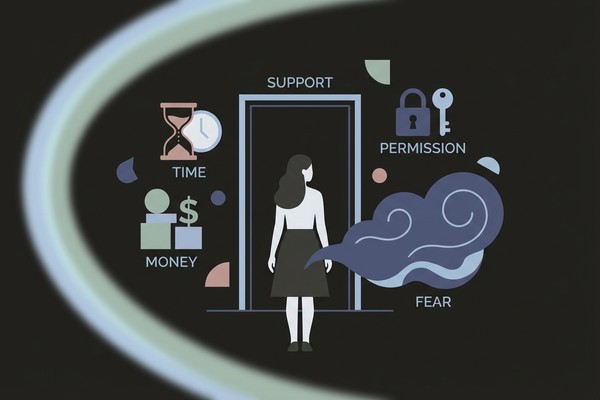
Most of us have been taught that needing support is temporary—something you do when you’re overwhelmed, when you’re going through a hard time, when you’re not quite managing on your own. We haven’t been taught to think of support as infrastructure, as something you build intentionally and maintain consistently because it makes everything else possible.
The Difference Between Wanting and Building
Here’s where most people get stuck: they know what kind of support they want, but they don’t know how to build for it. Wanting support is passive. It’s hoping someone will notice you’re struggling and offer help. It’s waiting for the right moment, the right person, the right system to appear. Building support is active. It’s making choices that create the conditions for support to exist and thrive.
Building for practical support might mean having a conversation with your partner about redistributing not just tasks, but the mental load that comes with those tasks. It might mean hiring help for the things that drain you most, even if you could technically do them yourself. It might mean teaching other people in your life how to help you in ways that actually reduce your work rather than just redistributing it.
Building for emotional support might mean being more specific about what you need when you talk to people about your challenges. Instead of venting about how overwhelmed you are, you might say “I need someone to remind me that managing all of this is actually hard work, not something I should be able to do effortlessly.”
Building for logistical support might mean investing time upfront in systems that will save you mental energy later. It might mean accepting that the setup phase will feel like more work before it feels like less work.
Building for social support might mean seeking out communities of people who share your specific reality instead of trying to explain that reality to people who don’t live it.
Support isn’t something that happens to you—it’s something you create the conditions for.
Your One Small Change
Now, with all of this in mind, what’s one small, specific thing you could do in the next two weeks to start building better support in your costliest gap area?
Not a complete overhaul. Not a perfect solution. Just one concrete step that acknowledges what you learned about yourself during this audit and moves you slightly closer to the kind of support that would actually make a difference in your daily life.
If your gap is in practical support, maybe it’s having one conversation about redistributing one specific responsibility. If it’s emotional support, maybe it’s reaching out to one person who really gets your situation. If it’s logistical support, maybe it’s setting up one system that will automate something you’re currently tracking manually. If it’s social support, maybe it’s joining one community or group where you can connect with people who share your reality.
The key is to choose something small enough that you’ll actually do it, specific enough that you’ll know whether you did it, and meaningful enough that it moves you toward the kind of support that would genuinely reduce your mental load.
Support as Sustainability
This isn’t about self-improvement or optimization. It’s about sustainability. You’ve been carrying a lot—maybe more than you realized before you started this audit. The question isn’t whether you’re strong enough to keep carrying it all. You’ve already proven that. The question is whether you want to.
Support isn’t an indulgence or a luxury or a sign that you’re not managing well enough on your own. Support is what makes it possible to keep showing up for all the things and people that matter to you without depleting yourself in the process.
The audit is over, but the building never really ends. Support, like any infrastructure, requires maintenance and occasional upgrades. What you need will shift as your life changes. The systems that work now might need adjustment later. The people who can help you today might not be available tomorrow, and new people might appear who can help in ways you haven’t even thought of yet.
But now you have something you didn’t have five weeks ago: a clearer picture of how support actually works in your life, what’s missing, and what one small step might look like. That’s not nothing. That’s the beginning of holding less and being held more.
This article was created with collaboration between humans and AI—we hope you ❤️ it.