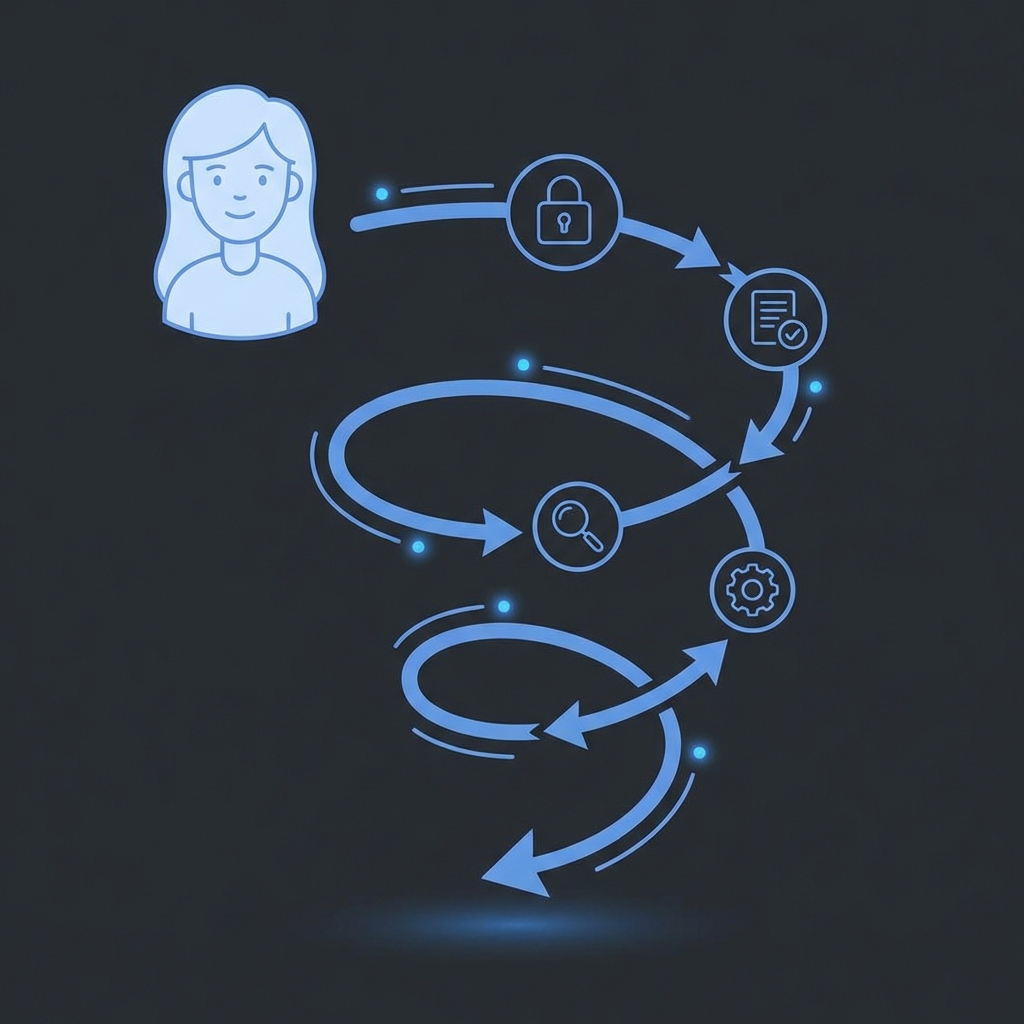
You know that sinking feeling when you’re 90% sure you locked the front door, but you walk back anyway to check? Or when you’ve already confirmed the meeting time twice but find yourself scrolling back through messages one more time? Welcome to the verification spiral—where the act of checking becomes more exhausting than the original task ever was.
This isn’t about being neurotic or detail-obsessed. It’s about operating in systems that don’t give us clear, trustworthy feedback about what’s actually done. When we can’t trust that something is truly complete, we get stuck in loops of re-checking, re-confirming, and re-opening what should be closed loops.
The Hidden Tax on Everything
The verification tax is that extra cognitive overhead we pay when systems don’t clearly communicate status. It’s the mental energy spent double-checking, cross-referencing, and confirming what should be obvious. Unlike the productivity world’s obsession with “decision fatigue,” verification tax isn’t about making choices—it’s about the exhausting work of figuring out what’s actually real.
Think about how this plays out in daily life. You send an important email and immediately wonder if it actually went through. You pay a bill online but screenshot the confirmation page because you don’t trust the system to remember. You ask your teenager if they finished their homework, get a “yes,” but still feel compelled to verify because past experience has taught you that “finished” might mean “started” or “thought about starting.”
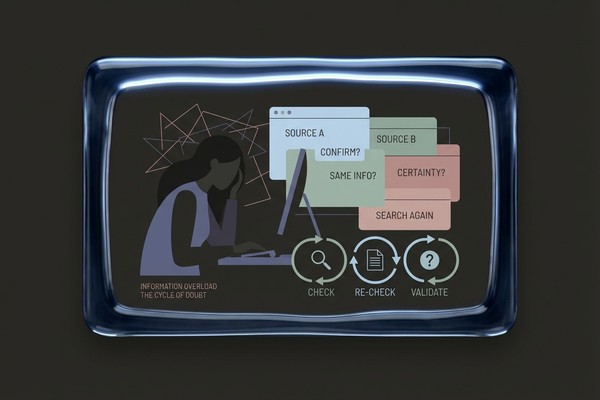
The verification spiral starts innocently enough. You check once “just to be safe.” But when systems are ambiguous or unreliable, that safety check doesn’t actually provide safety—it just creates another data point to doubt. So you check again. And again. Each verification attempt costs time and mental energy, but worse, it reinforces the underlying lack of trust that created the need to verify in the first place.
Why Verification Balloons Out of Control
The spiral grows because most of our systems—both digital and human—are terrible at communicating clear status. They leave us guessing about what “done” actually means. When your project management tool shows a task as “complete” but you’re not sure if that means “submitted” or “approved” or “filed away forever,” you’re going to keep checking.
Ambiguity is verification’s best friend. When expectations aren’t crystal clear, every interaction becomes a potential source of doubt. Did “I’ll handle it” mean they’ll do it today or eventually? Does “it’s ready” mean ready for review or ready to ship? These unclear handoffs create verification loops because nobody wants to be the person who assumed wrong.
Fear amplifies everything. The stakes feel high because the cost of missing something important outweighs the annoyance of over-checking. We’ve all been burned by assuming something was handled when it wasn’t. So we develop a defensive verification habit that treats every system and every person as potentially unreliable until proven otherwise.
The verification spiral isn’t paranoia—it’s a rational response to unreliable systems.
But here’s what’s insidious about verification spirals: they create exactly the kind of friction and overhead that productivity culture claims to solve, while completely missing the root cause. Most productivity advice treats verification as a personal failing—you just need better systems, clearer priorities, more discipline. But verification spirals are usually a symptom of poorly designed processes, not poorly disciplined people.
The Real Cost of Constant Checking
The obvious cost is time. When you spend fifteen minutes re-reading email chains to confirm what was decided, or when you call to verify an appointment you already confirmed online, that’s time that could have been spent on actual work. But the hidden costs run much deeper.
Verification spirals create tension in relationships. When you ask your partner for the third time if they remembered to call the insurance company, you’re not just checking on a task—you’re communicating that you don’t trust their word. When you follow up on emails that colleagues haven’t responded to yet, you risk coming across as pushy or micromanaging, even when you’re just trying to get clarity.
The cognitive load is exhausting. Your brain maintains an open loop for every unverified item, which means you’re carrying the mental weight of uncertainty long after you’ve done the checking. That nagging feeling that something might not be quite right doesn’t disappear just because you verified it once—it lingers until you have true confidence in the system.
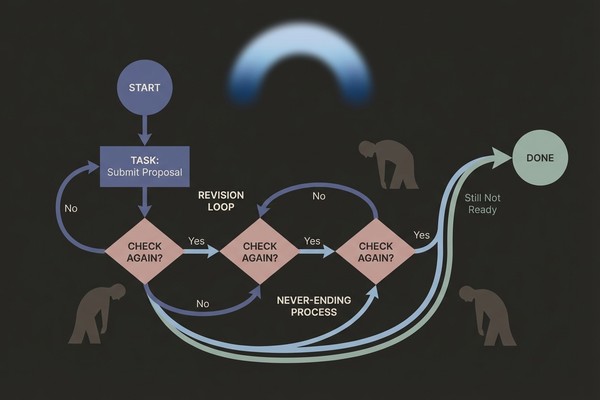
Progress stalls when verification becomes the default mode. Instead of moving forward with reasonable confidence, we get stuck in preparation loops. We research the research, plan the planning, and confirm the confirmations. The verification work starts to feel more important than the actual work, creating an illusion of productivity while nothing meaningful gets accomplished.
Designing Away the Need to Verify
The solution isn’t better verification habits—it’s designing systems that don’t require constant verification in the first place. This means creating clarity about what “done” actually looks like before you start, not after you’re already spinning.
Clear expectations eliminate most verification needs. When everyone understands exactly what complete looks like, there’s no ambiguity to verify. This isn’t about being rigid or controlling; it’s about reducing the cognitive overhead for everyone involved. When your babysitter knows that “clean up” means toys in bins and dishes in the dishwasher, nobody needs to verify what happened after bedtime.
Transparent status updates prevent verification loops before they start. The best systems make progress visible without requiring active checking. When you can see that your package has been delivered, your payment has been processed, or your request has been assigned to someone, you don’t need to follow up or double-check. The system is doing the verification work for you.
Shared definitions prevent mismatched expectations. One person’s “almost done” is another person’s “barely started.” When teams or families establish clear definitions for common status terms, verification becomes unnecessary because everyone’s working from the same playbook.
The Definition of Done for Real Life
Here’s a practical tool that software teams have been using for years that works brilliantly for personal life: the definition of done. Instead of treating “done” as obvious, you explicitly define what complete looks like for different types of tasks.
For household projects, “done” might mean the task is completed, supplies are put away, and any follow-up is scheduled. For work deliverables, “done” might mean the work is submitted, stakeholders are notified, and next steps are documented. For family logistics, “done” might mean the arrangement is confirmed, backup plans are in place, and everyone who needs to know has been informed.
When “done” has a definition, verification becomes unnecessary.
This isn’t about being pedantic or over-engineering simple tasks. It’s about creating enough clarity that your brain can actually close the loop and move on. When you know exactly what complete looks like, you’ll recognize it when you see it. No verification required.
The definition of done works because it shifts the cognitive work from the end of the process (verification) to the beginning (clarity). Instead of spending energy checking whether something is really finished, you spend a small amount of energy upfront defining what finished means. This prevents the verification spiral before it starts.
Breaking the Spiral
Recognition is the first step. When you catch yourself in a verification loop—checking the same thing multiple times, asking for the same confirmation repeatedly, or feeling like you can’t quite trust that something is handled—pause and ask what’s driving the uncertainty.
Sometimes the issue is genuinely unclear communication or unreliable systems. In those cases, the solution is to address the root cause: clarify expectations, improve the system, or build in better status updates. Don’t just accept verification as a necessary evil.
Other times, verification becomes a habit that outlasts its usefulness. You might keep checking things that used to be unreliable but have since improved, or you might be over-verifying low-stakes items because you’re in verification mode for high-stakes ones.
The goal isn’t to eliminate all checking—some verification is genuinely necessary and valuable. The goal is to distinguish between useful verification that provides new information and anxious verification that just burns mental energy without adding clarity.
Systems That Earn Trust
The most powerful antidote to verification spirals is systems that consistently follow through. When something reliably happens the way it’s supposed to happen, you stop needing to verify it. This is why we don’t check whether our alarm clock is still set every night—we trust that it will work the same way it worked yesterday.
Building trust takes time, but it starts with transparency. Systems that show their work—that make it easy to see what’s happening and when—reduce the need for external verification. When you can see that your grocery order is being packed, your expense report is being reviewed, or your kid’s permission slip has been received, you don’t need to follow up.
Personal systems need the same transparency. When you use a tool that tracks not just what you need to do, but what you’ve actually done and what’s waiting for someone else, you can see the status of everything without having to remember it all. The system becomes your external verification, freeing up your mental energy for more interesting work.
The best systems make verification unnecessary by making status obvious.
This is fundamentally different from productivity systems that just help you track more things more efficiently. Those systems often increase verification burden because now you have to verify both the original task and whether you’ve tracked it correctly. True mental load reduction comes from systems that take ownership of the remembering and the tracking, so you don’t have to verify that they’re doing their job.
The verification spiral thrives in environments of uncertainty and poor communication. It withers in environments of clarity and reliable follow-through. When we design our systems—both digital and human—to provide clear status and consistent outcomes, we eliminate the cognitive overhead of constant checking.
Your mental energy is too valuable to spend on verification loops. It should be spent on the work that actually matters, secure in the knowledge that everything else is genuinely handled. That’s not just better productivity—it’s a better way to live.
This article was created with collaboration between humans and AI—we hope you ❤️ it.