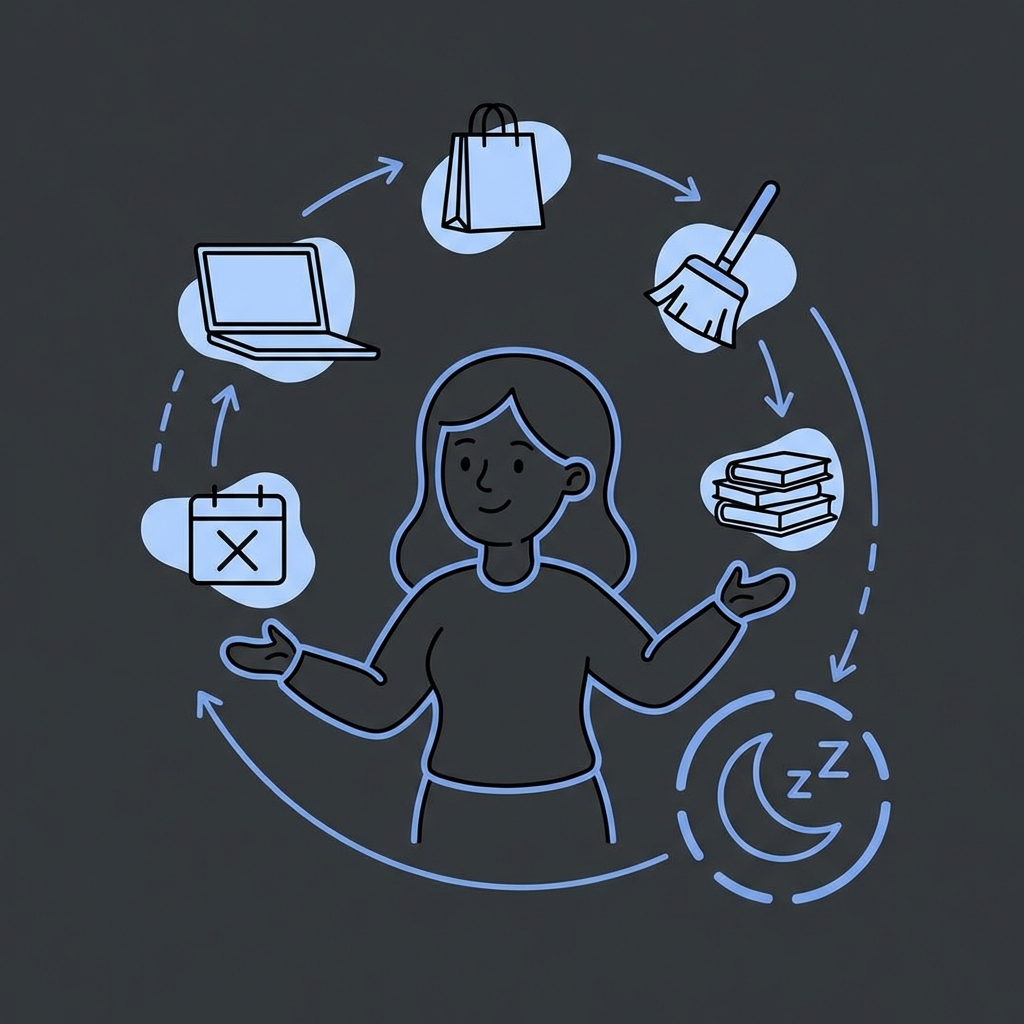
Saturday morning arrives with that familiar weight—not the gentle anticipation of leisure, but the quiet dread of everything that needs catching up. You wake up already making lists in your head. The laundry that’s been sitting in the basket since Tuesday. The groceries that somehow never happened during the week. The birthday gift you still need to buy. The work emails that followed you home on Friday and are now multiplying in your inbox like digital weeds.
This is the weekend that isn’t really a weekend at all. It’s maintenance time disguised as freedom.
You move through Saturday like you’re playing catch-up with your own life. Load the dishwasher while coffee brews. Sort through the mail pile that’s been growing on the counter. Return the library books that are somehow already overdue. Pick up prescriptions. Buy groceries. Fold laundry while mentally rehearsing Monday’s presentation. Sunday follows the same script—meal prep, house tidying, that work project you couldn’t finish during the week because of three back-to-back meetings that could have been emails.
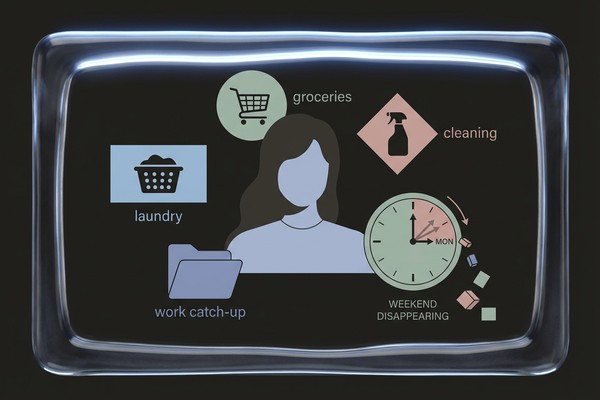
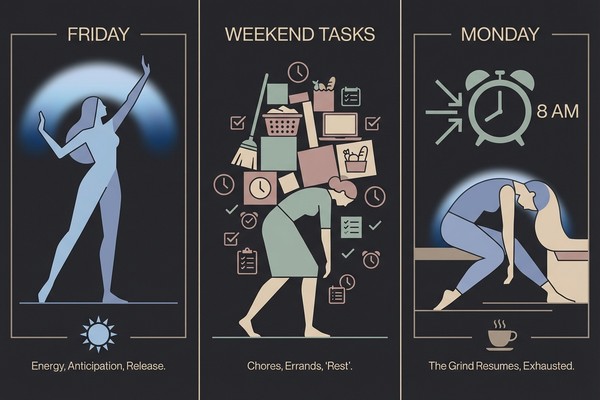
By Sunday night, you’re somehow more tired than you were on Friday. The weekend evaporated into a blur of necessary but unremarkable tasks. Monday looms with its familiar dread, and you realize you never actually rested. You maintained. You caught up. You prepared. But you didn’t recover.
The Maintenance Debt That Eats Recovery
Here’s what’s really happening: we’ve normalized living in a state of constant maintenance debt. During the week, life accumulates faster than we can process it. Dishes pile up. Laundry multiplies. Emails breed. Administrative tasks spawn like digital fruit flies. The weekend becomes our designated time to pay down this debt, but the interest rate is brutal—it costs us our recovery.
We’ve been sold this idea that weekends are “free time,” but they’re not free at all. They’re expensive. They cost us rest, spontaneity, and the kind of deep restoration that makes Monday feel possible instead of punishing.
The guilt makes it worse. There’s this persistent voice that whispers you don’t deserve rest until everything is handled. Until the house is clean and the inbox is manageable and next week is properly planned. Rest becomes something you earn through productivity, not something you need for basic human functioning.
Rest isn’t the reward for completing your maintenance tasks—it’s the foundation that makes everything else sustainable.
But here’s the thing about maintenance debt: it never actually gets paid off. There will always be laundry. There will always be groceries to buy and emails to answer and things that need organizing. The debt is designed to be perpetual. When we sacrifice rest to pay it down, we’re not actually solving anything. We’re just borrowing energy from future versions of ourselves.
The Real Cost of Recovery Deficit
That Monday morning dread isn’t just about not wanting to go back to work. It’s about starting the week already depleted. When weekends become maintenance marathons, Monday begins with an energy deficit that compounds throughout the week. You’re not just tired—you’re tired of being tired.
Chronic fatigue isn’t always a medical condition. Sometimes it’s a lifestyle design flaw. When recovery disappears from the weekly cycle, exhaustion becomes the baseline. You stop remembering what it feels like to feel rested because rest keeps getting postponed until some mythical future when everything is finally “handled.”
The irony is brutal: the more we sacrifice rest to stay on top of everything, the less equipped we become to actually handle anything well. Decision fatigue sets in. Everything feels harder than it should. Small problems become overwhelming because we’re operating from an empty tank.
Your cognitive capacity suffers too. When you’re constantly in catch-up mode, you lose the mental space for creativity, for spontaneous moments with family, for the kind of thinking that actually moves your life forward instead of just maintaining it.
Reframing Rest as Systems Maintenance
What if we stopped thinking about rest as something we earn and started thinking about it as preventive maintenance? Your car needs oil changes not because it deserves them, but because it requires them to function. Your phone needs charging not as a reward for good performance, but as a basic operational necessity.
You are not different. Rest isn’t a luxury item in your life’s budget—it’s infrastructure. When rest gets consistently deferred, everything else starts breaking down in small, almost invisible ways. Your patience gets shorter. Your focus gets scattered. Your immune system gets compromised. Your relationships get the leftover version of you instead of the rested, present version.
The weekend recovery block isn’t about being lazy or self-indulgent. It’s about being sustainable. It’s about recognizing that you can’t pour from an empty cup, but more than that—you shouldn’t have to try.
The Two-Hour Recovery Experiment
Here’s a practical experiment that feels small enough to be possible but significant enough to make a difference: protect one two-hour block during your weekend for actual recovery. Not maintenance disguised as rest (like organizing your closet), but genuine restoration.
This might mean reading a book without your phone nearby. Taking a walk without a destination or agenda. Sitting in a coffee shop and people-watching. Having a conversation with a friend that doesn’t involve coordinating schedules or solving problems. Lying on the couch and staring at the ceiling if that’s what your nervous system needs.
The key is to treat this block as non-negotiable. When the voice in your head says you should be doing laundry instead, remind it that this isn’t selfishness—it’s systems maintenance. When guilt creeps in about the undone tasks, remember that those tasks will still be there in two hours, but your capacity to handle them well depends on this recovery time.
The proof isn’t in what you accomplished during those two hours—it’s in how you feel approaching everything else.
Start small. Two hours feels manageable even in the busiest weekend. But notice what happens. Notice if Monday feels different. Notice if you have more patience with your family, more creativity at work, more energy for the things that actually matter to you.
Redesigning the Maintenance Load
The bigger question, though, is whether all that weekend maintenance is actually necessary. We’ve accepted a maintenance load that might be artificially inflated by systems that don’t serve us well.
What if some of those weekend tasks could be distributed throughout the week in smaller, less overwhelming chunks? What if some of them could be eliminated entirely? What if some of them could be shared with other people in your household who are perfectly capable of folding their own laundry?
The goal isn’t to optimize your weekend productivity—it’s to reduce the maintenance debt that’s stealing your recovery time. Every task you can remove, simplify, or redistribute is energy you get back for rest.
This might mean embracing “good enough” in areas that don’t actually matter. It might mean having conversations about household labor distribution that feel awkward but necessary. It might mean spending money on services that buy back time and energy, if that’s an option for you.
When Systems Support Recovery
The most sustainable solution isn’t individual optimization—it’s systemic support. Tools and systems that actually reduce your cognitive load instead of just organizing it differently. Support that remembers things for you instead of just reminding you to remember them.
This is where the right kind of assistance makes the difference between weekend maintenance marathons and weekend recovery. When something else is tracking the details, following up on the loose ends, and making sure nothing falls through the cracks, you’re not spending your weekend playing catch-up with your own life.
You’re not trying to hold less because you’re lazy or because you can’t handle responsibility. You’re trying to hold less because holding everything is unsustainable, and sustainability is what makes everything else possible—including being present for the people and experiences that make life worth living in the first place.
The weekend that actually restores you isn’t a luxury. It’s a requirement. And protecting it isn’t selfish—it’s strategic.
This article was created with collaboration between humans and AI—we hope you ❤️ it.