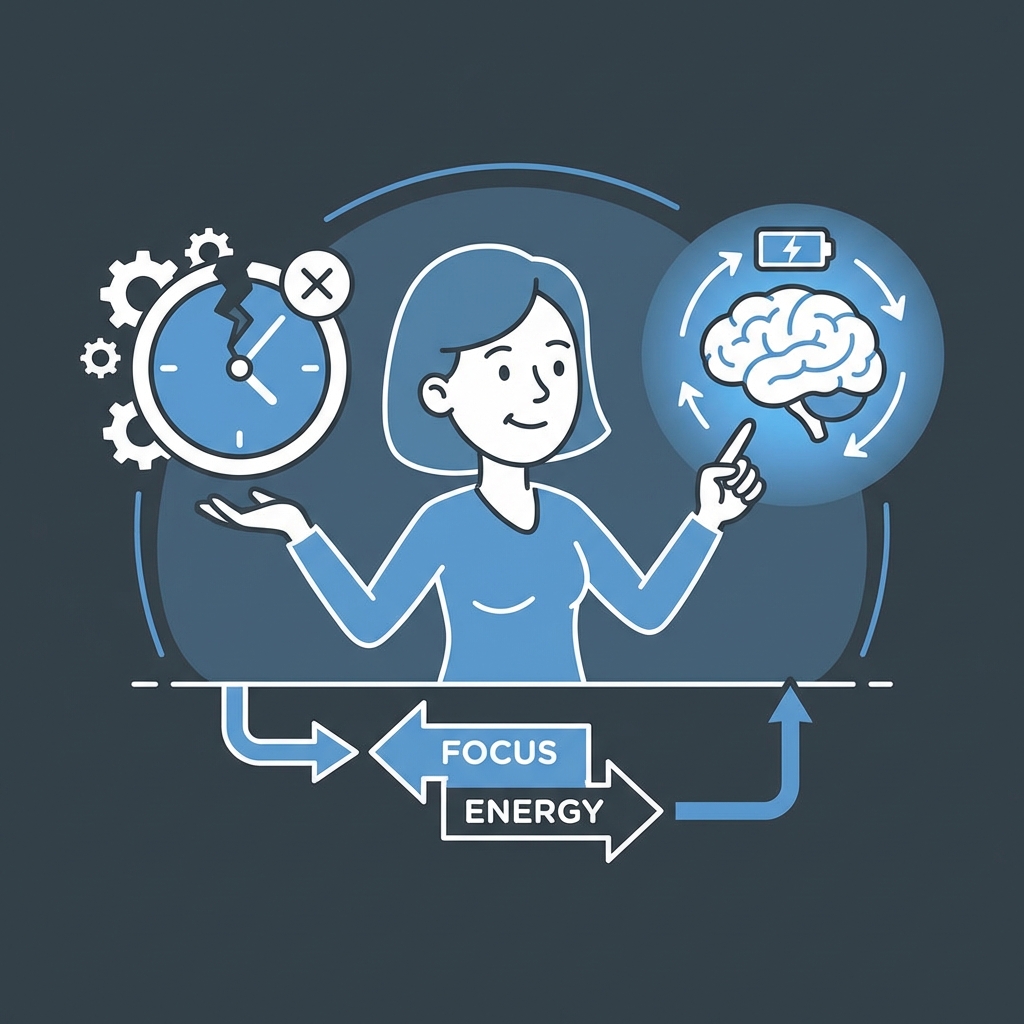
The phrase “time management” has always bothered me. Not because it’s wrong, exactly, but because it promises something impossible. You can’t manage time any more than you can manage the weather or the rotation of the earth. Time just is—relentless, uniform, completely indifferent to your plans.
What you can manage are the choices you make within time’s fixed container. The commitments you accept, the attention you direct, the boundaries you set. But somehow we’ve all agreed to call this “time management,” and that linguistic sleight of hand has caused more stress than it’s solved.
When you think you’re supposed to manage time itself, every scheduling conflict feels like a personal failure. Every interruption becomes evidence that you’re not disciplined enough. Every day that ends with undone tasks proves you haven’t mastered the fundamental skill of making hours bend to your will.
But what if the real skill isn’t managing time at all?
The False Promise of Time Control
The time management industry has built an empire on the illusion of control. Buy the right planner, follow the perfect system, optimize your calendar, and you’ll finally tame the chaos. The underlying message is always the same: if you’re overwhelmed, you’re doing it wrong.
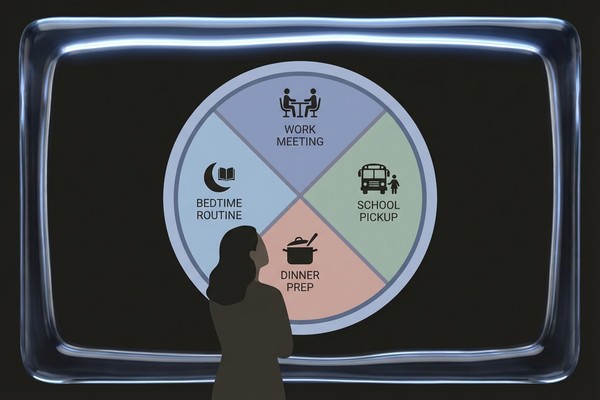
This framing is particularly cruel for working parents and anyone juggling multiple life domains. When your day includes both quarterly reports and pediatrician appointments, both client calls and school pickup, the idea that you should be able to “manage” time feels like a joke. Time doesn’t care that your meeting ran long and soccer practice starts in twenty minutes.
The real problem isn’t that you’re bad at time management. It’s that you’re trying to manage something that can’t be managed while ignoring the things that actually can be.
Time is the one resource that’s perfectly distributed—everyone gets exactly 24 hours. The inequality is in what fills those hours.
What fills your hours? Commitments. Some you chose deliberately, others you inherited or absorbed through social pressure. Some serve your goals, others serve other people’s expectations. Some energize you, others drain you completely.
These commitments—not time itself—are what determine whether your days feel sustainable or overwhelming. And unlike time, commitments can be negotiated, rearranged, or declined entirely.
What Actually Changes Outcomes
When people say they’ve gotten better at “time management,” they’re usually describing one of four things: better commitment design, clearer boundaries, smarter sequencing, or more intentional attention allocation.
Commitment design means being deliberate about what you agree to do. Most overwhelm comes from saying yes without considering the full cost—not just the time required, but the mental energy, the preparation, the follow-up, the opportunity cost of what you won’t be able to do instead.
Boundaries aren’t just about saying no to new requests. They’re about protecting the commitments you’ve already made from being eroded by interruptions, scope creep, or other people’s poor planning becoming your emergency.
Sequencing recognizes that not all hours are created equal. Your brain at 9 AM is different from your brain at 3 PM. Your energy after a good night’s sleep is different from your energy after a sick kid kept you up. Smart sequencing matches your most important work to your most capable moments.
Attention allocation acknowledges that your mental bandwidth is limited and leaky. Every open browser tab, unfinished conversation, and pending decision consumes cognitive resources whether you’re actively thinking about it or not.
None of these require managing time. They require managing yourself within time’s constraints.
The Attention Leak Problem
Here’s what the productivity gurus don’t tell you: attention doesn’t just get used, it gets lost. It leaks out through tiny gaps you don’t even notice until you’re running on empty.
The notification that pops up during focused work. The mental note you make to follow up on something later. The nagging awareness that you’re forgetting something important but can’t remember what. The cognitive overhead of tracking which tasks are waiting on other people, which deadlines are flexible, which promises you’ve made to whom.
This is why you can have a light day on paper but still feel mentally exhausted. Your attention has been nibbled away by a thousand tiny interruptions and micro-decisions.
Traditional time management focuses on scheduling blocks for important work, but it ignores the attention tax of everything else. You might block two hours for writing, but if you spend the first thirty minutes trying to remember what you were supposed to write about, or if you’re interrupted three times by “quick questions,” those two hours become much less productive.
Protecting attention isn’t about perfect focus—it’s about reducing the cognitive overhead that makes focus impossible.
The most effective people I know aren’t necessarily the most disciplined. They’re the ones who’ve designed systems that minimize attention leaks. They’ve automated the remembering, reduced the deciding, and created buffers around their most important work.
A Different Framework: Inputs, Constraints, Buffers, Priorities
Instead of trying to manage time, try thinking in terms of four categories: inputs, constraints, buffers, and priorities.
Inputs are everything competing for your time and attention. Work deadlines, family needs, personal goals, social obligations, maintenance tasks. The key insight is that inputs are often negotiable even when they don’t feel like it. That “urgent” request might be someone else’s poor planning. That social obligation might be optional despite feeling mandatory.
Constraints are the non-negotiable realities of your life. School pickup times, sleep requirements, commute duration, the fact that you can only be in one place at a time. Constraints aren’t problems to solve—they’re parameters to design around.
Buffers are the breathing room that makes everything else possible. Time between meetings to process what happened. Mental space to handle unexpected requests without derailing your day. Emotional reserves for when things don’t go according to plan.
Priorities aren’t just about what’s most important—they’re about what you’re willing to let slide when everything can’t fit. Real priorities become visible only when you’re forced to choose.
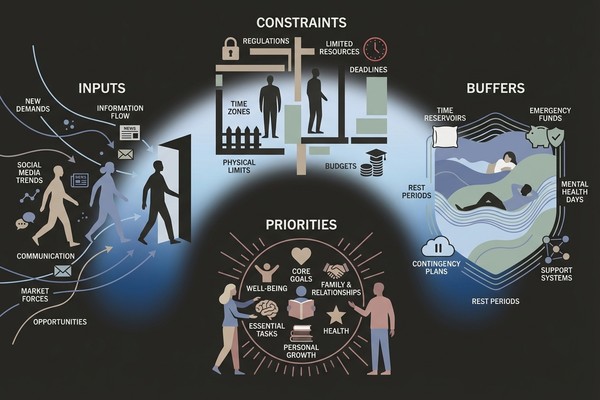
Most overwhelm happens when inputs exceed your capacity after accounting for constraints, but before you’ve created adequate buffers or clarified real priorities. The solution isn’t to manage time better—it’s to redesign the other three categories.
The Renegotiation Experiment
Here’s a simple exercise that reveals how much control you actually have: identify one commitment that’s draining your energy and see if you can renegotiate it.
Maybe it’s the weekly meeting that could be an email. The volunteer position you took on when life was different. The social obligation that made sense six months ago but feels burdensome now. The project that’s expanded beyond its original scope.
The goal isn’t to become someone who backs out of everything, but to recognize that many commitments can be modified, postponed, or approached differently. Sometimes the most responsible thing you can do is admit that your capacity has changed and adjust accordingly.
This isn’t about being flaky or unreliable. It’s about being honest about what you can sustainably deliver instead of agreeing to things you’ll either do poorly or resent doing.
When you renegotiate one commitment, you create space that can be filled more intentionally. Maybe with rest, maybe with a different opportunity, maybe with the buffer you needed to do your other commitments well.
Protecting Attention Without Perfect Schedules
The traditional approach to attention protection involves rigid time blocking and militant boundary enforcement. But that assumes a level of control over your environment that most people—especially parents and caregivers—simply don’t have.
A more realistic approach focuses on reducing decision fatigue and cognitive overhead rather than eliminating all interruptions. You can’t control when your kid gets sick or when an urgent work issue emerges, but you can control how much mental energy you’re spending on routine decisions and administrative overhead.
This might mean batching similar tasks together so you don’t have to keep switching mental contexts. It might mean creating templates for recurring situations so you don’t have to reinvent your response every time. It might mean setting up systems that handle routine follow-ups automatically so you don’t have to remember to remember.
The goal isn’t a perfectly controlled schedule—it’s reducing the background cognitive load that makes every interruption feel overwhelming.
The most sustainable productivity isn’t about doing more—it’s about thinking less about what you’re doing.
Beyond Individual Optimization
Here’s where most time management advice falls short: it assumes your overwhelm is an individual problem requiring an individual solution. But often, the issue isn’t that you’re bad at managing your commitments—it’s that you’re trying to manage too many commitments that other people should be handling.
If you’re the person who remembers everyone’s schedule, tracks all the household needs, and follows up on other people’s responsibilities, no amount of personal optimization will solve your overwhelm. The problem isn’t your system—it’s that you’ve become the system for everyone else.
Real solutions often require renegotiating not just your own commitments, but the invisible work you’ve absorbed on behalf of others. This might mean having conversations about shared responsibilities, setting up systems that distribute the mental load more fairly, or simply stopping the automatic assumption that you’ll handle whatever falls through the cracks.
The Right Kind of Support
This is where thoughtful tools can actually help—not by making you more efficient at remembering everything, but by taking the remembering off your plate entirely. The best systems don’t optimize your cognitive load; they reduce it.
Instead of a better way to track all your commitments, you need something that tracks them for you. Instead of smarter reminders, you need systems that handle routine follow-ups without your involvement. Instead of more organized to-do lists, you need tools that understand context and can make decisions about what actually needs your attention right now.
The goal isn’t to become a more efficient human processor of information and tasks. It’s to offload the processing entirely so you can focus on what actually requires your unique human judgment and creativity.
When tools truly reduce mental load rather than just organizing it, they create space for the kind of thinking that can’t be systematized—the strategic decisions, the creative solutions, the present-moment awareness that makes life feel manageable instead of just managed.
The next time someone talks about time management, ask them what they’re really trying to manage. Chances are, it’s not time at all. It’s the weight of carrying too much in their head, the exhaustion of being responsible for everything, the desire to feel like they have some control over the chaos.
You can’t manage time. But you can absolutely manage what fills it—and more importantly, what fills your mind while it passes.
This article was created with collaboration between humans and AI—we hope you ❤️ it.