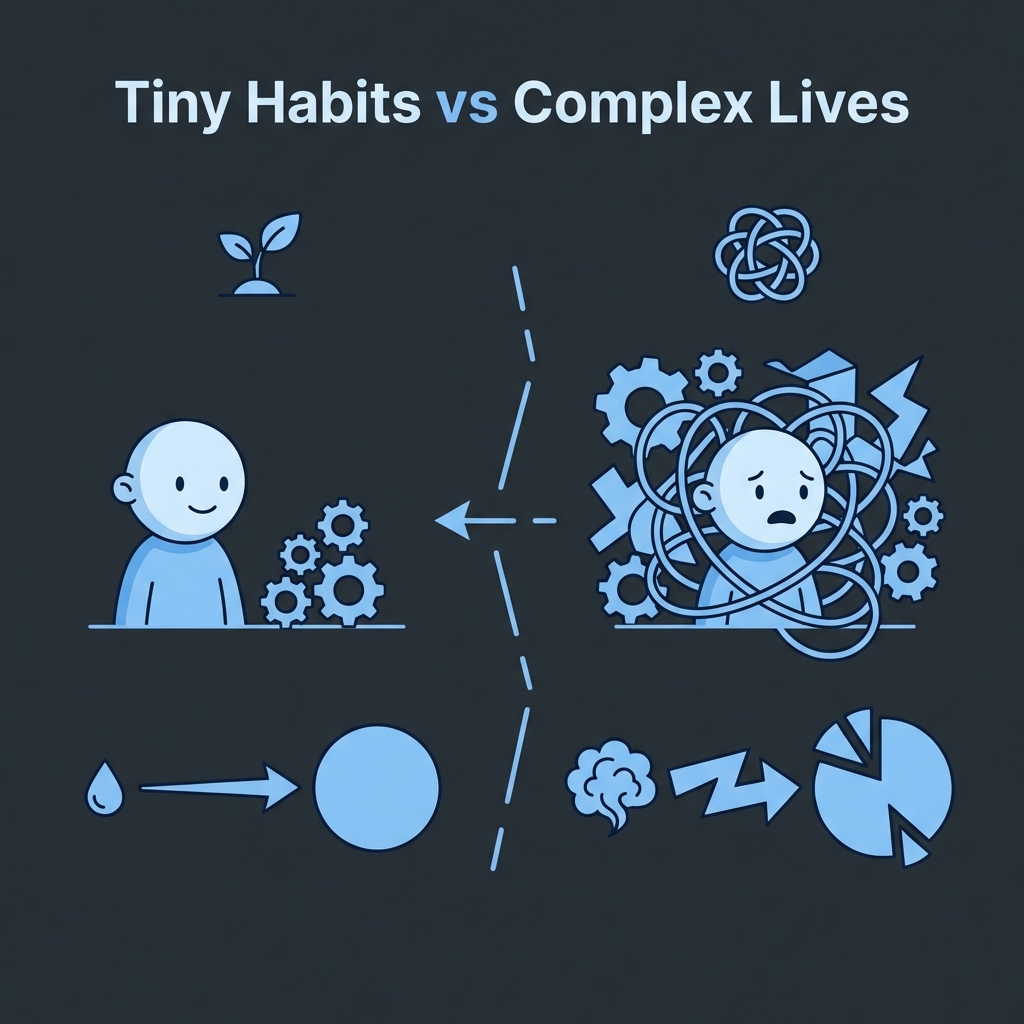
The promise of tiny habits feels like a lifeline when you’re drowning in everything you want to change. Just two minutes of meditation. One push-up. Read one page. The appeal is obvious: these steps are so small they’re basically impossible to fail at, right?
Except that’s not how it works in practice. Even the tiniest habit exists within the ecosystem of your actual life—a life that includes sick kids, work deadlines that shift without warning, and the mental overhead of coordinating a dozen moving pieces before you can even attempt your “simple” two-minute routine.
The gap between tiny habit theory and complex life reality isn’t a personal failing. It’s a design flaw in how we think about behavior change.
The Seductive Logic of Small Steps
Tiny habits work on paper because they solve the intimidation problem. When you’re staring at “exercise for 30 minutes” versus “do one push-up,” the choice feels obvious. The smaller version bypasses the resistance that kills bigger goals before they start.
But here’s what the tiny habits approach gets right that most advice misses: it acknowledges that motivation is unreliable. Instead of banking on feeling inspired, it designs around the assumption that you won’t. That’s genuinely helpful.
The problem isn’t with the size of the habit. It’s with the invisible infrastructure required to make even tiny actions happen consistently.
The smallest habit still needs the biggest thing: a life that can accommodate it.
Think about what actually has to align for you to do one push-up every morning. You need to remember it exists as a goal. You need to be wearing clothes that allow movement. You need floor space that’s clear. You need to not be rushing out the door because your partner forgot to mention an early meeting. You need your back to not be acting up from sleeping wrong.
None of these requirements are about the push-up itself. They’re about the coordination overhead that surrounds every action in a complex life.
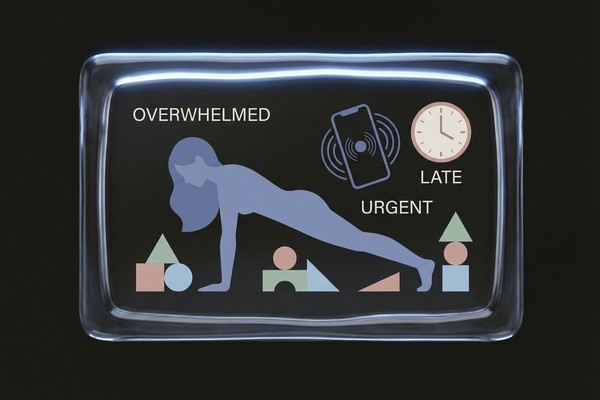
The Coordination Tax Nobody Talks About
Every habit, no matter how tiny, comes with what I call a coordination tax—the mental and logistical work required to create the conditions where the habit can happen.
For simple lives, this tax is minimal. If you live alone, work predictable hours, and have control over your environment, adding “drink one glass of water when I wake up” is genuinely straightforward.
But if you’re managing multiple people’s schedules, responding to constant interruptions, and operating with variable capacity depending on how the day unfolds, even tiny habits require significant overhead.
Consider the seemingly simple goal of “write for five minutes every day.” In a complex life, this requires:
Remembering that writing is something you want to do (cognitive load). Finding five uninterrupted minutes in a schedule that changes daily (scheduling load). Having your laptop charged and accessible (preparation load). Dealing with the guilt when family needs interrupt your five minutes (emotional load). Restarting after missing days without spiraling into self-criticism (recovery load).
The writing itself is tiny. The infrastructure to support it isn’t.
This is why so many people cycle through the same tiny habits repeatedly, feeling like failures each time they can’t maintain something that should be “so easy.” The habit isn’t the problem. The lack of scaffolding around the habit is.
When Tiny Still Feels Impossible
There’s another layer to this that habit advice rarely addresses: capacity fluctuations. Your ability to handle even tiny additions to your routine changes based on what else is happening in your life.
During high-stress periods—work crises, family illness, major transitions—your cognitive resources are already maxed out. Adding anything, even something objectively small, can feel overwhelming because you’re operating at the edge of your capacity.
This isn’t about discipline or commitment. It’s about recognizing that mental bandwidth is finite and variable. Some weeks you have space for new habits. Some weeks you’re in survival mode, and maintaining existing routines is an achievement.
The goal isn’t to optimize for your best days. It’s to design for your worst ones.
The traditional tiny habits approach assumes consistent capacity. But real life includes sick days, family emergencies, work deadlines, and the general chaos of managing multiple responsibilities. Effective habit design has to account for these fluctuations, not pretend they don’t exist.
Building Support Structures That Actually Work
Instead of just making habits smaller, we need to build better support structures around them. This means designing for interruption, not just motivation.
Trigger stacking is one piece of this. Instead of relying on memory, you attach your new habit to something that already happens reliably. But the trigger needs to be genuinely stable in your life, not just frequent. “After I brush my teeth” works better than “when I get to work” if your morning routine is more predictable than your commute.
Environmental scaffolding means setting up your space to support the habit without requiring daily decision-making. This isn’t just about putting your workout clothes out (though that helps). It’s about reducing the friction for every step of the process. If you want to read more, books need to be in the places where you actually have reading time—your bag, your bedside table, your car.
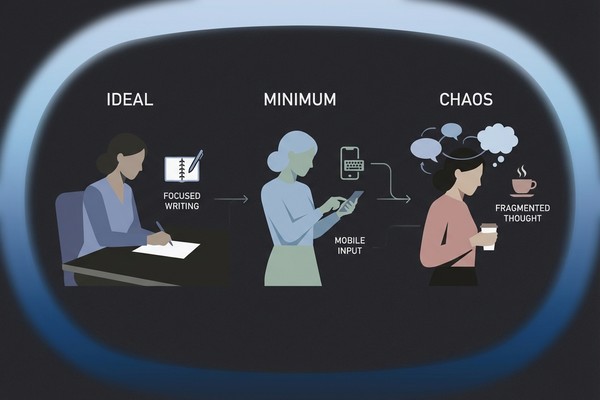
Fallback plans might be the most important piece that traditional habit advice ignores. What happens when your tiny habit gets interrupted? Most people restart from zero, which means losing all momentum. Better to design a spectrum of options: the ideal version, the bare minimum version, and the “life is chaos” version.
If your goal is five minutes of morning writing, your fallback might be opening the document and writing one sentence. If that’s still too much, maybe it’s just thinking about what you’d write while making coffee. The point isn’t to maintain the exact same action every day. It’s to maintain the connection to the intention.
Designing for Disruption
The real test of a habit system isn’t how well it works when life is smooth. It’s how quickly you can get back on track when things fall apart.
Most habit advice treats disruption as a bug to be avoided. But in complex lives, disruption is a feature. Kids get sick. Work emergencies happen. Life intervenes. The question isn’t how to prevent these interruptions—it’s how to design around them.
This means building habits that can survive gaps. Instead of “every day without exception,” think “most days, with grace for the exceptions.” Instead of perfect streaks, aim for quick recoveries.
The difference is profound. When you expect perfection, a single missed day becomes evidence that you’ve failed, which often leads to abandoning the habit entirely. When you expect interruption, a missed day is just data about what got in the way, and you can adjust accordingly.
One approach that works well is the “two-day rule”—never let yourself go more than two days without doing the habit. This gives you flexibility for life’s chaos while preventing the kind of extended breaks that make restarting feel impossible.
The Memory Problem
Here’s something tiny habits advocates rarely mention: remembering to do the habit is often harder than doing the habit itself. When you’re managing multiple people’s schedules, work deadlines, and household logistics, adding one more thing to remember—even a tiny thing—can feel like the straw that breaks the camel’s back.
This is where external systems become crucial. Not apps that gamify your habits or send you motivational quotes, but tools that actually remove the remembering work from your plate. Something that tracks what you intended to do, notices when it didn’t happen, and helps you figure out why without judgment.
The goal isn’t to optimize your performance. It’s to reduce the mental overhead of maintaining the habit so you can focus on actually doing it.
The best habit system is the one you don’t have to think about.
Making Tiny Actually Sustainable
Real sustainability comes from building habits that fit your actual life, not your aspirational one. This means being honest about your constraints and designing around them rather than through them.
If mornings are chaos in your house, don’t build morning habits. If evenings are unpredictable, don’t rely on evening routines. Find the pockets of stability in your schedule and build there, even if it’s not when productivity culture says you should.
Sometimes the most sustainable version of a habit looks nothing like the original goal. Maybe “exercise daily” becomes “park farther away when I’m running errands.” Maybe “meditate every morning” becomes “take three deep breaths before checking email.” The form matters less than the consistency.
The key is designing for your actual capacity, not your theoretical capacity. Your actual capacity includes the mental load you’re already carrying, the interruptions that are part of your life, and the energy you have left after handling everything else.
This isn’t settling for less. It’s being strategic about what more actually looks like in the context of everything else you’re managing. Because the goal isn’t to add more to your plate. It’s to create sustainable practices that reduce the overall burden of managing your life.
When tiny habits work, they work because they’re supported by invisible infrastructure that makes them genuinely easy. When they don’t work, it’s usually because that infrastructure is missing, and you’re trying to coordinate too much in your head.
The solution isn’t smaller habits. It’s better scaffolding around the habits you actually want to build.
This article was created with collaboration between humans and AI—we hope you ❤️ it.