
You’ve been there. It’s 6 PM on a Tuesday, and you’re staring at your workout clothes while dinner burns on the stove because you promised yourself you’d prioritize health this year. Your kid needs help with homework, there’s a work deadline looming, and you haven’t called your mom back in three days. Every choice feels like a betrayal of some other commitment you’ve made to yourself or others.
This isn’t about lacking willpower or being disorganized. You’re experiencing what I call goal collision—when multiple legitimate priorities crash into each other in real time, leaving you feeling like you’re failing at everything simultaneously.
The productivity world loves to pretend this doesn’t happen. It offers color-coded calendars and time-blocking techniques as if the problem is simply poor scheduling. But goal collision isn’t a logistics issue. It’s an emotional and cognitive burden that comes from trying to honor multiple versions of who you want to be, all at once.
The Anatomy of Collision
Goal collisions show up everywhere once you start looking for them. The working parent who wants to advance their career, be present for their family, maintain their health, and keep their home organized. The entrepreneur who needs to network for business growth while also protecting family time and managing their anxiety. The caregiver who’s trying to support an aging parent while pursuing their own dreams and maintaining their marriage.
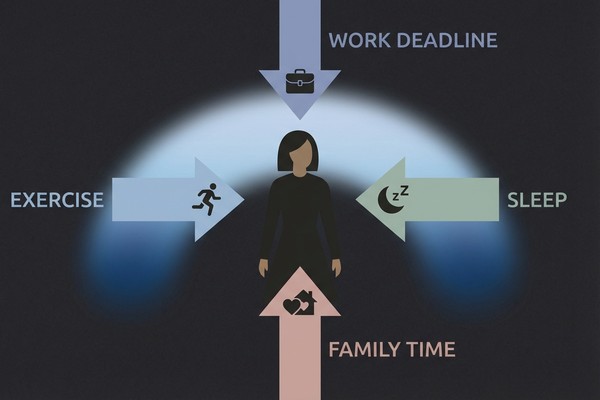
These aren’t lifestyle design problems to be optimized away. They’re fundamental tensions that exist because we’re whole people with multiple roles and responsibilities. The collision happens because each goal, taken individually, is completely reasonable. It’s the combination that becomes impossible.
What makes this particularly brutal is how our culture treats these collisions. We’re told to “have it all” or “find balance” as if there’s some perfect equation that makes everything fit. When we can’t make it work, we assume we’re doing something wrong. We internalize the failure instead of recognizing that some goals are genuinely incompatible within the same time frame.
The guilt that comes with goal collision isn’t just disappointment—it’s moral confusion. When your exercise goal conflicts with your parenting goal, you’re not just choosing between activities. You’re choosing between different versions of yourself, different values you hold dear. No wonder it feels impossible.
Why Traditional Goal Setting Fails
Most goal-setting advice treats each objective as if it exists in isolation. Set SMART goals, they say. Break them down into actionable steps. Track your progress. But real life doesn’t happen in neat categories.
When your health goal says “exercise five times a week” and your career goal says “take on that high-visibility project” and your relationship goal says “be more present with family,” these aren’t three separate challenges. They’re three demands competing for the same finite resources: your time, energy, and attention.
The problem isn’t that you’re not committed enough. The problem is that you’re committed to too many things that can’t coexist.
Traditional productivity culture makes this worse by treating every goal as equally important and achievable through better systems. But some goals are more foundational than others. Some can be scaled back without losing their essence. Others can’t.
A Framework That Actually Works
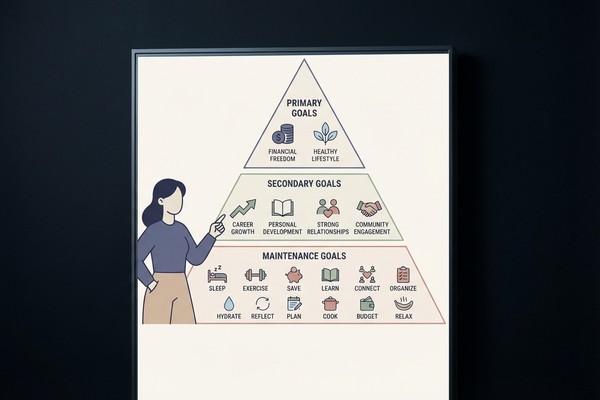
Instead of pretending all goals are created equal, try sorting them into three categories: primary, secondary, and maintenance goals.
Primary goals are the ones that, if you achieved nothing else this year, would still make you feel like you moved forward meaningfully. These are typically limited to one or two major areas. Maybe it’s stabilizing your business or supporting a family member through a health crisis or finally addressing your own mental health.
Secondary goals are important but not urgent. They’re the ones you’d love to make progress on, but you could delay without serious consequences. Learning a new skill, redecorating your home, taking that photography class.
Maintenance goals are about not losing ground in areas that matter. Keeping your marriage stable even if you can’t focus on deepening it right now. Maintaining basic fitness even if you can’t train for a marathon. Staying connected with friends even if you can’t be the social butterfly you once were.
This framework isn’t about giving up on things that matter. It’s about being honest about what’s possible right now and designing your life around that reality instead of around an idealized version of yourself.
The Art of Non-Catastrophic Compromise
Once you’ve sorted your goals, the next step is figuring out the minimum viable version of each one. This isn’t about lowering your standards—it’s about finding the smallest version that still serves the underlying need.
If your health goal is really about having energy for your family, maybe the minimum viable version isn’t five gym sessions a week. Maybe it’s a 15-minute walk every day and getting to bed by 10 PM. If your career goal is about financial security, maybe it’s not the promotion this year but the skills that position you for the promotion next year.
The key is identifying what you’re actually trying to accomplish, not just what you think you should be doing. Often, our goals are proxies for deeper needs. We want to exercise because we want to feel strong and energetic. We want to advance at work because we want security and recognition. We want to be perfect parents because we want our children to feel loved and supported.
When you get clear on the underlying need, you can often find ways to meet it that don’t require the full goal as originally conceived.
Three Non-Negotiable Protections
While everything else might be up for negotiation, there are three areas that research consistently shows we can’t compromise on without serious consequences: sleep, relationships, and income stability.
Sleep isn’t optional. When you’re chronically tired, every other goal becomes harder to achieve. Your decision-making suffers, your emotional regulation breaks down, and your physical health deteriorates. Protecting sleep often means saying no to evening commitments or morning workouts, but it’s the foundation that makes everything else possible.
Relationships—particularly your closest ones—can’t run on autopilot indefinitely. You don’t need to be the perfect partner or parent, but you need to maintain connection. This might mean choosing family dinner over networking events, or having honest conversations about what you can and can’t take on right now.
Income stability provides the security that makes other goals possible. This doesn’t mean you can’t take career risks, but it means being realistic about what you can afford to experiment with and when.
These aren’t the only things that matter, but they’re the things that, if lost, make everything else much harder to rebuild.
Spotting Your Collision Points
Take a moment to map out where your goals are actually competing with each other. Write down what you’re trying to accomplish in different areas of your life, then look for the overlaps and conflicts.
Maybe your goal to be more social conflicts with your goal to save money. Your desire to be more present with family conflicts with your need to work extra hours on a project. Your commitment to eating healthier conflicts with your already overwhelming schedule.
These collision points aren’t failures—they’re information. They tell you where you need to make conscious choices instead of hoping everything will somehow work out.
Once you can see the collisions clearly, you can start making intentional tradeoffs instead of feeling guilty about accidental ones. You can decide that for the next three months, career growth takes priority over social commitments. Or that family stability is more important than personal fitness goals right now.
The relief that comes from making these choices consciously, rather than failing at them accidentally, is profound.
Beyond Individual Willpower
Here’s what the productivity industry doesn’t want to admit: some goal collisions can’t be solved through better personal systems. Sometimes the problem isn’t your time management—it’s that you’re trying to do too much with too little support.
This is where tools that actually reduce mental load, rather than just organizing it, become crucial. The goal isn’t to become better at juggling competing priorities. It’s to reduce the number of things you have to actively juggle.
When something else can handle the cognitive work of remembering, tracking, and following up on the maintenance-level stuff, you free up mental space for the goals that actually need your attention and creativity.
The most sustainable approach to goal collision isn’t perfect balance—it’s conscious choice. It’s designing a life around what’s actually possible right now, rather than what you think should be possible. It’s protecting the foundations that make everything else work, and being strategic about where you focus your limited energy.
Your goals don’t all have to succeed simultaneously. They just have to add up to a life that feels coherent and sustainable. Sometimes that means some goals wait their turn. And that’s not failure—that’s wisdom.
This article was created with collaboration between humans and AI—we hope you ❤️ it.