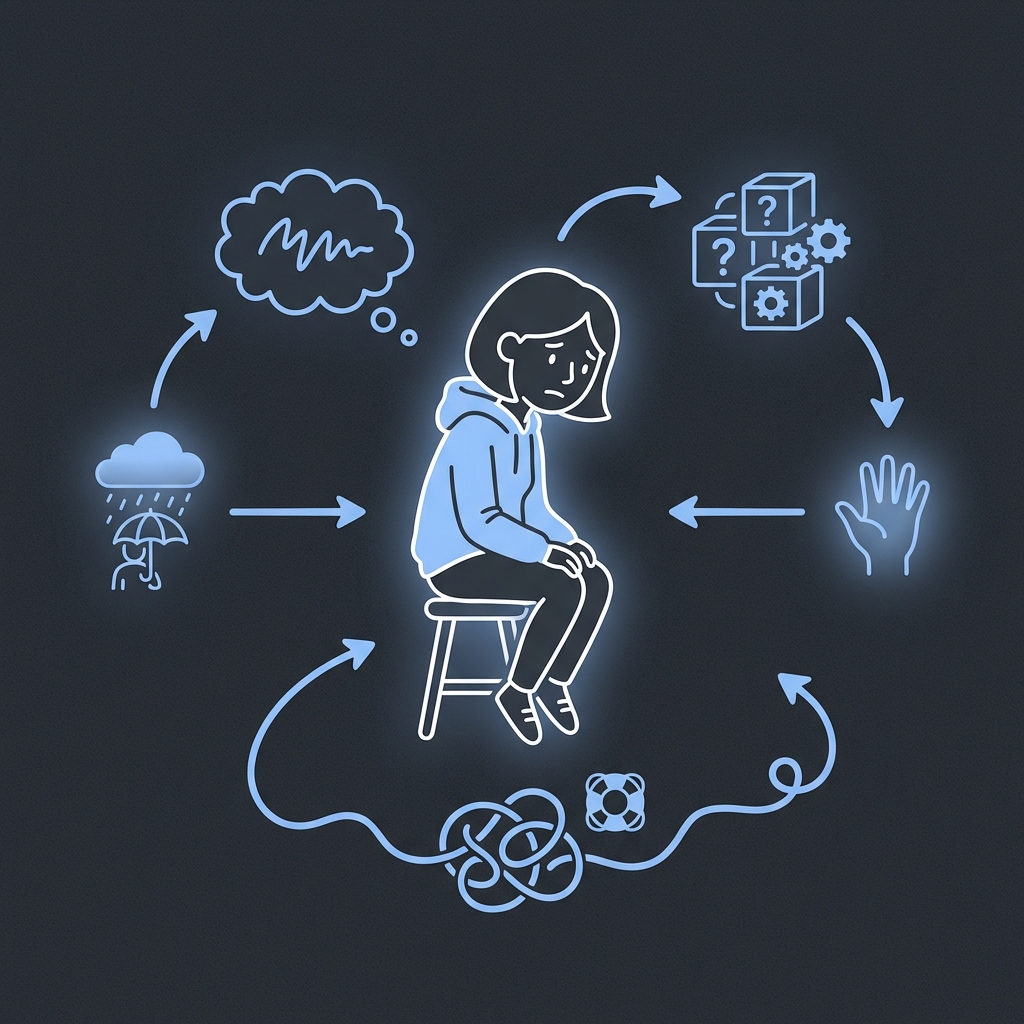
There’s something particularly cruel about being the person everyone turns to when you’re the one falling apart. You’ve built your identity around being reliable, capable, the one who remembers birthdays and keeps projects on track and somehow always has an extra phone charger. But now you’re drowning, and the very competence that made you indispensable has become a prison that keeps you from reaching out.
If you’re reading this while juggling seventeen different crises and pretending everything’s fine, you’re not alone. And more importantly, you’re not broken for finding it harder to receive help than to give it.
The Weight of Being “The Capable One”
When you’re known as the person who has it together, asking for help doesn’t just feel vulnerable—it feels like a fundamental betrayal of who you are. Your identity becomes so intertwined with your ability to handle things that needing support feels like admitting you’ve been a fraud all along.
This isn’t vanity or stubbornness. It’s the natural result of building your sense of self around your capacity to manage, solve, and support. When colleagues email you because “you always know how to handle these things” or family members call because “you’re so good at figuring stuff out,” you internalize that your value lies in your competence.

The cruel irony is that high-capacity people often develop the deepest empathy for others’ struggles precisely because they carry so much themselves. You understand exactly how overwhelming life can be—which is why you’d never judge a friend for asking for help with their kids, their work, or their mental health. But somehow, when it comes to your own needs, those same compassionate standards don’t apply.
The very competence that made you indispensable has become a prison that keeps you from reaching out.
The Competence Trap
There’s a particular flavor of suffering that comes with being capable: you can see exactly how you could solve your problems if you just had more time, energy, or bandwidth. This creates what I call the competence trap—the belief that because you could handle something (under different circumstances), you should handle it now.
Maybe you’re drowning in work projects, but you know you could manage them all if you just worked weekends for the next month. Maybe your house is chaos, but you could organize it if you had a free Saturday. Maybe you’re struggling with anxiety, but you could probably handle it with the right combination of exercise, meditation, and better sleep habits.
The competence trap convinces you that asking for help is premature—that you should exhaust every possible solution first. But this logic is fundamentally flawed. It assumes that grinding yourself into the ground is somehow more noble than accepting support.
Here’s what the competence trap gets wrong: your ability to theoretically handle something doesn’t mean you should have to handle it alone. A professional organizer can sort your house in hours instead of the months it would take you to find the time. A babysitter can give you the space to think clearly instead of making decisions while mentally tracking snack schedules and nap times.
What Needing Help Actually Means
Let’s address the fear that’s probably sitting in your chest as you read this: that needing help means you’re weak, incompetent, or failing at life. This fear is so common among high-capacity people that it deserves its own examination.
Needing help doesn’t mean you’re incapable—it means you’re human. It means you have limits, like every other person on the planet. It means you’ve been carrying more than one person should reasonably carry, and your system is asking for relief.
Think about it this way: when a friend comes to you overwhelmed and asking for support, do you think less of them? Of course not. You probably feel honored that they trusted you enough to be vulnerable. You might even feel a little relieved that they’re not trying to handle everything alone.
The same logic applies to you. The people who care about you want to support you—not because they pity you, but because relationships are meant to be reciprocal. When you never ask for help, you’re actually depriving others of the opportunity to care for you in return.
Learning to Ask When You’re Out of Practice
If you’ve spent years being the helper rather than the helped, asking for support can feel like learning a new language. The words might feel foreign in your mouth. You might find yourself over-explaining, minimizing your needs, or apologizing for asking.
Start small. Instead of waiting until you’re in crisis mode, practice asking for minor support when the stakes feel manageable. Ask a friend to pick up coffee for you when they’re going anyway. Ask a colleague to handle a task that’s in their wheelhouse. Ask your partner to take over bedtime routine one night so you can have an hour to yourself.
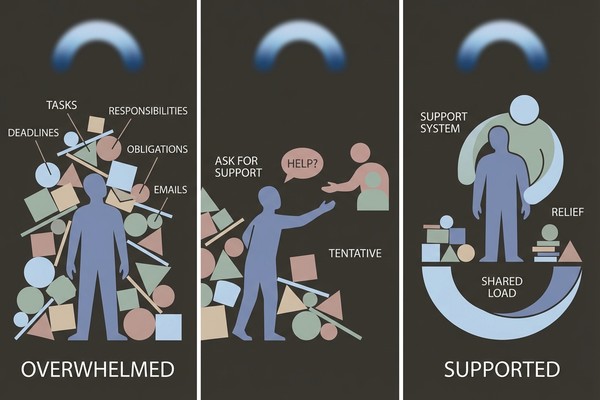
Notice what happens when you ask. Most of the time, people say yes easily, without the drama or judgment your anxiety predicted. This helps recalibrate your internal alarm system about asking for help.
When you never ask for help, you’re actually depriving others of the opportunity to care for you in return.
Scripts for When Words Feel Hard
Sometimes the hardest part of asking for help is simply finding the words. Here are some frameworks that can make it easier:
When you’re overwhelmed at work: “I’m juggling more than I can handle effectively right now. Could you take the lead on [specific task] so I can focus my energy on [priority]?”
When you’re dealing with health issues: “I’m managing some health stuff that’s taking more energy than I expected. Would you be able to help with [specific need] over the next few weeks?”
When you’re grieving or going through a major life change: “I’m going through a difficult time and not operating at full capacity. I could really use support with [specific area]. Would you be willing to help, or do you know someone who might?”
When you’re burned out: “I’ve been running on empty for too long and need to make some changes. Can we talk about redistributing some responsibilities so I can get back to sustainable?”
Notice that these scripts are direct about the situation without being overly detailed about your emotional state. They focus on specific, actionable requests rather than general pleas for help. They also acknowledge that your capacity is temporarily reduced without apologizing for being human.
Building Your Support Network Before You Need It
The best time to build a support network is when you don’t urgently need one. This might seem counterintuitive—when things are going well, asking for help feels unnecessary. But creating reciprocal relationships during stable times makes it much easier to reach out during difficult ones.
This doesn’t mean keeping a transactional scorecard of favors. Instead, it means nurturing relationships where mutual support feels natural and expected. Offer help when you have capacity. Accept small favors when they’re offered. Share your struggles before they become crises. Check in on others regularly.
When you normalize both giving and receiving support as part of your relationships, asking for help stops feeling like such a dramatic departure from your usual role.
The Radical Act of Receiving
In a culture that glorifies self-reliance and individual achievement, receiving support is actually a radical act. It’s a rejection of the myth that we should be able to handle everything alone. It’s an acknowledgment that we’re interconnected beings who thrive through community and mutual care.
Receiving support is actually a radical act—a rejection of the myth that we should be able to handle everything alone.
For people who’ve built their identity around capability, learning to receive can feel like learning to be human all over again. It requires grieving the version of yourself that could handle everything and embracing a more sustainable way of being.
This doesn’t mean becoming helpless or dependent. It means recognizing that your worth isn’t tied to your capacity to carry everything alone. It means understanding that asking for help when you need it is actually a sign of wisdom, not weakness.
The goal isn’t to stop being capable—it’s to be capable within human limits. To build a life where your competence is an asset, not a burden. Where your ability to help others comes from a place of fullness rather than depletion.
You deserve support. Not because you’re broken or failing, but because you’re human. And humans aren’t meant to carry everything alone.
This article was created with collaboration between humans and AI—we hope you ❤️ it.