
Last Tuesday, I watched a friend scroll through her calendar during lunch, her face growing more frustrated with each swipe. “I don’t understand,” she said. “I care about my health, my relationships, my creativity—but look at this week. Where is any of that?” Her calendar was packed with meetings, errands, and obligations, but nowhere did she see the things that actually mattered to her.
This is the care-calendar gap, and it’s quietly destroying people’s sense of purpose and peace. It’s the space between what you value and what you actually maintain. Between what feeds your soul and what fills your schedule. And it’s probably wider than you think.
The gap doesn’t form overnight. It builds slowly, as urgent tasks crowd out important ones, as other people’s priorities somehow become yours, as you say yes to preserve relationships while saying no to yourself. Before you know it, your time has become a reflection of everyone else’s values except your own.
The Invisible Architecture of Resentment
The care-calendar gap creates a specific kind of resentment—not the sharp anger of betrayal, but the dull ache of self-abandonment. It’s the feeling that your life is happening to you rather than being lived by you. That you’re maintaining everyone else’s world while your own withers.
This resentment is particularly cruel because it often targets the wrong people. You resent your kids for needing dinner, your boss for scheduling meetings, your partner for not reading your mind about what you need. But the real issue isn’t them—it’s that your calendar has become a foreign country where your values don’t have citizenship.
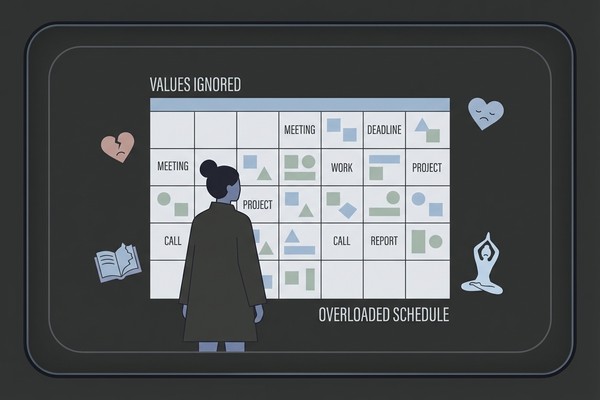
Most productivity advice makes this worse by treating time like a math problem. “Just prioritize better,” they say. “Time-block your values.” But when you’re already stretched thin, adding another layer of optimization feels like being told to organize your sinking ship instead of plugging the holes.
The truth is, you can’t schedule your way out of a life that doesn’t reflect your values. You have to make space for what matters, which means making less space for what doesn’t.
The Values Audit: What Actually Matters to You
Here’s a simple but revealing exercise: Take five minutes to write down what you actually care about. Not what you think you should care about, not what looks good on social media, but what genuinely matters to you when you’re honest with yourself.
Maybe it’s deep conversations with friends. Maybe it’s moving your body in ways that feel good. Maybe it’s creating something with your hands, or reading books that change how you see the world, or simply having enough mental space to think your own thoughts.
Now look at last week’s calendar. How much time did those values get? If someone studied your schedule without knowing you, what would they conclude you care about most?
The gap between these two lists is where resentment lives. It’s also where your power to change things begins.
I did this exercise last month and realized that while I say I value rest and creativity, my calendar suggested I valued responding to emails and attending meetings about meetings. The disconnect was stark enough to be funny, if it weren’t so exhausting.
What’s Missing From Your Maintenance
When you live in the care-calendar gap, certain essential things consistently go unmaintained. Rest becomes something you’ll get to later. Relationships become something you maintain through text messages between tasks. Health becomes something you optimize rather than nurture. Creativity becomes something you consume rather than practice.
These aren’t luxuries—they’re the foundation of a sustainable life. But they’re also the first things to disappear when your calendar becomes a game of Tetris where other people’s priorities are the falling blocks.
The things that matter most are often the things that matter least urgently.
The missing pieces are usually quiet, internal, and long-term. They don’t send calendar invites or deadline reminders. They don’t advocate for themselves. They just wait, patiently, while you attend to everything else.
This is why the care-calendar gap feels so insidious. You’re not actively choosing against your values—you’re just not actively choosing for them. And in a world that defaults to urgency, not choosing for something is the same as choosing against it.
The Micro-Shift: One Small Protection
The solution isn’t to overhaul your entire life—that’s just another form of productivity pressure. Instead, pick one thing you care about and make one small shift to protect it.
Maybe it’s protecting the first hour of Saturday morning for yourself before anyone else’s needs enter the picture. Maybe it’s saying no to one meeting per week to create space for a walk. Maybe it’s putting your phone in another room during dinner to protect connection time with your family.
The key is choosing something specific and defendable. “I want to rest more” is too vague to protect. “I will not check email after 8 PM on weekdays” gives you something concrete to maintain.
Start with what feels most starved in your life right now. If you’re exhausted, protect rest. If you’re lonely, protect connection. If you feel creatively dead, protect making time. Don’t try to fix everything—just choose one value and give it a fighting chance.
What Would You Protect If You Weren’t So Tired?
Here’s a question that cuts through the noise: If you had enough energy, what would you protect in your life that you’re currently letting slide?
When you’re running on empty, protection becomes a luxury you can’t afford. You let boundaries blur because you don’t have the energy to maintain them. You say yes to things you don’t want because saying no feels like more work than just doing it.
But exhaustion is often a symptom of the care-calendar gap, not the cause. When your time doesn’t reflect your values, everything feels harder because you’re constantly swimming against your own current.
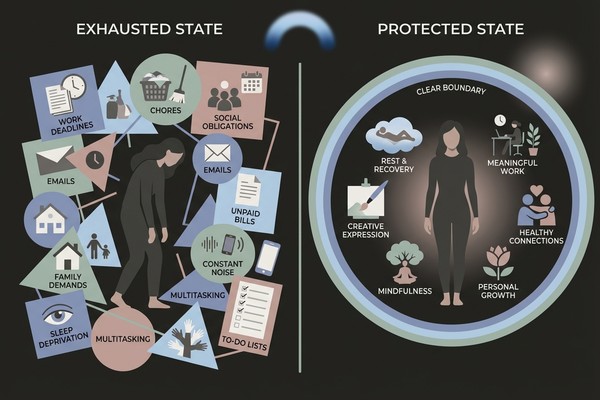
Imagine you had a full tank instead of running on fumes. What boundaries would you draw? What would you say no to? What would you insist on having time for? These aren’t fantasies—they’re clues about what needs to change.
Sometimes the answer surprises people. One client realized she would protect her morning coffee ritual—not because it was productive, but because it was the only time of day that belonged entirely to her. Another discovered he would protect his commute home, using it to transition between work mode and family mode instead of making phone calls.
The things you would protect if you weren’t so tired are often the things that would prevent you from being so tired in the first place.
Making Space by Removing, Not Adding
The care-calendar gap can’t be solved by better time management—it requires space management. You need to remove things, not optimize them. You need to say no more often, not yes more efficiently.
This is where most productivity advice fails. It assumes your problem is organization when your problem is overcommitment. It offers systems to manage more when what you need is permission to maintain less.
Real alignment isn’t about doing everything better—it’s about doing less of what doesn’t matter.
Start by looking at your recurring commitments—the meetings that happen every week, the activities your kids are enrolled in, the social obligations you’ve inherited rather than chosen. Ask yourself: If I were designing my life from scratch today, would I choose this?
Some things are truly non-negotiable. But many things are only non-negotiable because you’ve never questioned them. The weekly team meeting that could be an email. The volunteer commitment you took on two years ago when your life looked different. The social gathering you attend out of habit rather than joy.
Every yes to something that doesn’t align with your values is a no to something that does. The math is unforgiving, but it’s also liberating once you see it clearly.
The Bridge Between Care and Calendar
The goal isn’t perfect alignment—that’s another form of optimization pressure. The goal is enough alignment that your life feels like yours. That your calendar reflects your care often enough to sustain you.
This is where thoughtful systems become essential, not for productivity but for protection. Systems that remember what matters to you when you’re too tired to remember. Systems that follow up on your values when everything else is following up on your obligations.
The right kind of system doesn’t add to your mental load—it reduces it by holding space for what you care about. It reminds you to protect your morning ritual when your calendar tries to schedule over it. It follows up on your commitment to call your friend when work tries to consume your evening. It tracks whether you’re actually living according to your values or just hoping to.
These systems work not because they make you more efficient, but because they make your values more visible. They create accountability to yourself, which is often the accountability we need most.
Living in Alignment, Not Perfection
Closing the care-calendar gap isn’t about achieving perfect balance—it’s about making intentional choices about where your attention goes. Some weeks will be heavy on obligations and light on values. That’s okay, as long as it’s temporary and conscious rather than permanent and accidental.
The goal is to notice the gap when it widens and have tools to close it before resentment sets in. To protect what matters to you with the same energy you use to protect what matters to everyone else.
Your calendar will never be a perfect reflection of your values, but it can be a better one. And that small shift—from accidentally living someone else’s priorities to intentionally protecting your own—makes all the difference between a life that exhausts you and one that sustains you.
The care-calendar gap isn’t a personal failing—it’s a predictable result of living in a culture that values doing over being, urgent over important, visible work over invisible care. But recognizing the gap is the first step to closing it. And closing it, even partially, is the first step to getting your life back.
This article was created with collaboration between humans and AI—we hope you ❤️ it.